All About English Literature: Absurd Drama

For Exclusive Notes and Analysis

Showing posts with label Absurd Drama. Show all posts

Saturday, 6 June 2020

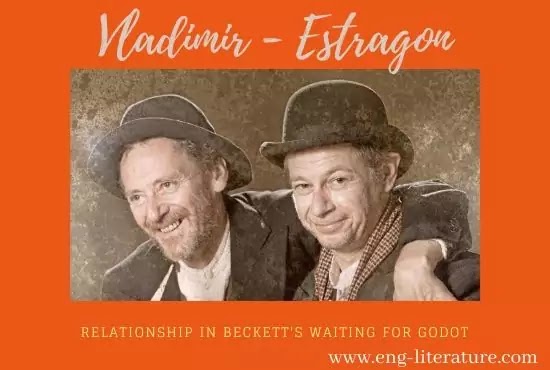
Vladimir-Estragon Episode or Vladimir and Estragon Relationship in Beckett's Waiting for Godot

Vladimir-Estragon Episode or Vladimir and Estragon Relationship in Beckett's Waiting for Godot
Vladimir and Estragon Relationship

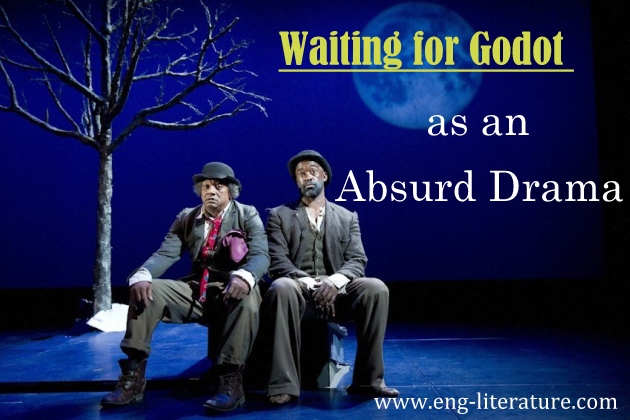
Vladimir and Estragon, the joint protagonists in Beckett’s Waiting for Godot are two tramps, voluntary exiles from all human contacts. A boy appears on the scene and addresses Vladimir as Mr. Albert; Estragon tells the audience that he is Adam. Later Vladimir and Estragon introduce themselves as Didi and Gogo respectively. In an Absurd drama such fantasy and mystification are quite natural.

“Vladimir and Estragon", says Martin Esslin, “have complementary personalities.” They are the heroes or precisely antiheroes of the play, for unlike the heroes of the Greek or Shakespearean tragedies, they do not command our respect or admiration; at best they evoke our compassion. Yet they had their past.

“In the nineties",' says Vladimir, "hand in hand from the top of the Eiffel Tower, among the first. We were respectable in those days. Now it's too late. They wouldn't even let us up." When told by Vladimir that Estragon “should have been a poet", he replies that he was a poet.

But later both of them were on the platform. They have lost their moorings, all local ties, their hearth and home. Their common platform is that they have no grass roots. Now that they have been thrown together and have a common cause, i.e. Waiting for Godot, they are extremely friendly in spite of occasional tiffs and misunderstanding. Estragon is timid and mentally feeble, and needs somebody to look after him. Vladimir becomes his guardian without pontifical solemnity.

Estragon dreams, for by dreaming he can withdraw from the alien and hostile world. His boots constantly pinch him, and he whines like a child. Once he had thrown himself into a river to put an end to his dreary existence, and Vladimir rescued him. He waits for God not so much for spiritual salvation as for some material benefit. Vladimir, however, is serious about salvation. He has only one mental weakness, his hat constantly pricks him. Estragon wants to forget his past as well as the stark reality. Vladimir faces the reality.

Both Vladimir and Estragon have to share the intolerable boredom of waiting. Vladimir is a widely read man. He knows Latin and has read the Old Testament as well as the New with avid care. Estragon does not seem to have read the Bible, and, therefore, does not know that what the four Evangelists have said about the redemption and damnation of the two thieves, crucified by the side of Christ on Mount Calvary. All that he knows of the Bible is from a lonely picture of the Holy Land. "All my life", he continues, I've compared myself to Christ". Here Estragon and Vladimir are on the same footing. They are equally ignorant and helpless, pitted against the inexorable and enigmatic Godot. It is here that Estragon and Godot represent the hopeless and helpless suffering humanity.

The two tramps have lost all sense of time. Waiting is what concerns them. They don't know if Godot will come today or tomorrow. So they have to kill time. Pozzo philosophies that man has an inevitable passage from the womb to the tomb : "One day we were born, one day we shall die." Vladimir does not philosophize. He chooses to live in the world of spirit, and asks: "Was I sleeping while others suffered ?"

Knowing full well that "Habit is a great deadner". Vladimir wants to meet the challenge of time by having recourse to idle talks and harangues playfully abusing each other doing the tree, antics and exercises, playing at Pozzo and Lucky-all traditional pastimes. One activity is followed by another. Then the same activity is repeated. That also becomes dull and monotonous. They, then, stop talking and resort to thinking. They start talking again.

Vladimir suffers unbearable agony arising out of spiritual questionings. His ability to think is also a source of suffering. Hugh Walpole observes : “The world is a comedy to those who think, the world is a tragedy to those who feel." But Vladimir gives the lie to this statement, and suffers intensely in spite of thinking. He has to suffer for being an intellectual.

Estragon, on the other hand, has a mind that is a clean slate. He does not tax his mind with the memory of the past, of time and date. He does not care to remember of even what happened yesterday: "I'm not a historian”.

Vladimir and Estragon had their past, not an ignoble one. They were then respectable beings, not to be jettisoned from the fashionable society. But cruel life has taken its heavy toll. Both of them are vagrants. This is a bleak picture of regression. Their personalities have suffered disintegration. Himself a miserable man, Estragon has warm praise for Pozzo, the tyrant.

Vladimir, on the other hand, has warm sympathy for Lucky, who is treated like a dog. But both Estragon and Vladimir are inextricably tied to the place, Waiting for Godot. They have no choice, no freedom. It is here they become identified. "Yes, let's go", they say at the end of Act 1, and yet they donot move. At the end of Act II, they say, "yes, let's go", and yet they donot move. Godot will never come. They are in the twilight of their life with nothing to illuminate their souls.

In spite of their brief separation, Estragon and Vladimir meet again, Vladimir approaches Estragon : "Come here till I embrace you". Estragon in a fit of tantrum replies: "Don't touch me ! Don't question me! Don't speak to me! Stay with me!"

Occasionally there might have been a brief moment of love-hate relationship between the two, but it is love that triumphs. Desolation, doubt, fear and helplessness will persist till the end of their days. But the lamp of love between the two friends may dim, but not die.

Also Read:
~~~~~*~~~~~
Share:

Friday, 22 May 2020

Who is Godot in Beckett's Waiting for Godot?

Who is Godot in Beckett's Waiting for Godot?
What is the identity of Godot?

The meaning of Waiting for Godot has defied analysis. Critics have spilled ink and failed to arrive at a satisfactory conclusion. “Even those who agreed that Godot had a 'meaning’," says Alec Reid, "were deeply divided among themselves as to what that meaning was”.  Two tramps, Vladimir and Estragon, are waiting to meet a men or a divine being known as Godot, who eventually does not turn up. The identity of Godot has posed a question, yet to be answered. According to Ruby Cohn, Godot has been variously identified as God, a diminutive God, Love, Death, Silence, Hope, DeGaulle, a Balzac character, a bicycle racer, and a Paris Street for call girls.

To Alan Schneider, who anxiously asked him about the identity of Godot, Beckett replied: "If I know, I would have said so in the play." He also remarked, and it is difficult to ascertain if he was serious or flippant, that the spectacular success of Waiting for Godor was due to the misunderstanding. The critics and public alike were seeking to impose an allegorical or symbolic explanation of Godot.

And yet Godot remains an enigma. Others abide our question, and Godot, like Mathew Arnold’s Shakespeare, smiles and smiles, and out tops our knowledge. Had Godot appeared on the stage even for a moment, we could have sized him up. But he does not come. We learn from a messenger boy that he will come on the following day. But he fails to fulfil his appointment.

Furthermore the name ‘Godot’ will entail many possible meanings if it is observed within the context of French. According to Graver, there are some common French words and phrases which begin with ‘god’. Godillot in French for ‘old shapeless boot’; Godasses are ‘military boots’, Godailler is ‘to go pub‐crawling’. Goder means ‘to pucker’. In addition, ‘Godo’ is spoken Irish for God. Thus, as a ‘signifier’, ‘Godot’ potentially will result in many debatable and fractured interpretations.

Is Godot God?

Right upto the end of the play Godot remains a mysterious figure. If we regard Waiting for Godot as Christian play or a Morality play, Godot may stand for God. Martin Esslin lends unqualifying support to this view. He says that the play is concerned with the ultimate realities of the human condition, for an Absurd Drama is concerned with the fundamental problems of life and death. When man fails to answer the questions relating to ultimate reality, he has to think of God and religion.

If so, Godot is as much the God of the Old Testament as of the New. Jehovah and Godot may look alike, particularly for his white beard. The similarity may also be noticed when we consider that Godot does not love everybody. He has handsome rewards for the boy who tends the goats, while he metes out punishment to the shepherd the award appears arbitrary. That reminds us of Jehovah, who preferred Abel to Cain. The reference to the goats and sheeps is to be found in the Gospel according to St. Matthew : "And he [Christ] shall seat the sheep on his right hand, but the goats on the left."

Godot may refer suffering also. “The casual relationship between divine cruelty and human suffering is perhaps most effectively dramatised in Beckett's portrayal of many of his characters as emblematic Biblical sufferers". Suffering is divine punishment. Christ himself is the worst sufferer in his mundane existence His death on the Cross, says Hersh Zeifman, is the paradigm of divine rejection. It is for this reason that Estragon says: "All my life I've compared myself to Christ."

With absolutely no ambiguity Beckett refers to salvation and damnation in his play. Vladimir mentions two thieves crucified on either side of Christ, one of whom was saved and the other damped. The two tramps are also thinking in terms of salvation or damnation according to the sweet will of Godot. Much depends on their repentance, which is the way to divine grace. On an inquiry from Vladimir if he has ever read the Bible, Estragon replies: "I remember the maps of the Holy Land, Coloured they were. Very pretty. The Dead Sea was pale blue. The very look of it made me thirsty. That's where we'll go, I used to say, that's where we'll go for our honeymoon."

If we accept this view, Godot may mean God. But Becket has no anthropomorphic conception of God. The very fact that God does not come means that he is disembodied. But just because he does not come, it does not mean that he is non-existent As far as Vladimir is concerned, he very much exists. The idea of salvation is all the while haunting his mind.

When asked by Pozzo to think', Lucky gives a harangue on Godot. When the gaudy and inane phraseology is left out, he says: "Given the existence of a personal God with a white beard outside time who from the heights of divine apathia loves us dearly with some exceptions for reasons unknown but time will tell."

Godot may be termed as “waiting” what really matters. Waiting is charged with expectancy. Everybody waiting for something expects that something better will turn up.

Eric Bentley does not set store by the religious interpretation of Waiting for Godot. He maintains that the name Godot is taken from a play entitled Mercader. Mercadet is a stock Exchange speculator who all the while complains that his financial trouble are largely due to Godeau, who defalcated the money and away.

But the religious interpretation has a greater appeal himself quoted from St. Augustine: “Don’t despair ! One of the thieves was saved. Donot presume. One of the thieves was damned.” It is this conviction that makes Godot a loving figure and not a bugbear.

 Also Read:
~~~~~*~~~~~

Share:

Follow Me in Social Media

Get Free Updates

Tags

A Doll's House (1) A Renouncing of Love (1) Absurd Drama (2) African English Literature (2) Agyeya (1) Alexander Pope (7) American Literature (26) Amitav Ghosh (3) Analyses (22) Anglo-Saxon Period (1) Aravind Adiga (1) Arthur Miller (5) Australian Literature (2) Beowulf (3) Bertrand Russell (2) Bible (1) Biographies (12) Book Review (2) British Literature (106) Broad Notes (94) Character Analysis (2) Charles Dickens (1) Charles Lamb (2) Charlotte Bronte (2) Chetan Bhagat (2) Chinua Achebe (1) Christopher Marlowe (2) Classical Literature (2) Composition (4) Creative Writing (5) D. H. Lawrence (1) Daniel Defoe (1) Diaspora (4) Drama (1) Dream Children: A Reverie (1) E-book Download (12) Edmund Spenser (1) Edward Fitzgerald (1) Edward II (3) Elizabethan Era (2) English Language (15) English Literature (9) English Literature Quiz (8) Escapism (1) Essay (12) Essays (12) Eugene O'Neill (7) Explanations (3) Feminism (3) Francis Bacon (4) Frankenstein (4) Free E-book Download (5) Free PDF Download (4) Genre (1) Geoffrey Chaucer (1) George Eliot (4) George Herbert (1) George Orwell (1) Girish Karnad (1) Hard Times (1) Heart of Darkness (1) Henrik Ibsen (1) Henry Vaughan (2) Historical Novel (6) History of English Literature (22) Indian Drama (2) Indian English Poetry (1) Indian Fiction (3) Indian Writing in English (33) Indo-Anglican Literature (32) Interesting Facts (9) Interpreter of Maladies (2) Jane Austen (2) Jane Eyre (2) Jayanta Mahapatra (2) Jhumpa Lahiri (3) John Donne (5) John Dryden (1) John Keats (4) Joseph Addison (1) Joseph Conrad (1) Keki N. Daruwalla (1) Kenilworth (3) Kim (1) Knowledge and Wisdom (1) Leo Tolstoy (1) Linguistics (2) Literary Criticism (5) Literary Essay (9) Literary Facts (1) Literary MCQ (4) Literary Photo Album (1) Literary Terms (14) Literary Trends (1) Literary Types (7) Lord of the Flies (1) Lyric (1) M. K. Anand (2) Mac Flecknoe (1) Macbeth (7) Mahadevi Verma (2) Man Eater of Malgudi (2) Mark Twain (1) Mary Shelley (4) Mathew Arnold (1) Midnight's Children (1) Modern Poetry (3) Modernism (1) Motivational Short Story (21) My Penning (1) Nayantara Sahgal (1) Notes (25) Novel (60) Novels (5) O' Henry (1) Ode to a Nightingale (1) Ode to the West Wind (1) Oedipus Rex. Oedipus the King (2) Of Friendship (1) On Fame (1) Online Quiz (8) Othello (1) P B Shelley (1) P. B. Shelley (1) Paulo Coelho (2) Philological Notes (10) Phonetics (3) Picaresque Novel (5) Plays (41) Poetry (52) Popular Literature (1) Post Colonial Literature (1) Post Colonialism (1) Pride and Prejudice (2) Prosody (3) Quiz (6) Quotations (6) R. K. Narayan (2) Rabindranath Tagore (2) Random Quiz (6) Rape of the Lock (5) Realistic Fiction (1) Restoration Era (2) Rhetoric (2) Robert Browning (1) Robinson Crusoe (1) Romantic Poetry (2) Romanticism (2) Rubaiyat of Omar Khayyam (1) Rudyard Kipling (1) Salman Rushdie (2) Samuel Beckett (3) Sarojini Naidu (1) Seven Ages of Man (1) Shakespearean Influence (2) Shakespearean Plays (11) Shakespearean Sonnets (4) Sheridan (4) Short Notes (10) Short Stories (9) Soliloquy (1) Songs of Innocence (1) Sons and Lovers (1) Sophocles (1) Sri Aurobindo (1) Substance Writing (1) Summary (8) Sylvia Plath (1) T. S. Eliot (2) Texts (10) The Adventure of Tom Sawyer (1) The Alchemist (1) The Crucible (3) The Emperor Jones (7) The Golden Light (2) The Guide (1) The Mill on the Floss (4) The Namesake (1) The Pulley (2) The Rivals (5) The Shadow Lines (3) The Sunne Rising (5) The Superannuated Man (1) The Town Week (1) The White Tiger (1) The Winter's Tale (2) Things Fall Apart (1) Thomas Hardy (2) Thomas Wyatt (1) Toni Morrison (6) Tragedy (3) Tughlaq (1) Untouchable (2) Waiting for Godot (2) Walter Scott (3) Way of the World (1) William Blake (2) William Golding (1) William Shakespeare (14) William Wordsworth (3) Word Notes & Annotations (1) Word Notes & Anotations (2)

Blog Archive