

All About English Literature: Eugene O'Neill

For Exclusive Notes and Analysis

Showing posts with label Eugene O'Neill. Show all posts

Wednesday, 29 April 2020

Use of Interior Monologue in The Emperor Jones

Use of Interior Monologue in The Emperor Jones

The technique of interior monologue means the use of the speech of a character to himself. He himself is the speaker and listener. He uses this device to open his mind, to reveal his inner being, his dreams and desires, fears and anxieties, his aspirations and emotions. Since The Emperor Jones is a psychological drama or expressionistic play, the dramatist has used the technique of the interior monologue very effectively and successfully. The device is used to express the soul or psyche of a character, Emperor Brutus Jones.

The first scene and the last scene of the play consist of realistic dialogue in the best manner of O'Neill, but the central six scenes (scene ii to scene vii) which take place at night in the forest, are sustained pieces of the interior monologue of Jones. It is through the use of monologue that we have been given a peep into the terror-stricken, anguished soul of Brutus Jones. A brief analysis of these forest scenes shows a step by step spiritual disintegration and regression of the erstwhile emperor. In these scenes he is seen continuously talking to himself, as visions from his personal past of crime and evil-doing, as well as from his racial past, crowd in upon him.

In scene second we find Jones in the grip of an extremely intensified fear-complex. He is continuously talking to himself in order to get rid of the nervousness and fear to which he has become subject Owing to the woods and the threatening beat of the tom-tom. He has mistaken the route which he should have taken and when he looks for the white stones where he had hidden his food, he finds that they have disappeared.

In Scene third, we have retrospective dramatic monologue in which Jones imagines that he is seeing the ghostly figure of the Negro Jeff whom he had killed in a quarrel over a game of dice. This figure is nothing but a hallucinatory apparition conjured by the over-wrought brain of Jones. He addresses it directly and tries to talk to it. "Finally, not finding any response, he gets nervous and fires at the apparition with furious rage. The moment the smoke clears away, he finds that he is alone in the forest."
Also Read:

In scene fourth we find a completely exhausted and miserable Jones, the erstwhile emperor. He tears away the “frippery Emperor trapping’s" from his body. It makes him feel lighter. Throughout he continues talking to himself in a wild fashion. The things which he keeps seeing have made him absolutely nervous. He tries to reassure himself that there are no such things and tells himself: "You jus' seein' dem things cause yo' belly's empty and you's sick with hunger inside".

Almost immediately after this he has another hallucinatory vision and prays loud to Lord Jesus. His guilty conscience makes him see the vision of that white prison-guard who had whipped him across the back and whom he had killed in a fit of anger. The whole scene is re-enacted on the stage of his mind. He shouts with baffled, terrified rage, lugging frantically at his revolver. He addresses the figure of the guard directly and fires point blank at his back. Immediately the whole vision is blotted out and Jones stands alone in darkness.

In scene fifth, as the night advances, Jones through the forest becomes more and more tormented. His morale has sunk and his loss of courage is no longer kept up. In anguish he sits and moans, raising to "Lawd Jesus, 'the desperate cry of a poor sinner', and asserting that 'De Lawd' II preserve me from dem haunts." But his words lack conviction as his faith is not deep enough. As the primitive jungle tightens its grip over Jones, he throws away his shoes, adding truthfully, "Emperor you 'se gitting mighty low."

The hallucinatory visions presented in Scenes sixth and seventh, are two of the greatest triumphs of the modern psycho-analysis and the law of mental association. The first of these visions makes Jones feel that he has already been sold as a slave and be finds himself on board a galley where he is plying at the oars like a common galley-slave.

Finally, the unconscious associations in Jones' mind carry him to the original home of his ancestors, into the dark and dreadful jungles of Africa, where in a horrifying vision he joins in the crooning and dancing of the Congo Witch-Doctor who by a gesture seems to tell him that he must offer himself as a sacrifice in order to appease an angry god. Then the huge head of a crocodile, with wide open jaws, appears on the stage and Jones, hypnotized by the fascinating glare of its green eyes, moves towards it with deliberately slow steps, all the time praying to Lord Jesus to have mercy on him. Then, all of a sudden, the spell is broken and coming out of his trance Jones fires at the crocodile. Immediately the whole vision disappears and, "Jones lies with fear flat on the ground, his arms outstretched, whimpering, as the throb of the tom-tom fills the silence about him with a sombre pulsation, a baffled but revengeful power."

Throughout these scenes Jones is alone on the stage. All these six scenes are sustained pieces of interior monologue. Through these monologues of the ex-emperor, his tortured and anguished soul is laid bare before the readers. They are clever pieces of psycho-analysis such as had never before been presented on the American stage. Throughout we are concerned with what is passing in the mind of Jones; our involvement in his spiritual plight is total.
Also Read:
~~~~~*~~~~~
Share:

Expressionism in The Emperor Jones

Expressionism in The Emperor Jones

Expressionism in The Emperor Jones

Expressionism is a revolt and protest against: society. In drama it is a technique that lays emphasis on inner reality or stream of consciousness. The inner reality is communicated through various devices such as masks, asides, Soliloquies, broken dialogues, stage-effects such as lighting, costumes, etc. The dramatist deforms the plot and depersonalizes the characters. The characters, events and the scenes are as few as possible. The play is not divided into Acts but into Scenes. The photography of realism, the dramatic sequences of events, is abandoned for a stream of consciousness in terms of stage-symbols whereby the surface of life becomes disjointed, scattered, as in a dream. There are also distortions and exaggerations in expressing the abstract through the concrete.

The play being a psychological study of Brutus Jones, his visions, is and scars and his consciousness, is an attempt to show what is happening in his soul. Further, the use of symbols, its loose structure, the technique of interior monologue, blend of past and present, and the use of stage effects to express inner reality, are some of the things that make The Emperor Jones an expressionistic drama.

Scenes II to VII which take place at night in the forest are expressionistic. But in these fantasy scenes the movement is straight-forward, O'Neill writes with an eye on the clock, and the passing spiritual decay and regression of Jones, and the end of each scene is marked by Jones' firing a bullet. Indeed, there are as many bullets in his revolver as there are scenes and in each scene some vision from his personal unconscious' or his collective unconscious presented, and the vision disappears as soon as a bullet is fired.

The expressionist seeks to solve the problem by representing the soul of man in the form of external symbols. He produces figures moving obscurely on a darkened stage to personify good or bad motives. He gives words to unseen voices to express the secret thoughts of a man's mind. O'Neill has also used symbols in The Emperor Jones. For example, Brutus Jones symbolizes the irrational and brutish in every man, the silver bullet is the symbol of his pride, and it also stands for worldly wealth and greed for money. The dark and dense forest symbolizes the inner darkness and confusion of Jones, his escape through the forest is symbolic of his escape from his own self, from the memories of his criminal past.
Also Read:


In an expressionistic play, the number of characters is cut down to the minimum. The attention is focused on the central figure, and the other characters are not individualized. They serve merely as it background to throw into sharp relief the central figure. In The Emperor Jones the attention is focused throughout on Brutus Jones, and the other characters arc merely background figures.

The expressionists are not concerned with individuals at all. They write of capitalism, industrialism and so forth, but they make no attempt to personify any one of these in a realistic guise. They have no quarrels with individuals but only with systems. In this respect the Leftists believe that The Emperor Jones is an expressionistic play.

Not only is the structure of the plot in an expressionistic drama loose but also the pattern of dialogue is different. The substitute o symbolic types for individual human beings have caused a change in dialogue. The expressionist does not attempt realistic conversation. In an expressionistic play dialogue is used to reveal the pre-speech love and disjointed inner thoughts of the character. In The Emperor Jones O'Neill has used realistic dialogue only in the first and the last scenes and in the remaining six scenes instead of realistic dialogue the dependence is one monologue, and what happens inside the mind of Jones.

In order to render the inner terrors of the chief protagonist, O'Neill has made extensive use of interior monologue.

The one of most of the expressionistic plays is pessimistic and they end at the note of tragedy. The end of The Hairy Ape is tragic, so it is of The Emperor Jones. The play is a tragedy and ends with the death of the hero. The final scene is important for the portrayal of Jones as a tragic hero who died as he lived, with a kind of grandeur, false though it was.

An expressionistic play is usually formless and chaotic. The action moves backward and forward in time in keeping with the thought processes of the chief protagonist. However, O'Neill has skillfully avoided this pitfall of the expressionistic play. The internal and external action has been fully synchronized and the formlessness and chaos of the usual expressionistic play has been skillfully avoided.

Hence, The Emperor Jones is the greatest of American expressionistic plays. The story of flamboyant Negro, enacted to the frenzy of the tom-tom, the sustained monologue and the rapidly shifting setting framed into one single desperate action, were all unique features that made the play an instant success as a superb expressionistic drama.
Also Read:
~~~~~*~~~~~

Share:

Collective Unconscious in The Emperor Jones

Collective Unconscious in The Emperor Jones

Collective Unconscious in The Emperor Jones

The Emperor Jones is a clever piece of psychoanalysis. It is expressionistic play in which the psychological or inner reality is subject-matter. In the expressionistic drama, the playwright effectively to express internal action dreams, visions, aspirations, desires, emotions and the like, the technique of interior monologue dramatic monologue. The device of the monologue, the speech of an individual to himself, is thus used to express the soul or psyche of a character both by the stream of consciousness novelists and expressionistic dramatists. O'Neill has used it in his plays very effectively and successfully.

The play was written under an impact of the theories of modern psychologists like Freud, Bergson and Jung, to illustrate in particular Jung's concept of collective consciousness, that is, the past of a person influences his present and future. The mind of a given man contains ideas from the collective unconscious which come to him simply to virtue of his membership in the human race as well as ideas inherited from his own specific race, tribe and family. His mind contains, in addition, unconscious ideas and symbols arising from his unique personal situation to make up the structure of his personal unconscious.
Also Read:

Finally, from his personal unconscious emerges his own consciousness, his ego. So by collective unconscious' Jung means one's racial memories which lie buried deep in the unconscious; by 'personal unconscious' he means memories of one's own past actions particularly memories of one's sins and evil doings and then there is the "personal conscious" or ego of the individual.

In the play O'Neill has shown how the ego or self of Emperor Jones breaks down under the impact of terror, and how his personal and racial memories crowd in upon him, cause the disintegration of ego or personal consciousness. It is in this way that the past of Jones determines his present, and leads to his decay and undoing.

The Emperor Jones is a record of the gradual breaking down Brutus Jones' conscious ego and the revelation of his personal and collective unconscious. The first two visions of Jeff and of the Prison Guard-proceed from his personal unconscious, but the later hallucinations proceed from a racial memory, for Jones had never actually undergone the traumatic experience of being auctioned as a slave, nor had he a direct knowledge of any Congo Witch-Doctor. Yet under the influence of fear, when his veneer of culture is not there to protect him, his racial unconscious projects frightening visions and completely subjugates his conscious mind.

The sin of pride seen in all tragic heroes had a particular meaning for O'Neill and Jung. Man commits a fatal error when he relies on his conscious ego too much in order to fulfill his needs, without acknowledging the power of the unconscious. Hence, the unconscious is viewed by O'Neill as the equivalent of the Greek gods. His play seems to preach the moral that for happiness man must find the golden mean between humility and pride, reconciling the unconscious needs with the conscious ones. Self-knowledge is something that all should strive for.

O'Neill's protagonists seem very much like Shakespeare's Lear "who but slenderly knew himself". They move towards self-discovery painfully, and arrive at it just before the end. Jones like Lear, is slowly stripped of all 'lendings' to become "unaccommodated man.” The gradual disintegration of his conscious ego, the revelation of his personal and collective unconscious and his flight from himself (the fundamental self from which his blind pride and its self-image have so long separated him, and which inevitably comes into its own) constitute the dramatic movement.
Also Read:

~~~~~*~~~~~
Share:

Tuesday, 28 April 2020

Is Brutus Jones a Tragic Hero?

Is Brutus Jones a Tragic Hero?

Is Brutus Jones a Tragic Hero?
What type of character is Brutus Jones considered in Eugene O Neill's play The Emperor Jones?

The hero of The Emperor Jones is a remarkable creation. He has attained a stature, and is a person of some magnitude. He has not been involved in any physical conflict. It is through his own egotism and pride, through his exploitation of the natives, that he has provoked a revolution. His own hubris has brought about his downfall. But the main interest lies in following his mental reactions, his cogitations, and imaginary fears.

Who is the protagonist of the play The Emperor Jones?

Brutus Jones resembles the heroes of the Greek tragedies in so far as his own pride and egotism have antagonized him with others, and he wishes to belong to the universal order. Like other tragic heroes, Brutus Jones also has his epiphany or the moment of the self-realization. But O'Neill's hero is the twentieth century character involved in conflict with himself. Doris Folk has observed in connection with O'Neill's heroes : "An O'Neill protagonist is not compelled to make choices between alternate actions in order to accomplish another action ; he must make a choice between the alternate images of the self in order to discover the real-self which he often fails to do.”

Thus, O'Neill's heroes are engrossed in their conflict with self-images and real images. They must realize their true-self from which they have been removed. In this process, they clash with other characters.

Also Read:


Doris Falk, further comparing characters in Aristotle and O'Neill, points out that in Aristotle the character reveals a moral purpose. But in case of O'Neill's heroes there is "the ethos or moral : purpose of the character to perpetuate and strengthen an illusion about himself.” Thus every hero including Brutus Jones has created a self-image which he regards as the real image, but it runs against his real image or self. The false image causes hatred of the self and this impels him to run after something illusory, and this is the hero's hubris. O'Neill's hero has neurotic pride which entails his suffering and doom. Brutus Jones' self-image is born of his pride and dishonesty.

Brutus Jones is not an Aristotelian hero. Aristotle laid down the hero of a tragedy must be an exceptional individual, a man of high rank, a king or a prince, so that his fall from his former greatness would arouse the tragic emotions of pity and fear. All Shakespeare heroes fulfill this requirement. But Jones, the central figure in the play is not a hero in the Aristotelian sense. He is a crook with a shady criminal, who freely exploits the natives and by his superior cunning becomes their emperor within two years. No doubt he is superior to the natives in intelligence but he is entirely lacking in that nobility and greatness of soul which the tragic hero should have.

Pride is the fatal flaw in Jones' character. His pride makes him contemptuous of the natives over whom he rules, of the laws which he himself has made, and of his role as an emperor which he calls "a circus show” and which he stages not for love of it, but for the benefit of the ignorant and superstitious negroes. He is contemptuous even of the white Smithers. He is like the enslaved mankind to whom Prometheus had taught the use of fire. His first instinct is to despise all those who are still in bondage, to turn traitor to his own people, and to enslave them, as he himself had been enslaved, by superior knowledge and trickery of the whites.

Jones’s pride and arrogance make him a tyrant. He exploits the natives and extorts money from them, till the repression becomes intolerable and they rise against him in revolt. Their revolt is the direct outcome of his pride and wrong-doing. He knew that the natives were bound to revolt against him sooner or later, and had carefully planned his escape from the island. On the fateful day, he ran away from the palace with great self-confidence, but to no avail. He is ultimately killed by the natives with a silver bullet, the symbol of his pride and greed. 'Thus, it is his pride that is responsible for his downfall and death. But he is not fully purged of his pride because it is a silver bullet alone that has killed him. So his death is not cathartic in the Aristotelian sense either. He is not purged of his faults.

O'Neill has not exalted his hero. He has reversed the tragic process ; instead of going up the spiritual ladder, Jones goes down. The regression of Brutus Jones is akin to Lear's stripping, but Lear gains spiritually what he loses psychologically. Instead of revealing the nobility and grandeur of the human soul, Emperor Jones shows that man is essentially a beast and we find that his progress in civilization has made him a bundle of nerves.
Also Read:

~~~~~*~~~~~
Share:

Symbolism in Emperor Jones

Symbolism in Emperor Jones

Symbolism in Emperor Jones

A literary symbol unites an image and an idea. Malarme explained symbolism as the art of evoking an object little by little so as to reveal a mood'. Working as an experimentalist, O'Neill adopted symbolism because with the help of symbols he could say more than ordinary speech. The symbols could serve to interpret a theme, to make it acceptable, as an escape, to awaken dormant or suppressed experience, as adornment or exhibition. But O'Neill used them time and again to express mental states, dream, visions and inner experiences.

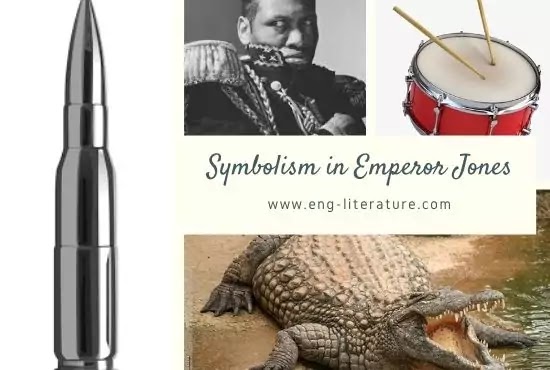
The setting, the characters, the flight through the forest, the forest itself, the tom-tom, the silver bullet, the stone altar and tree, the crocodile etc. in the play have symbolic significance.

Symbolism in Setting


The setting is symbolic. The forest with its sensuous blackness represents nature, while its primeval terror represents the primitive consciousness. In fact, standing at once for the glory and horror of human freedom, the forest assumes numerous shapes (e.g., prison, auction-room, ship, and altar). The flight through the forest symbolizes psychological regressive fight from one's own self. As mentioned by Doris Falk, the "stone altar near the tree combines the sexual and the religious symbols as if to signify that physical and spiritual births are one." Jones's feeling that he has come to a familiar place indicates symbolically that he has returned to the primitive stage of evolution. And now evil which has been his God appears as a crocodile and demands life. In killing it, therefore, Jones kills himself. The action starts in the afternoon which signifies confidence, continues at night which is the symbol of terror, retrogression and disintegration, and ends at dawn which stands for retribution.

Symbolism in Characters


The characters are also used as symbols. Brutus stands for the brute power of man, his animal instincts and impulses. Thus, Brutus Jones is the symbol of every man. He is also a symbol of man's vain boast of power. He as the Negro is the symbol of displaced superstitious humanity, of innocence and violence, of elemental simplicity and primal humanity. Loss of his hat, coat, spurs, represents the stripping off the layers of civilization.

What does the silver bullet signify in Emperor Jones?


In The Emperor Jones, the silver bullet is the symbol of materialism, of that superstition by which the dishonest rich have made the world believe that their very riches could save them from the revenge of their victims, just as Jones had made the natives believe that he could be killed only by a silver bullet. The silver bullet is also the symbol of the white man's mask under which he works. It is the symbol of his pride of release from bondage, the fetish of his particular pride.
Also Read:

Symbolism in Theme


On the surface the play is the story of a negro emperor, his guilty and sinful past, his rise to kingship, his fears and nervousness, and his escape from the aggressive natives, and ultimately his death. But symbolically the flight represents the soul's attempt to seek salvation and freedom from bondage. The progress of Jones is progress in self-understanding it is the stripping off of the masks of self, layer by layer, just as bit by bit his emperor's uniform is ripped off from his back, until at the end he must confront his destiny himself-in nakedness.

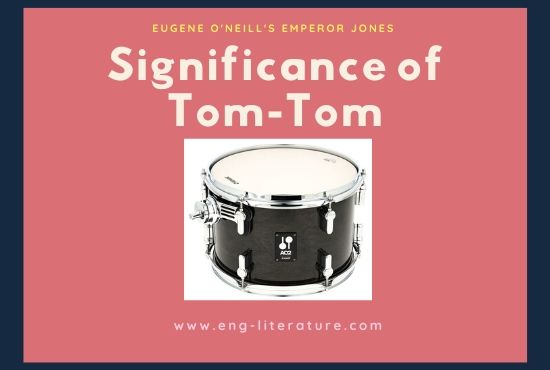
The Symbolic Significance of the Tom-Tom


The beating of the tom-tom is equally symbolic. According to Edwin Engel, "The beating tom-tom symbolizes the all-pervasive and inescapable presence of the primitive.” The tom-tom beats in the camp of the 'bush niggers' to which Jones is helplessly drawn and it beats in Jones's body, representing the primitive blood which charges through his arteries. Beginning at a rate corresponding to the normal pulse beat and only faintly heard, it becomes perceptively louder and more and more rapid as Jones becomes increasingly terror-stricken, as his visions are regressively aboriginal, as he approaches the camp of the bush niggers, when he is finally killed with a silver bullet, the tom-tom instantly ceases.

Colour Symbolism


O'Neill has made use of colour symbolism in many of his plays, such as, Thirst, Warnings and The Emperor Jones. The emperor’s audience chamber has whitewashed walls, a floor of white tiles, and the portico having white pillars. Since Brutus is a negro, a black man, the white colour has both a moral and a racial meaning. Jones has made a spectacular rise by imitating the shrewd and clever ways of white men but his blackness in the form of his heredity causes his tragedy. It should also be noted that whiteness is also the symbol of death-in-life, Jone's white imperial existence is nothing but a death-in-life, and to Smithers whiteness is the symbol of the tomb. The scarlet colour has also its significance in the play. To Jones it is a symbol of imperial authority, but, in fact, it stands for materialism, sinfulness, violence and blood. Again and again Smithers makes use of its last meaning by swearing "bloody" and "bleeding". He calls Jones "the bleedin' nigger."

Symbolism of Crocodile


The crocodile stands for the evil of the self. Doris V. Falk says. “from the symbolism of the dance and the use of the silver bullet, we know that the evil represented by the crocodile is the evil of the self that in killing it Jones has killed himself--at least, that distorted image of the self which was his life motivation. He has performed the justice demanded by the dance.”

Conclusion


In this play, O'Neill has achieved a remarkable synthesis of symbol and dramatic action of the inward and the outward. Brutus Jones emerges as a gigantic universal figure whose terror strikes. But the symbolism aspect has been mixed with realism to make the play concrete and more acceptable.
Also Read:
 ~~~~~*~~~~~
Share:

Monday, 27 April 2020

Significance of Tom-Tom in Neill's Emperor Jones

Significance of Tom-Tom in Neill's Emperor Jones

Significance of Tom-Tom in Neill's Emperor Jones

The expressionistic dramatists were fond of using sound and lighting effects to reveal the states of mind of their characters. O'Neill also attached great importance to sound effects and made them structural parts of his plays. In The Emperor Jones also, throughout the six forest scenes we hear a number of sounds, e.g. the sounds of the Great Forest, the clicking sound, the sounds of the Prison-Guard, the Witch-Doctor's croon and the tom-tom sound.

Throughout the play the sounds from Jones' revolver, like the tom-tom, have an important unifying function; they end each forest scene except one-the slave ship scene where instead a similar effect is gained by Jones' voice rising to the highest pitch of sorrow and desolation as the scene ends. His wail is carried over to the next scene, the Congo Scene, thereby binding the two together. Similarly, the Witch-Doctor's cries of "furious exultation" as the demands Jones' sacrifice are echoed in the "savage exultant yells" of the natives as they kill Jones in the final scene; here the parallel sounds help to suggest the mysterious identity of Jones with his killers.

However, the sound which is most important, and which is heard persistently throughout the play is the beating of the tom-tom on a distant hill. The tom-tom is a kind of big drum which the natives sounded on various occasions for various reasons. It was sounded to encourage the tribes to attack a hostile tribe or to prepare them for their own defense against the attack of an enemy. The wild primitives danced to the beat of the drum and the pace of dancing increased in keeping with the rhythm of the tom-tom. In this way a wild frenzy was induced and they marched dancing, if an invasion was in the offing.

The tom-tom was also beaten to exorcise (to frighten away) devils and evil spirits. It was also beaten to cast spells to destroy some enemy. As the tom-tom was sounded the witch-doctor danced, swayed and chanted mantras for the purpose, and it was supposed that in this way the fate of the enemy in question would be sealed. The beating of the tom-tom is thus seen to be the instrument of fate for determining the doom of the individual concerned. In The Emperor Jones, the tom-tom is beaten with this very end in view, and its sound, increasing in rapidity and intensity, pursues the fleeing Brutus Jones, like some relentless Fate, till he is almost driven crazy. He has the illusion that his enemies are coming nearer and nearer to him while, as a matter of fact, they were there on the same hill. Thus here the tom-tom serves to increase the terrors of Jones as well as it affords his enemies time to mould silver bullets with which he is ultimately killed.
Also Read

In the afternoon of the fateful day the sound of the tom-tom is heard at the end of Scene I, coming from the distant hill, and Jones at once understands that his subjects are in revolt against him. He knows his game is up, and so he runs away from the palace according to the n he has already formed. In the beginning, it is a low, vibrating end, but soon it seems to grow in rapidity and intensity. In Scene II the silence is broken, we are told, "by the far off quickened throb the tom-tom." In Scene III, it seems to the terrified Jones that sound of the drum is coming from some nearby place. They must have carried it along with them. The very thought is maddening to him Jones fires his revolver, "the heat of the far off tom-tom become perceptibly louder and more rapid."

The tom-tom sound is the symbol of relentless destiny of Jones Its increased volume of sound and rapidity of beat induces terror and nervousness in Jones. At the end of Scene VII, Jones sees in it some baffled but revengeful power. As mentioned by Isaac Golden. "Tom-Tom is part and parcel of the psychological action; at first it is the call to war, then it merges into the Emperor Jones' vision of the slaves working to its beat; finally it becomes his own throbbing, feverish temples, and all the while it is our heart-beating more and more rapidly as we follow his fate.”

On the realistic level, the beating of the drum is part of the "war dance" which the natives in rebellion perform to get up their courage to pursue Jones, whom they believe to possess strong magical powers. Thus, by beating the tom-tom they work a counter-spell. To Jones this beating is like an illomen. In increases his heart-beat; a strange look of apprehension overtakes him. As the drum beats grow faster and louder, his fear increases in the same proportion. When the heart of Jones finally ceases to beat, the sound of the tom-tom abruptly stops. To indicate further that the drum beat represents essentially an inner fate, O'Neill makes it grow and accelerate after each shot from Jones' revolver.

The tom-tom drum further symbolizes the pervasive and inescapable presence of the primitive. With its sounds the primitive blood of Jones charges through his arteries. Furthermore, the throb of the tom-tom is the most effective device used in the play to objectify the inner terrors of Jones.

As stated by Chaman Ahuja, "At first a call to war, it gradually becomes a presentiment of a brooding fate, i.e., a call to death; next, it merges with Emperor Jones' visions of the slaves working to its beat; and later still, it becomes successively the voice of his internal guilt and the throbbing of his temples. What is more, all the while it is our own heart, beating more and more rapidly as follow it. The tom-tom that projects Jones' rising panic is part of the psychological action; but since that is the dramatic action as well, we may say that through the tom-tom the symbolic and the drama; actions are synthesized. What is more, by inducing panic in the audience, it helps them to share emotions of the terrified Jones - a wonderful seat in participation mystique."
Also Read


 ~~~~~*~~~~~
Share:

Significance of the Title of Eugene O'Neill's Emperor Jones

Significance of the Title of Eugene O'Neill's Emperor Jones

Significance of the Title of Eugene O'Neill's Emperor Jones

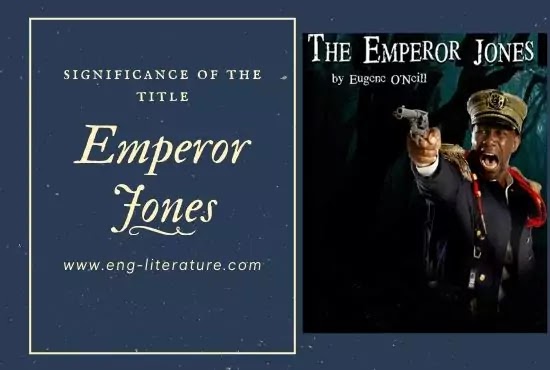
Eugene O'Neill first intended to entitle the play, The Silver Bullet, but on second thought he dropped the idea and named it 'The Emperor Jones'. Thus, he named it after the chief protagonist. It was a happy choice for the play deals entirely with the life, career and tragic death of Jones.

The action of the play revolves round Brutus Jones. The play opens one afternoon of a crucial day in the career of Jones and it ends with his tragic death at the dawn of the next day. Throughout the play attention is focused on Jones. In Scene I, through a dialogue between Jones and Smithers, a white trader, we come to know about the past of Jones. We are told that he is a negro who worked as a Pullman carter in the States for a number of years. There he acquired the veneer of western civilization, but failed to control his animal instincts and impulses which came to the surface at the least provocation. Thus he committed two murders, was jailed for life, but he broke out from the prison and made good his escape to an island in the West island in the West Indies.

It is the Emperor Jones who is the centre of the legend of the Silver Bullet. On reaching the island he is able to impress the simple and ignorant natives that within two years he is able to rise to the position of the Emperor in the island. He amassed huge wealth in a foreign bank. Once Lem, a tribal chief tried to kill him by shooting at him from point blank range, but he was not killed. He used the incident to great advantage to create the myth that he bore a charmed life, and he can be killed only by a silver bullet. In order to make this myth credible by carries a silver bullet in his revolver, and intends to shoot himself with it, if the circumstances make it necessary. The superstitious natives fully believed that he bore a charmed life.
Also Read


Jones is not interested in playing the role of an emperor. It is not the glamour of kingship which he craves, for he lusts only for money. Moreover, he knows that the natives would soon revolt: against him, and he was carefully planned out his future course of action. He would escape through the great forest which is close by, and for the purpose he was hidden there some food under a white stone and has carefully familiarized himself with the route he intends to take, Crossing the forest he would reach the seacoast where he would be quite safe from his revolting subjects. Then he would freely and comfortably live on the wealth he has already amassed. The Scene I shows that he is intelligent, crafty, proud, self-confident and far-sighted.

On the afternoon of the day on which the play opens, the natives are already in revolt against him. Jones runs away according to his plan. The Scenes II to VII which follow are sustained pieces of monologue, the speaker being the runaway emperor Jones. Throughout, the attention is focused on Jones and the monologue is expressive of what is happening in his soul or psyche. He has illusions or hallucinations which are objectifications of his racial and personal memories. Thus the shapeless figures of nameless fears which he sees at the edge of the forest are symbolic of the fear complex within him.

He also sees the vision of Jeff-a negro whom he had killed is an externalization of his guilt-complex. Similar is the vision of his fellow prisoners and the prison-guard whom he had killed. The vision or the auction in the slave market, the visions of the slave-ship and of the Congo Witch-Doctor, the altar and the crocodile-god, are so many externalizations of his racial memories or what Jung calls the "collective unconscious".

At the end of each scene, Jones fires his revolver and the hallucination comes to an end. The last bullet, the silver bullet, is fired at the crocodile god. In each scene Jones strips himself of some part of his emperorhood till he becomes a primitive negro dressed in a loin-cloth. His regression to his primitive negro-origin is complete.

In the last score of the play, Jones again is the centre of attention. The beating of tom-tom strikes terror into his soul, he becomes panicky, forgets the route, and takes a circular course. The result is that he returns to the edge of the forest where he had begun his last journey, and where his enemies are waiting to kill him. He is killed by a silver bullet which the natives had moulded for the purpose.

Thus, the play is entirely concerned with Jones' life, career and death, his past and present, his hopes and fears, his aspirations and machinations, his pride and greed, his racial consciousness and hallucinations. Both his external and internal lives are explored. Hence from the thematic, structural points of view the title of the play is quite suitable. Jones is the emperor with a distinction. He is superior both to the English trader Smithers and to the other natives on whom he rules. Even he lives like a king. He is killed not by an ordinary bullet but the silver bullet. Thus, he is able to preserve the legend he had created. Hence, both in his life and death he is the emperor.

The title of the play is also a fine instance of O'Neill's use of irony. The full name of the hero of the play is 'Brutus Jones'. Jones is every man and Brutus implies the irrational (brute' in every man). It is ironical that a mere brute, an irrational animal, should be the emperor. Jones' death is pathetic and ironic rather than tragic.
Also Read

~~~~~*~~~~~

Share:

Follow Me in Social Media

Get Free Updates

Tags

A Doll's House (1) A Renouncing of Love (1) Absurd Drama (2) African English Literature (2) Agyeya (1) Alexander Pope (7) American Literature (26) Amitav Ghosh (3) Analyses (22) Anglo-Saxon Period (1) Aravind Adiga (1) Arthur Miller (5) Australian Literature (2) Beowulf (3) Bertrand Russell (2) Bible (1) Biographies (12) Book Review (2) British Literature (106) Broad Notes (94) Character Analysis (2) Charles Dickens (1) Charles Lamb (2) Charlotte Bronte (2) Chetan Bhagat (2) Chinua Achebe (1) Christopher Marlowe (2) Classical Literature (2) Composition (4) Creative Writing (5) D. H. Lawrence (1) Daniel Defoe (1) Diaspora (4) Drama (1) Dream Children: A Reverie (1) E-book Download (12) Edmund Spenser (1) Edward Fitzgerald (1) Edward II (3) Elizabethan Era (2) English Language (15) English Literature (9) English Literature Quiz (8) Escapism (1) Essay (12) Essays (12) Eugene O'Neill (7) Explanations (3) Feminism (3) Francis Bacon (4) Frankenstein (4) Free E-book Download (5) Free PDF Download (4) Genre (1) Geoffrey Chaucer (1) George Eliot (4) George Herbert (1) George Orwell (1) Girish Karnad (1) Hard Times (1) Heart of Darkness (1) Henrik Ibsen (1) Henry Vaughan (2) Historical Novel (6) History of English Literature (22) Indian Drama (2) Indian English Poetry (1) Indian Fiction (3) Indian Writing in English (33) Indo-Anglican Literature (32) Interesting Facts (9) Interpreter of Maladies (2) Jane Austen (2) Jane Eyre (2) Jayanta Mahapatra (2) Jhumpa Lahiri (3) John Donne (5) John Dryden (1) John Keats (4) Joseph Addison (1) Joseph Conrad (1) Keki N. Daruwalla (1) Kenilworth (3) Kim (1) Knowledge and Wisdom (1) Leo Tolstoy (1) Linguistics (2) Literary Criticism (5) Literary Essay (9) Literary Facts (1) Literary MCQ (4) Literary Photo Album (1) Literary Terms (14) Literary Trends (1) Literary Types (7) Lord of the Flies (1) Lyric (1) M. K. Anand (2) Mac Flecknoe (1) Macbeth (7) Mahadevi Verma (2) Man Eater of Malgudi (2) Mark Twain (1) Mary Shelley (4) Mathew Arnold (1) Midnight's Children (1) Modern Poetry (3) Modernism (1) Motivational Short Story (21) My Penning (1) Nayantara Sahgal (1) Notes (25) Novel (60) Novels (5) O' Henry (1) Ode to a Nightingale (1) Ode to the West Wind (1) Oedipus Rex. Oedipus the King (2) Of Friendship (1) On Fame (1) Online Quiz (8) Othello (1) P B Shelley (1) P. B. Shelley (1) Paulo Coelho (2) Philological Notes (10) Phonetics (3) Picaresque Novel (5) Plays (41) Poetry (52) Popular Literature (1) Post Colonial Literature (1) Post Colonialism (1) Pride and Prejudice (2) Prosody (3) Quiz (6) Quotations (6) R. K. Narayan (2) Rabindranath Tagore (2) Random Quiz (6) Rape of the Lock (5) Realistic Fiction (1) Restoration Era (2) Rhetoric (2) Robert Browning (1) Robinson Crusoe (1) Romantic Poetry (2) Romanticism (2) Rubaiyat of Omar Khayyam (1) Rudyard Kipling (1) Salman Rushdie (2) Samuel Beckett (3) Sarojini Naidu (1) Seven Ages of Man (1) Shakespearean Influence (2) Shakespearean Plays (11) Shakespearean Sonnets (4) Sheridan (4) Short Notes (10) Short Stories (9) Soliloquy (1) Songs of Innocence (1) Sons and Lovers (1) Sophocles (1) Sri Aurobindo (1) Substance Writing (1) Summary (8) Sylvia Plath (1) T. S. Eliot (2) Texts (10) The Adventure of Tom Sawyer (1) The Alchemist (1) The Crucible (3) The Emperor Jones (7) The Golden Light (2) The Guide (1) The Mill on the Floss (4) The Namesake (1) The Pulley (2) The Rivals (5) The Shadow Lines (3) The Sunne Rising (5) The Superannuated Man (1) The Town Week (1) The White Tiger (1) The Winter's Tale (2) Things Fall Apart (1) Thomas Hardy (2) Thomas Wyatt (1) Toni Morrison (6) Tragedy (3) Tughlaq (1) Untouchable (2) Waiting for Godot (2) Walter Scott (3) Way of the World (1) William Blake (2) William Golding (1) William Shakespeare (14) William Wordsworth (3) Word Notes & Annotations (1) Word Notes & Anotations (2)

Blog Archive