

All About English Literature: Character Analysis

For Exclusive Notes and Analysis

Showing posts with label Character Analysis. Show all posts

Friday, 17 April 2020

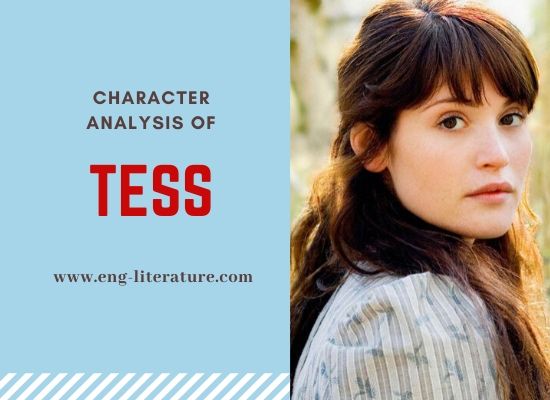
Character Analysis of Tess in Hardy's "Tess of the d'Urbervilles"

Character Analysis of Tess in Hardy's "Tess of the d'Urbervilles"

"Among Hardy's woman Tess claims attention first, not only by reason of popularity, but more specially in that her creator distinguished her by the appellation of a pure woman".

Tess’s Physical Grace:

Tess is described early in the novel as a cute and handsome girl whose mobile mouth and large innocent eyes added eloquence to colour and shape. Phases of childhood lurked in her aspect still. When she meets Alec for the first time, her attractiveness of face and figure cause his eyes to rivet themselves on her. "It was a luxuriance of aspect, a fullness of growth, which made her appear more of a woman than she really was". Angel Clare is also greatly attracted by her physical charms, her "real vitality" and her "real warmth". He had seen nothing to equal the beauty of her mouth which, to any young man with least fire in him, would have been distracting, infatuating, maddening. Her lips and teeth could be compared to roses filled with snow. In spite of the "animalism," however, Angel Clare finds something unearthly in her. On certain occasions Tess was no longer the milk-maid, "but a visionary essence of woman a whole sex condensed into one typical form. He called her Artemis, Demeter add other fanciful names........"

Contrast with Her Mother:

Tess is not an illiterate girl. She has passed the sixth standard in the national school under a London-trained mistress, and she speaks two languages: the dialect at home, more or less; and ordinary English outside and to persons of quality. Although she has a tendency to believe in omens, she is not superstitious like her mother. She is considerably ahead of her mother as regards knowledge and outlook. Between Tess's mother and Tess, says Hardy, there was a gap of two hundred years: "when they were together, the Jacobean and the Victorian ages were juxtaposed".

Tess : Her Devotion to Her Family:

One of Tess's most outstanding traits of character is her steadfast and unfaltering devotion to her family. She is keenly conscious of her duty as the eldest child in the family. She feels constantly solicitous throughout the story about the welfare of her brothers and sisters. In fact, Alec succeeds in exploiting Tess partly because of this trait in her character. His gifts to her parents and to her brothers and sisters both at the outset and at the later stages of the story produce in her a feeling of gratitude towards him which he does not fail to make use of for his own nefarious purpose. Tess's sense of duty to her father and mother is as deep as her devotion to her brothers and sisters.

At the same time Tess is fully conscious of the weakness of both her father and her mother. She knows that her father is only making a fool of himself by feeling vain his ancient lineage, and she feels quite a Malthusian towards her moth thoughtlessly producing so many children. She is always ready to give financial help with the last penny she has got. When she receives the new her mother's serious illness, she gives up her job at Flintcomb-Ash and back to Marlott to be by her mother's side and remains with the family.

Tess : Her Melancholy Nature:

Tess is by nature a melancholy person. There is a morbid element in her thinking. When still a young girl, she tells her little brother Abraham that they are living, not on a splendid and sound planet, but on a blighted one, the evidence for this being that their father is generally ill and often gets too drunk to be able to attend to his work, and that their mother is “always washing and never getting finished". And she says this before any real misfortune has descended upon the family, even before the accident in which Prince the horse gets killed. Angel Clare later on discovers this melancholy streak in her nature. Angel feels surprised to find in her a tendency to such "sad imaginings" and feelings which might almost have been called "the ache of modernism". It seems strange to Angel that these feelings should have come to her while still so young. Referring to her "woebegone" look! Tess tells Angel, "My life looks as if it had been wanted for want of chances. I feel what a nothing I am ! I'm like the poor Queen of Sheba who lived in the Bible. There is no more spirit in me".

Tess’s Relationship with Alec:

Tess's very initial reaction to Alec D'Urberville is one of strong dislike. She is repelled by his advances when he tries to kiss her while driving her to Trantridge. When working at Trantridge she constantly feels suspicious about his intentions and refuses to let him take any liberties with her. Her sexual experience with him in the wood has been called a rape. However, we must recognize the fact that she does acquiesce in what he does to her. The acquiescence should not be called a willing surrender. As she afterwards tells him, she hardly knew what was happening till it was too late.

The Marriage of Tess and Angel:

Hardy's women are usually led by love and passion. The fourth phase shows us Angel's love becoming more and more intense, and Tess steadily refusing to agree to any commitment. Some more light is thrown on Angel who is intellectually admirable, and on Angel's family. We also learn that Alec D'Urberville has met old Mr. Clare and spoken rudely to him. Tess's resistance to Angel's pressure is maintained almost to the point of incredibility, but at last she consents to become “his for ever and ever". Five times she has tried to tell him her secret, and five times she has failed. In the days that follow she lives "in spiritual latitudes more nearly approaching ecstasy than any other period of her life". As they wander about enjoying the new freedom and openness of their love, Hardy continually points to the waiting terrors. The omens multiply, but the quiet wedding takes place; still the omens continue—the legendary death foreboding coach, the crowing cock, the fearsome D'Urberville portraits, and finally the news of Retty Priddles's attempt to kill herself. The last blow compels Tess to a decision; she will tell Angel there and then.

Also Read:

Tess's Confession and Its Consequence:

And so we come to the most painful scene in the novel. Before Tess reveals her secret, Angel confesses a moral lapse on his part, and she forgives him readily. But he refuses to adopt a similar liberal attitude towards her guilt. This reminds us that the Victorians had one standard of judgment to men and another for women. Angel in this situation does not even show logical mind. He raises various objections. He says that Tess is not pure however, goes under the carpet and does not come into Angel's hands. Subsequently when she makes a confession after the marriage, the reaction comes as a great shock to her. Life now loses all its meaning for her.

Tess: Her Tragic End:

Deserted by Angel, Tess goes back to her family and, after a short stay with them, becomes a wage-earner at a place called Flintcomb-Ash. But her love for Angel does not diminish, and she has an inward faith that he will come to her. Her attempt to meet Angel's parents proves futile. Her long wait for Angel's return proves unrewarding. Her desperate letter to Angel brings no reply. Chance throws her again in Alec's path, and her love for Angel into ashes. When Angel returns to her it is too late, but not too late for her murder Alec and enjoys a brief interlude of happiness in Angel's arms before she is overtaken by the long arm of the law. Thus Tess proves herself to be woman with an exceptional capacity for love and for self-sacrifice. Tess is splendid woman, if ever there was one. In this peasant girl there is the stuff and the substance of which true heroines are made. Her love is of a sublime quality, and her death is a martyrdom in the cause of that love.

Tess: Her Heroic Endurance of Her Misfortunes:

What makes Tess a truly tragic figure is her heroic endurance of her misfortunes. Her seduction early in the story is, of course, her greatest misfortune. Then comes the death of her baby aptly named "Sorrow". The chapter describing Tess's hasty baptism of the child, the child's death, and its burial makes painful reading. Then comes the heart-rending episode of Angel's desertion of her. At the end of her confession of her past she waits for Angel to speak words of comfort and good cheer to her but instead hears the following words. "The woman I have been loving is not you." She bursts into a flood of self-sympathetic tears, but they have no effect on Angel. She is now overcome by a feeling of the injustice and cruelty that she has been subjected to. She wishes that she were dead. Then there follows for her a life of despair, hard toil, helplessness, and mental torture. One of the most painful chapters in the book describes Tess's work at the threshing-machine. Alecs importunities aggravate her affliction, and the eviction of the family from the cottage at Marlott comes as the final blow. Her brief stay at Sandbourne as Alec's mistress is a shameful episode in her life, but her state of mind there one of stupor, as if she were heavily drugged. The wrecking of this sensitive girl's happiness and the blighting of her hopes are unbearable for the reader but Tess endures her fate with a rare fortitude.

Tess : Her Gentle and Sympathetic Nature:

Tess is ineffably gentle. She is by nature a sympathetic being. Herself in love with Angel, yet wants to allow an opportunity to the other milk-maids to try to cap Angel's heart and even suggests to Angel that he should choose one of the rather than her. To the milk-maids she says: "He ought to marry one of you. You are all better than I."


Conclusion:

"She is high-strung, impressionable, poetic; her soul soars into space when she gazes at the night heavens, in the stress of her emotions at the sound of Clare's harp the whole of the twilight garden grows instinct with harmony and passion, and at his touch her accelerated pulse drives the blood flushing to her finger-ends. She is heroic, for we hear of her many months of lonely self-chastisement, wrestling, communings, schemings to lead a future of austere isolation, and her long endurance of retributive agonies is sublime. And she shows perfect nobility and generosity of sentiment in her attitude towards her simple rivals at the farm and in her splendid faith in Clare. Whatever else we call her, Tess remains the most lovable of Hardy's heroines. All women adore her, and some men. What she might have made of life, what life might have made of her, had circumstances and Clare been kind, is beyond dreaming."

Also Read:
~~~~~*~~~~~
Share:

Thursday, 16 April 2020

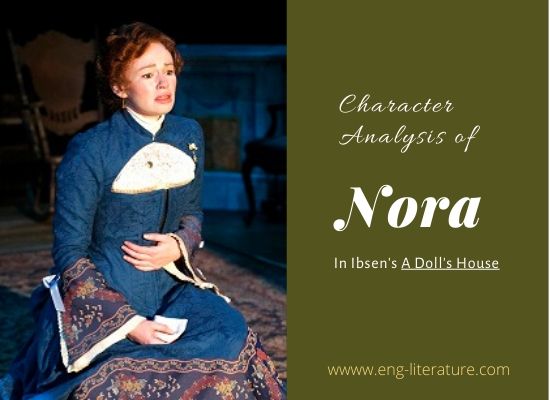
Character of Nora in Henrik Ibsen's "A Doll's House"

Character of Nora in Henrick Ibsen's "A Doll's House"

Character Analysis of Nora

Nora, the protagonist is the doll in Henrik Ibsen’s play, “A Doll’s House”. In order to be an ideal wife, she surrenders herself submissively and calmly to her husband, Torvald Helmer. She is very shy and reserve and tires to wrap her into the shell to hide her personality thus makes her character more complicated and complex.  Although they belong to a middle class family, suffering from economic problems still they are managing to live happily.

Nora, the heroine in Ibsen’s drama “A Doll’s House” is a true representative woman of Victorian era as throughout the play Ibsen has portrayed her as a loving, caring and devoted daughter, mother and wife. From the beginning of the play we get the impression of Nora as an organized woman who lovingly takes care of her house. She keeps the house clean and places the things orderly.

Nora is a cheerful woman who enjoys her life as we see her in the beginning celebrating Christmas with acute enthusiasm. She is a sympathetic woman who also cares about subservient. She brings a gift for her maid on the occasion of Christmas which shows that she is a good human being by nature.

Nora lives in the world of imagination. Now that her husband’s salary has been increased she is much excited thinking that there would be no economic problems thereafter. “Now that you’re to earn a big salary".(Ibsen, Act 1) Torvald, on the other hand does not like her habit of spending much money and therefore calls her “spendthrift”.

In spite of all his positive traits Nora believes that borrowing can be a solution of their financial problem at the end of the month “We can borrow till then” (Ibsen, Act 1) while borrowing money became a cause of their break up. She could have resolved the issue by disclosing it to her husband before giving a chance to Krogstad, a selfish person.

Though Nora was a young woman, living in the world of imagination she loved her husband from the core of heart and she tried to mould herself according to his wishes. She loves him so much that she enjoys being dependent on him and asks him to choose thing for herself. “I really can’t think of anything-unless, Torvald” (Ibsen, Act 1). One aspect of her love surfaces when she takes loan for her husband’s health through forgery. Here she commits forgery out of her love because the doctors had clearly declared that Torvald’s improvement was not possible unless he had been taken to some airy place.

After taking the loan, a woman who was enjoying her life as a Doll wife has turned into a practical woman who struggles day and night to pay back the loan she has taken. She used to work late at night to earn money. “Often I was desperately tired; but all the same it was a tremendous pleasure to sit there working and earning money.” (Ibsen, Act1)

Nora is a caring mother who thinks it her responsibility to impart manners to her children. When she finds that she has done something wrong and has violated the rules of the society, her conscious pricks her that she is not a suitable mother. Through this Ibsen has highlighted the fact that it was a male -dominated society which implies that mothers are totally responsible for upbringing their children. If the child is morally not strong then the blame will go to the women of the society.

Apart from her positive traits in her personality we also come to know that she was a deceptive person who tries to do things according to her own wishes. She is a kind of a person who hides things from her husband.

As in the beginning of the play, her husband asks her not to eat sweets she lies to him by saying that “I shouldn’t think of going against your wishes”.(Ibsen, Act1) This shows she is a liar who tells lies frequently in her daily life and is not ashamed of it.
There is another instance of her lying when Helmer, after seeing Krogstad coming out of his home, asked Nora “has there been anyone here?” (Ibsen, Act2) she replied with “no”.

Nora’s crisis begins when her husband takes the charge of Bank Manger. Mr. Helmer is determined to fire out Krogstad, a dishonest person in his bank who once forged signature for some illegal purpose. But on the other hand, Krogstad also came to know that Nora had forged her father’s signature in order to get money from him. At this revelation, he plans to exploit Nora in order to retain his position in the bank.

So when Krogstad comes to know that Helmer is going to dismiss him from his post which, he starts blackmailing Nora and threatens that he will reveal her crime if her husband fired him. Naturally, Nora tries to influence her husband but he could not understand the real matter taking Nora as a simple child who cannot understand the secrets of business.

Despite her utmost efforts to save Krogstad’s current position, the latter discloses Nora’s act of taking loan to her husband through a letter. When Helmer discovers that Nora has forged her father’s name he is ready to disclaim his wife without realizing her passion and that she took loan, after all, for his treatment purpose. At Helmer’s harsh reaction against her act of borrowing, Nora sees that her husband is not worth of her love and immediately leaves him.

In terms of her moral character Nora does not prove herself to be immoral at anytime. At times she thinks of taking loan from Mr. Rank but soon she changes her mind when it appears that Mr. Rank has some loving passions for her in his heart. In fact, she does not like to take privilege from her lover. This is the main reason that she adopted a risky way of getting loan by an act of forgery which proves to be catastrophic for her marital life.

Of all the qualities and characteristics of Nora, the most important aspect of her personality is that she is a loving, caring and loyal to her husband irrespective of the economic problems. Though Nora knows about the cannons of society that a Victorian woman cannot take loan without the permission of her husband but she loves her husband so much that she ignores such a serious issue and handles it as a courageous woman. Her love was so pure that she had been struggling throughout her life. Nora always tries to make her husband happy. In fact, she becomes a doll in the hands of her husband.

Nora has always been treated by her husband as his property, as his possession, as his doll-wife. She can no longer live in the doll’s house in which she has been living for eight years, obeying every wish and whim of her husband.  Her decision to leave her husband is certainly heart-breaking for us. It is a painful renunciation on her part. Nora is leaving not only her home and her husband but also her children.

In short Nora grows in stature, and is purged by suffering. When everything lies in ruins around her, she emerges strong and independent; she is in the process of attaining complete maturity at the same time, her action at the end points to a freer and more honest humanity in a healthier society. In this sense she is a modern tragic heroine and the play is a modern tragedy.


~~~~~*~~~~~
Share:

Follow Me in Social Media

Get Free Updates

Tags

A Doll's House (1) A Renouncing of Love (1) Absurd Drama (2) African English Literature (2) Agyeya (1) Alexander Pope (7) American Literature (26) Amitav Ghosh (3) Analyses (22) Anglo-Saxon Period (1) Aravind Adiga (1) Arthur Miller (5) Australian Literature (2) Beowulf (3) Bertrand Russell (2) Bible (1) Biographies (12) Book Review (2) British Literature (106) Broad Notes (94) Character Analysis (2) Charles Dickens (1) Charles Lamb (2) Charlotte Bronte (2) Chetan Bhagat (2) Chinua Achebe (1) Christopher Marlowe (2) Classical Literature (2) Composition (4) Creative Writing (5) D. H. Lawrence (1) Daniel Defoe (1) Diaspora (4) Drama (1) Dream Children: A Reverie (1) E-book Download (12) Edmund Spenser (1) Edward Fitzgerald (1) Edward II (3) Elizabethan Era (2) English Language (15) English Literature (9) English Literature Quiz (8) Escapism (1) Essay (12) Essays (12) Eugene O'Neill (7) Explanations (3) Feminism (3) Francis Bacon (4) Frankenstein (4) Free E-book Download (5) Free PDF Download (4) Genre (1) Geoffrey Chaucer (1) George Eliot (4) George Herbert (1) George Orwell (1) Girish Karnad (1) Hard Times (1) Heart of Darkness (1) Henrik Ibsen (1) Henry Vaughan (2) Historical Novel (6) History of English Literature (22) Indian Drama (2) Indian English Poetry (1) Indian Fiction (3) Indian Writing in English (33) Indo-Anglican Literature (32) Interesting Facts (9) Interpreter of Maladies (2) Jane Austen (2) Jane Eyre (2) Jayanta Mahapatra (2) Jhumpa Lahiri (3) John Donne (5) John Dryden (1) John Keats (4) Joseph Addison (1) Joseph Conrad (1) Keki N. Daruwalla (1) Kenilworth (3) Kim (1) Knowledge and Wisdom (1) Leo Tolstoy (1) Linguistics (2) Literary Criticism (5) Literary Essay (9) Literary Facts (1) Literary MCQ (4) Literary Photo Album (1) Literary Terms (14) Literary Trends (1) Literary Types (7) Lord of the Flies (1) Lyric (1) M. K. Anand (2) Mac Flecknoe (1) Macbeth (7) Mahadevi Verma (2) Man Eater of Malgudi (2) Mark Twain (1) Mary Shelley (4) Mathew Arnold (1) Midnight's Children (1) Modern Poetry (3) Modernism (1) Motivational Short Story (21) My Penning (1) Nayantara Sahgal (1) Notes (25) Novel (60) Novels (5) O' Henry (1) Ode to a Nightingale (1) Ode to the West Wind (1) Oedipus Rex. Oedipus the King (2) Of Friendship (1) On Fame (1) Online Quiz (8) Othello (1) P B Shelley (1) P. B. Shelley (1) Paulo Coelho (2) Philological Notes (10) Phonetics (3) Picaresque Novel (5) Plays (41) Poetry (52) Popular Literature (1) Post Colonial Literature (1) Post Colonialism (1) Pride and Prejudice (2) Prosody (3) Quiz (6) Quotations (6) R. K. Narayan (2) Rabindranath Tagore (2) Random Quiz (6) Rape of the Lock (5) Realistic Fiction (1) Restoration Era (2) Rhetoric (2) Robert Browning (1) Robinson Crusoe (1) Romantic Poetry (2) Romanticism (2) Rubaiyat of Omar Khayyam (1) Rudyard Kipling (1) Salman Rushdie (2) Samuel Beckett (3) Sarojini Naidu (1) Seven Ages of Man (1) Shakespearean Influence (2) Shakespearean Plays (11) Shakespearean Sonnets (4) Sheridan (4) Short Notes (10) Short Stories (9) Soliloquy (1) Songs of Innocence (1) Sons and Lovers (1) Sophocles (1) Sri Aurobindo (1) Substance Writing (1) Summary (8) Sylvia Plath (1) T. S. Eliot (2) Texts (10) The Adventure of Tom Sawyer (1) The Alchemist (1) The Crucible (3) The Emperor Jones (7) The Golden Light (2) The Guide (1) The Mill on the Floss (4) The Namesake (1) The Pulley (2) The Rivals (5) The Shadow Lines (3) The Sunne Rising (5) The Superannuated Man (1) The Town Week (1) The White Tiger (1) The Winter's Tale (2) Things Fall Apart (1) Thomas Hardy (2) Thomas Wyatt (1) Toni Morrison (6) Tragedy (3) Tughlaq (1) Untouchable (2) Waiting for Godot (2) Walter Scott (3) Way of the World (1) William Blake (2) William Golding (1) William Shakespeare (14) William Wordsworth (3) Word Notes & Annotations (1) Word Notes & Anotations (2)

Blog Archive