



Showing posts with label Linguistics. Show all posts
Showing posts with label Linguistics. Show all posts
Saturday, 15 February 2020
Thursday, 13 February 2020
What is 'Lateral Consonant Approximant'?


Definition
Lateral consonant approximant is articulated with a
stricture of partial closure, i.e. with complete closure in the centre of the
vocal tract, but the sides of the tongue are lowered and the lung air escapes
along the sides of the tongue freely. The lateral sound is
frictionless. It is in many respects vowel-like and could be considered as a
continuant. There is one lateral consonant in English which is symbolized / l /.
/ l / as in the word ‘leader’
Classification
There is only one lateral
consonant in English: /l/. Like other consonants the lateral sound is
customarily described on the following three bases:
1. Manner of Articulation: The
manner of articulation refers to how the articulators approach to each
other to create a closure. It also determines the type and degree of hindrance
the airflow meets on its way out affected by the closure. The closure takes
different manners for different sounds. For instance, during the articulation
of the lateral sound the following sequence of events occurs:
·
The tip of the tongue
makes a firm contact with the upper alveolar ridge to form a complete closure
in the middle of the mouth.
·
The soft palate is
raised to completely block the nasal passage .
·
The sides of the tongue
are lowered to let the air escape along the sides of the tongue without any
friction.
2. Place/Point of Articulation: The place of articulator refers
to the place or point where the speech organs create a closure by either coming
close or near contact. This is the place where the sound is produced. For
lateral sound the place of articulation is alveolar, which means it is
articulated with the tip the tongue at the alveolar ridge.
3. Voicing/Phonation: Voicing refers to whether or not the vocal folds are vibrating. If the vocal folds vibrate during the articulation then a voiced sound is produced. Contrariwise, if the vocal folds do not vibrate then a voiceless sound is produced. Some phoneticians use the terms Lenis and Fortis to describe the voiced and voiceless sounds respectively. During the production of /l/ the vocal folds vibrate. It is thus a voiced sound.
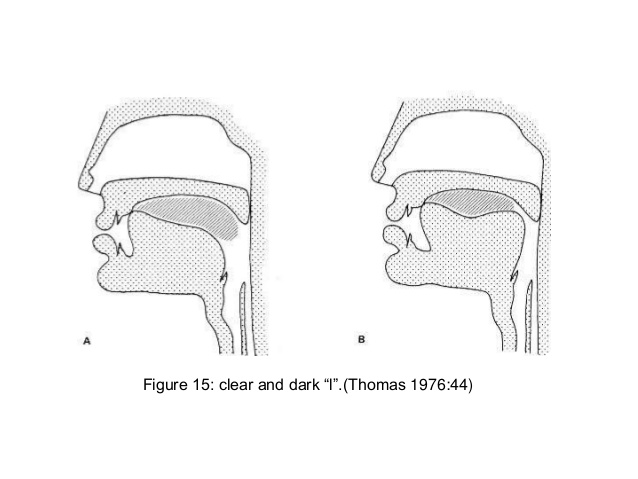
From the above discussion we can identify /l/ as a voiced alveolar lateral. However, In English the pronunciation of this sound differs from person to person. But the usage of wrong /l/ won’t necessarily change the intended word. Therefore, In English /l/ occurs in two pronunciation variations, that is, /l/ consists of two allophonic variants:
(i) Clear[ l ]: It is also known as light [ l ].
3. Voicing/Phonation: Voicing refers to whether or not the vocal folds are vibrating. If the vocal folds vibrate during the articulation then a voiced sound is produced. Contrariwise, if the vocal folds do not vibrate then a voiceless sound is produced. Some phoneticians use the terms Lenis and Fortis to describe the voiced and voiceless sounds respectively. During the production of /l/ the vocal folds vibrate. It is thus a voiced sound.
From the above discussion we can identify /l/ as a voiced alveolar lateral. However, In English the pronunciation of this sound differs from person to person. But the usage of wrong /l/ won’t necessarily change the intended word. Therefore, In English /l/ occurs in two pronunciation variations, that is, /l/ consists of two allophonic variants:
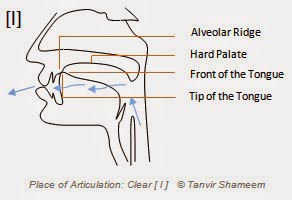
(i) Clear[ l ]: It is also known as light [ l ].
Leela loves eating lollypop with Liza.
Place of Articulation: The upper alveolar ridge, the tip of the tongue, the front of the tongue, and the hard palate.
Place of Articulation: The upper alveolar ridge, the tip of the tongue, the front of the tongue, and the hard palate.
Manner of Articulation:
1. The tip of the tongue makes a firm contact
behind the upper alveolar ridge to form a complete closure in the middle of the
mouth.
2. At the same time the front of the tongue is
raised towards the hard palate.
3. The sides of the tongue are lowered to let the
air to escape along the sides of the tongue without any friction.
Voicing: During the production of
[ l ] the vocal folds vibrate. It is thus a voiced lateral variant.
Distribution: [ l ] is found before a vowel. It is distributed in all three basic positions.
Distribution: [ l ] is found before a vowel. It is distributed in all three basic positions.
|
Initial
|
Medial
|
Final
|
|
|
[ l ]
|
lee
|
clear
|
ball
|
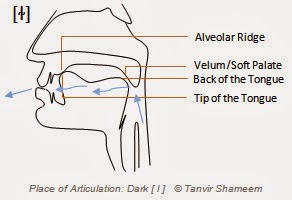
(ii) Dark [ l ]: Dark /l/ also involves raising the back of the tongue towards the velum.The IPA symbol for this lateral variant is a " l " symbol with a tilde “ ~ ” symbol superimposed onto the middle: [ ɫ ].
Can
Paul call tall Phil on his mobile?
Place of Articulation: The upper alveolar ridge, the tip of the tongue, the back of the tongue, and the velum.
Place of Articulation: The upper alveolar ridge, the tip of the tongue, the back of the tongue, and the velum.
Manner of Articulation:
1. The tip of the tongue makes a firm contact
behind the upper alveolar ridge to form a complete closure in the middle of the
mouth.
2. At the same time the back of the tongue is
raised towards the velum or the soft palate.
3. The sides of the tongue are lowered to let the
air to escape along the sides of the tongue without any friction.
Voicing: During the production of
[ ɫ ] the vocal folds vibrate. It is thus a voiced lateral variant.
Distribution: [ ɫ ] occurs before consonants. It is distributed in the final position only.
Distribution: [ ɫ ] occurs before consonants. It is distributed in the final position only.
|
Initial
|
Medial
|
Final
|
|
|
[ ɫ ]
|
-
|
-
|
pool
|