
All About English Literature: The Winter's Tale

For Exclusive Notes and Analysis

Showing posts with label The Winter's Tale. Show all posts

Wednesday, 22 April 2020

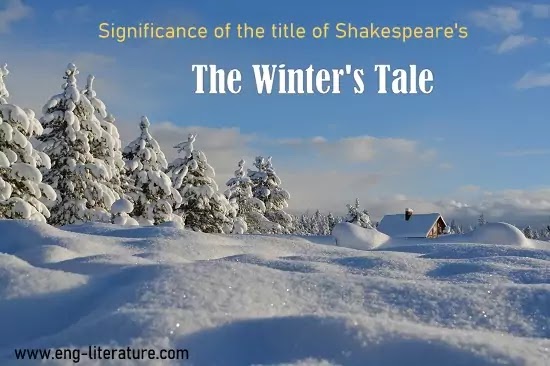
Significance of the Title of The Winter's Tale

Significance of the Title of The Winter's Tale

Significance of the Title of The Winter's Tale

The title of a play should be like the signboard of a shop. Just as a signboard indicates the goods that are sold in the shop, so as a good title should give an indication as to the contents of the play, its theme, symbolism etc. Shakespeare's titles are always well-chosen. The phrase a “winter’s tale” means an old wives’ tale, a story narrated to children in the night before they go to bed. It can be connected with some ancient legend or ballad, often exaggerated by the narrator, or it can be a fairy-tale or a story concerned with ghosts.

Here Shakespeare puts a very popular story into a dramatic form. He advertised his readers by calling this play a "tale". So the main intention of the title may be to emphasize that this play tells an incredible story because in this play we find certain attributes of a tale. For instance tale is a fanciful, unreal and fairy thing which takes us away from the bitter realities of life. It lands us on such a realm which is imaginative. The world of The Winter's Tale is also the world of dreamlands, of the fairy tales and of the folk-lore. Strange things happen which demand a complete suspension of disbelief. Here a prince becomes a shepherd: a shepherdess becomes a princess; a woman becomes a statue; and, a statue becomes a woman.
In the second part there are still more tale like qualities. Here we have an ideal and picturesque setting. We have a shepherd and a shepherdess. The scene which begins with a mellifluous song introduces a pastoral world to us. Before this act the story which we read is a story of tragedy, sufferings, injuries and troubles. Then suddenly scene changes and in act IV we are taken to an imaginative realm of scintillating and sublime beauty.

The play has a happy ending for all which every tale must have. The grim past is forgotten and a new life begins for everyone. So this play is basically meant to entertain the children; to provide for their sense of wonder and to ignite their imagination. The logic of The Winter's Tale is the logic of dream because children are credulous, therefore, so speculation in necessary. Thus it has been claimed that the purpose of the title is to break the dramatic illusion and thus keep the audience detached and critical.

But this still does not exhaust the possible significance of the title. The play's story is not only a fantastic and incredible story, it is also a tale which is primarily about winter, the winter which Leontes creates within him and around him. This is fit subject for a tragedy.

In the first part the atmosphere of the drama is marked by winter and mist, fog of suspicion, jealousy and injustice. Thus Cowden Clarke rightly remarked:
“The first portion of the play, full of chilling suspicion, bitter injustice, and cold blooded cruelty harmonises finely with the name of The Winter's Tale"

Winter in literature stands for destruction and cessation of life, and here the winter is so cold that it does not allow an innocent flower Mamillius to bloom. The fog of this winter is so thick with the fume of suspicion and jealousy that it renders Leontes diametrically unable to see beyond this mist. So hazy the atmosphere is that it creates a smoke-screen between 'Leontes and truth. The air of vanity, arrogance and pride blind him to reality. Some of the incidents such as the trial of Hermione in the open court, the casting away of Perdita, mighty tempest in which the ship is wrecked, send a shuddering sensation through the veins of the reader.

The play is indeed a winter's tale set in a chilling atmosphere of winter. Now the question that surfaces in our mind for answer is why Shakespeare calls it The Winter's Tale and not ‘Winter's Tale'. There is a remote possibility that he may want to refer us to the tale narrated by Leontes' son Mamillius at the opening of act II.
Hermione: Pray you, sit by us,
And tell's a tale
Mamillius: Merry, or sad, shall't be?
Hermione: As merry as you will
Mamillius: A sad tale's best for winter: I have one of sprites and goblins.

But the play may have deeper significance also. It may be interpreted as depicting the conflict of evil and good, in which the good triumphs in the long run. Evil is represented by Leontes and good by Hermione, Paulina and other Characters of the play. The play does begin in winter but ends in spring where there is regeneration and renewal of life. So the title expresses a vital philosophy of creation and growth as well.

In conclusion we can say that the title The Winter's Tale can be interpreted in many different ways. It may be taken as a reference to the tale like quality of the play; it may be a reference to the winter which we observe in the first half of the play; it may have symbolic meaning; and it may have any deeper significance also. So the relevance of the Winter’s Tale title is quite suitable and suggestive.

Also Read:


~~~~~*~~~~~
Share:

The Winter's Tale as a Pastoral Romance or Tragi-comedy

The Winter's Tale as a Pastoral Romance or Tragi-comedy
The Winter's Tale as a Pastoral Romance 

When we review the drama under discussion we arrive at a definite conclusion that the play The Winter's Tale is neither predominantly a tragic play nor predominantly a romantic play. It may be regarded as a tragi-comedy. Before spilling ink on the elements of pastoral romance in The Winter’s Tale it appears appropriate to discuss what pastoral romance is.

Lexically the world "Pastoral" means portraying country life or countryside especially in a sentimental or romantic way. Etymologically the word "Pastoral" has been derived from the Greek world "Pastor" which means "to graze", Romance means a feeling of intensity and pleasure associated with love.

The world of romance is a world free of reason. It is purely imaginative and sees life through magic casements. In pastoral romance we have a shepherd and a shepherdess as lovers. Their lives are free from affectation, worries, corruption or any indecency. The characters are also different from us, as they are denizens of not our humdrum world but imaginary and colourful world of their own.

Romances are the last plays of Shakespeare's dramatic career when he himself was approaching his second childhood. He had already written comedies, tragedies, histories problem plays. He had thoroughly explored the world of human pleasure and pain, and perhaps concluded that life is only to be lived, not to be thought of. After a great innings of writing all the serious and dark plays Shakespeare gives himself a holiday.

These romances of Shakespeare are structured on tragic pattern but they end-up as comedies. In The Winter's Tale the hero has a very serious tragic flaw. He is jealous and acts rashly in jealousy. This is fit subject for a tragedy. Leontes, the king, almost goes mad in his jealousy and develops an acute inferiority complex. It starts with a court scene showing the ideal love between friends. The love is destroyed by undue suspicion. Then the scene shifts to the countryside and Perdita comes forward as the romance queen of the remaining part of the play.
"To speak of Perdita, now grown in grace
Equal with wond'ring".

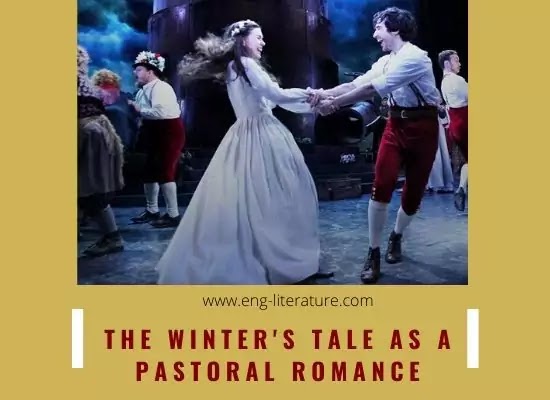
It becomes a pastoral play when the scene shifts to the country-side. It deals with the lives of shepherds and shepherdesses in the country-side. There are songs and dances, spring festivals, wakes and fairs. Shakespeare has given a world of colour and sound. It is all festivity disguised. He simply wants to entertain and please:
“Present mirth hath Present laughter There is nothing hereafter".

In Act-IV of this play we have all those pastoral elements required to be called as a pastoral romance. The scene shifts from the suffocating atmosphere of Leontes' court to the countryside where one can breathe fresh air and witness the ship-shearing festivities. The wooing of Perdita by Florizel has an intense appeal for young readers. Florizel speaks of his love in terms of ancient myths, citing the examples of Jupiter, Neptune and Apollo:
"Became a bull and bellow'd; the green Neptune”.

He describes Perdita as "Flora peering in April's front". All her acts are "queen's". In his eyes; when she dances, he wished that she were a wave of the sea so that she could dance forever.
"When you speak sweet
I'd have you do it ever ...........
................ when you do dance, I wish you
A wave O'th' sea, that you might ever do"

Without her, life would have little meaning for him, even if he were crowned the "most imperial monarch". Perdita loves him with an equal ardor. Her grace, charm and beauty lend an exquisite touch to the scene. She waits to have Florizel "quick and in her arms".
The dance party starts and the Clown dances with his sweet heart Mopsa and other shepherds and shepherdesses too join in the dancing. Florizel catches hold of Perdita by the hand and begins to dance with her signing:
"But come: our dance, I pray,
Your hand, my Perdita: so turtles pair
That never mean to part".

Perdita is shown presenting flowers and garlands to the guests according to their ages. There is a whole cataloguing of different kinds of flowers. Her speech is exquisite poetry, richly sensuous, evoking all the charm and beauty of the English countryside:
"Here's flowers for you:
Hot lavender, mints, savoury, marjoram,
The marigold, that goes to bed with sun
And with him rises, weeping:"

To complete the festivities there is the dance of twelve satyrs. The comic episodes in the play pertain to three characters - Autolycus, the old shepherd and the clown. One is amused by the clown's trying to calculate the total price of the wool obtained from the sheep but giving up the effort because the simple arithmetical sum is baffling to his rustic wit. The manner in which Autolycus gulls him at this time and robs his money is also very amusing. Autolycus' description of himself as a thief and pick-pocket is an instance of light comedy in the play. His posing as a courtier and robbing the old shepherd and the clown of some of their gold is also very funny. The talk the old shepherd and the clown after they have been elevated to the position of two king's kins further add to the comic interest of the play.

Act V provides touching scenes of recognition, reunion, reconciliation and forgiveness. On the old shepherd's producing necessary evidence, Perdita is discovered to be a princess and is united with her father. Leontes is "ready to leap out of himself for joy of his found daughter” and thinks wistfully of Hermione. He asks forgiveness of Polixenes for the for the wrong. Then there is the statue scene where Hermione is found to be still alive. Hermione’s reunion with her husband and her daughter is an even greater event. Hermione forgives her husband, embraces him, and then invokes the blessings of the gods upon her daughter. Finally Leontes announces his decision that Paulina and Camillo will get married. Thus the play has a happy ending for all, which every comedy must have. The grim past is forgotten and a new life begins for everyone.

Nor are the pastoral pictures in Act IV of the play devoid of realism. In fact, Shakespeare, in this play, does not give us an idealized picture of rural life. The sheap-shearing feast, the merry-making and dances, the ballad singing, the roguery of Autolycus and the gullibility of the clown these are true to life. Indeed, if there is any idealization in the play it is to be found in the nobility of characters like Hermione, Antigonus and Paulina. Also it is only the character of Perdita that has been idealized.

To sum up The Winter's Tale as a pastoral romance there is a confrontation of the country and pastoral. As against the first three acts wherein we have postulation, hatred, jealousy and envy- here in we have love, harmony and sympathy. With heart-full of exuberance the hero and heroine indulge themselves in romance. The pastoral is highly idealized to such an extent that whenever we think about the play, the pastoral part resurfaces in our mind overshadowing the country part.

Also Read:


~~~~~*~~~~~
Share:

Follow Me in Social Media

Get Free Updates

Tags

A Doll's House (1) A Renouncing of Love (1) Absurd Drama (2) African English Literature (2) Agyeya (1) Alexander Pope (7) American Literature (26) Amitav Ghosh (3) Analyses (22) Anglo-Saxon Period (1) Aravind Adiga (1) Arthur Miller (5) Australian Literature (2) Beowulf (3) Bertrand Russell (2) Bible (1) Biographies (12) Book Review (2) British Literature (106) Broad Notes (94) Character Analysis (2) Charles Dickens (1) Charles Lamb (2) Charlotte Bronte (2) Chetan Bhagat (2) Chinua Achebe (1) Christopher Marlowe (2) Classical Literature (2) Composition (4) Creative Writing (5) D. H. Lawrence (1) Daniel Defoe (1) Diaspora (4) Drama (1) Dream Children: A Reverie (1) E-book Download (12) Edmund Spenser (1) Edward Fitzgerald (1) Edward II (3) Elizabethan Era (2) English Language (15) English Literature (9) English Literature Quiz (8) Escapism (1) Essay (12) Essays (12) Eugene O'Neill (7) Explanations (3) Feminism (3) Francis Bacon (4) Frankenstein (4) Free E-book Download (5) Free PDF Download (4) Genre (1) Geoffrey Chaucer (1) George Eliot (4) George Herbert (1) George Orwell (1) Girish Karnad (1) Hard Times (1) Heart of Darkness (1) Henrik Ibsen (1) Henry Vaughan (2) Historical Novel (6) History of English Literature (22) Indian Drama (2) Indian English Poetry (1) Indian Fiction (4) Indian Writing in English (34) Indo-Anglican Literature (33) Interesting Facts (9) Interpreter of Maladies (2) Jane Austen (2) Jane Eyre (2) Jayanta Mahapatra (2) Jhumpa Lahiri (3) John Donne (5) John Dryden (1) John Keats (4) Joseph Addison (1) Joseph Conrad (1) Keki N. Daruwalla (1) Kenilworth (3) Kim (1) Knowledge and Wisdom (1) Leo Tolstoy (1) Linguistics (2) Literary Criticism (5) Literary Essay (9) Literary Facts (1) Literary MCQ (4) Literary Photo Album (1) Literary Terms (14) Literary Trends (1) Literary Types (7) Lord of the Flies (1) Lyric (1) M. K. Anand (2) Mac Flecknoe (1) Macbeth (7) Mahadevi Verma (2) Man Eater of Malgudi (2) Mark Twain (1) Mary Shelley (4) Mathew Arnold (1) Midnight's Children (1) Modern Poetry (3) Modernism (1) Motivational Short Story (21) My Penning (1) Nayantara Sahgal (1) Notes (25) Novel (60) Novels (6) O' Henry (1) Ode to a Nightingale (1) Ode to the West Wind (1) Oedipus Rex. Oedipus the King (2) Of Friendship (1) On Fame (1) Online Quiz (8) Othello (1) P B Shelley (1) P. B. Shelley (1) Paulo Coelho (2) Philological Notes (10) Phonetics (3) Picaresque Novel (5) Plays (41) Poetry (52) Popular Literature (1) Post Colonial Literature (1) Post Colonialism (1) Pride and Prejudice (2) Prosody (3) Quiz (6) Quotations (6) R. K. Narayan (2) Rabindranath Tagore (2) Raja Rao (1) Random Quiz (6) Rape of the Lock (5) Realistic Fiction (1) Restoration Era (2) Rhetoric (2) Robert Browning (1) Robinson Crusoe (1) Romantic Poetry (2) Romanticism (2) Rubaiyat of Omar Khayyam (1) Rudyard Kipling (1) Salman Rushdie (2) Samuel Beckett (3) Sarojini Naidu (1) Seven Ages of Man (1) Shakespearean Influence (2) Shakespearean Plays (11) Shakespearean Sonnets (4) Sheridan (4) Short Notes (10) Short Stories (9) Soliloquy (1) Songs of Innocence (1) Sons and Lovers (1) Sophocles (1) Sri Aurobindo (1) Substance Writing (1) Summary (8) Sylvia Plath (1) T. S. Eliot (2) Texts (10) The Adventure of Tom Sawyer (1) The Alchemist (1) The Crucible (3) The Emperor Jones (7) The Golden Light (2) The Guide (1) The Mill on the Floss (4) The Namesake (1) The Pulley (2) The Rivals (5) The Shadow Lines (3) The Sunne Rising (5) The Superannuated Man (1) The Town Week (1) The White Tiger (1) The Winter's Tale (2) Things Fall Apart (1) Thomas Hardy (2) Thomas Wyatt (1) Toni Morrison (6) Tragedy (3) Tughlaq (1) Untouchable (2) Waiting for Godot (2) Walter Scott (3) Way of the World (1) William Blake (2) William Golding (1) William Shakespeare (14) William Wordsworth (3) Word Notes & Annotations (1) Word Notes & Anotations (2)