


All About English Literature: The Crucible

For Exclusive Notes and Analysis

Showing posts with label The Crucible. Show all posts

Tuesday, 31 March 2020

How far the Title of Arthur Miller's Novel, "The Crucible" is justified?

How far the Title of Arthur Miller's Novel, "The Crucible" is justified?

Initially called The Chronicle of Sarah Good, The Crucible is a dramatization of the Salem Witch trial. Arthur Miller uses the title of his play The Crucible as a Metaphor constantly throughout the text. A crucible is a container used to heat metals at a high temperature so the metal can be cast, often using intense pressure to do so. Crucibles are often also used to remove impurities from a substance, so that only the pure matter remains. The relevance of the title is apparent in many of the themes and issues of the play, and is demonstrated through striking imagery and the actions of characters that Miller portrays to us.
The relevance of the play’s title becomes evident during the first act, as we gradually piece together the information concerning the girls dancing. The kettle viewed by Reverend Parris, a argumentative and unreasonable man in his middle forties, mirrors a crucible. We are told that the girls had made a brew that contained a little frog and blood. This concoction was viewed by the characters involved as a potent, fearsome mixture and this signifies the beginning of the Salem tragedy. It seems that from this ‘brew’ a more sinister force is released, or metaphorically speaking, the impurities are released due to the aid of a crucible.
The dancing and the contents of the little pot seem to fuel the rumours, lies and tragedy of Salem. Suspicion soon engulfs the community and the little privacy that once existed suddenly shatters. Privacy was quickly interpreted to mean that people had some terrible fault to hide and there was an intense pressure for neighbours to reveal each other’s sins. Here is evidence of how the play’s title is reflected in the actions and words of the characters.
In fact, Reverend Parris makes an ironic comment that is closely linked with the The Crucible:
Reverend Parris: Why, Rebecca, we may open up the boil of all our troubles today because in the end the witchcraft investigation provokes the burning down and destruction of the community. “
Here The Crucible is once again used metaphorically to illustrate characters beliefs. The use of such words as ‘boil’ and ‘burning down’ are directly linked with the image of a crucible at work.
The witch trials are also metaphorically a crucible for people’s grudges, and their seeking of revenge. The play shows us also how people can give into their fear and superstition. Salem quickly turns into a melting pot of suspicion and vengeance with nearly everyone trying to pull power out of the pot. The witch trials provided an avenue to bring hostilities out into the open in a theocratic society that had little opportunity for speaking out.
The trials are not really about witchcraft. Abigail Williams, a strikingly pretty seventeen-year-old orphan, admits to John Proctor, a well-respected farmer in his mid thirties, how the witchery is a hoax:
Abigail:         We were dancing in the woods last night and my uncle leaped out on us. She took fright, is all”.
Furthermore, the relationship between Abigail and Proctor is highlighted using imagery connected to the concept of a crucible. The relationship, based more on lust than love, is one that Proctor dearly regrets and that constantly plays on his conscience. Heat and fire can be used as symbols that are strongly connected with a crucible, and Miller uses this symbolism cleverly:
Abigail:     “… you clutched my back behind your house and sweated like a stallion whenever I came near!”
And later,
Abigail: “I have a sense for heat, John … and I have seen you … burning in your loneliness.”
The relationship can be likened to the concept of a crucible because it represents the high temperatures and reactions that take place in a crucible. The relationship between Abigail and John is shown in great contrast with his wife Elizabeth, a cold and unforgiving woman. The relationship between John and Elizabeth is cold, distant and tense, with no passion or fire. However, despite his feelings of passion for Abigail, Proctor realizes that he must not succumb to them again. This decision effectively ends their relationship and extinguishes the heat between them.
Fire and heat is used as a symbol once again in Act Three. The Crucible metaphor is illustrated in the play when Judge Danforth, a strict judge with a strong belief in authority, says to Proctor,
Danforth:  We burn a hot fire here; it melts down all concealment”.
The court scenes were times of tension, intensity, pressure and conflicts between powerful authorities refusing to realise they have signed away innocent lives on the strength of a lie. Also things are permanently and physically changed in a crucible, when they are turned from one thing into another. This is reflected in the play by the fact that many characters in the play are exposed to high pressures during the trial. This pushes many characters to the limits of reason and changes them mentally, physically and spiritually.
Another parallel between the word crucible and the play is the fact that a meaning of the word crucible is a severe test or trial. When John Proctor is convicted of witchery he wrestles with his conscience about whether he should confess or be hanged. His internal conflict between the opportunity to protect himself at the expense of others weighs heavily on his mind, but he chooses the ultimate sacrifice - his life. He asks his wife towards the end of The Crucible:
Proctor:  Would you give them such as lie? You would not; if tongs of fire were singeing you, you would not.”
This makes it evident that Proctor recognises his own shortcomings and once again conjures the image of fire that is closely related to a crucible. Miller also uses the text to make connections between Salem and Hell.

Proctor:  A fire, a fire is burning! I hear the boot of Lucifer, I see his filthy face! …. And we will burn, we will burn together!”
Here Miller makes the ultimate connection between the play’s title The Crucible and the society he is portraying. The intense heat and pressure of Hell is also present in a crucible, and both can be associated with the hysteria and suspicion of the people in Salem during the witch trials.
The obvious relevance of The Crucible can be found at the very core of the text. A crucible can be used to separate and discard impurities the in a substance - in effect, that was the essence of the Salem witch trials. In an attempt to separate the ‘good from the bad’, many respectable and virtuous people were hung due to the mass hysteria and pressure caused by ‘The Crucible’ of the times.
By reflecting his play’s powerful and effective title throughout the text, Miller prompts his audience to apply his metaphor to other situations in history. It was most certainly Miller’s own experiences during the ‘communist hunt’ of the 1950’s that provoked him to write this play. Miller saw the parallels between the McCarthy era and the Salem witch hunts for what they really were - a crucible. Severe trials held in an attempt to separate the good from the evil, the pure from the tainted. Through his text, he shows the frailty and vulnerability of human nature by showing how hypocrisy and hysteria can lead to times of suspicion and instability. He leaves us, his audience, to make our own judgement about similar periods in history and to ask ourselves the question - Is it possible, or even predictable, that this situation will ever occur again?

 ~~~~~*~~~~~
Share:

Monday, 30 March 2020

Analyse the Character of Abigail Williams in Arthur Miller's "The Crucible" or Discuss Why Miller calls Abigail Williams "the prime mover of Salem hysteria"?

Analyse the Character of Abigail Williams in Arthur Miller's "The Crucible"

Miller says that the “structure” of The Crucible “centres on John, Elizabeth, and Abigail.” Reverend Parris’s niece Abigail has been dismissed from service by Elizabeth Proctor after she found out the illicit affair between Abigail and her husband seven months ago. Since then Abigail has been living with Parris. But she still lusts for Proctor and, by involving his wife in the rampant rumored practices of witchcraft in Salem and getting her hanged, she plots to become Proctor's wife. She thus orchestrates the behaviour of the girls who follow her blindly in raising the bogey of witchcraft and by involving several innocent citizens in the witch hunt. Her motivation is a blend of private vengeance and desire. She proves that people's terror could be manipulated to meet her own selfish ends.

Abigail Williams, Reverend Parris's seventeen-year-old niece and antagonist of the play, is a "strikingly beautiful girl ... with an endless capacity for dissembling". The sexual repression of the times drives Abigail and a group of teenage girls to secret outings in the woods, where they dance naked. When Parris spies them, guilt and fright cause two of them, Ruth Putnam and Betty Parris, either to pretend or experience catatonia. Betty lies mysteriously ill and Parris is worried because Doctor Gregory has failed to diagnose the cause of her illness. News spreads fast, hymn-singing villagers crowd the parlor below, and Reverend Hale arrives, summoned as an expert on witchcraft. But Abigail tells Parris, "It were sport, uncle!" When her accomplices Marry Warren and Mercy Lewis arrive, Abigail bullies them into submission. Later as the girls are questioned, Abigail, to clear her own name, accuses, as a tool of the Devil, Parris's black West Indian slave Tituba.

She keeps up the pretense that her name is "good", it is not "soiled", and there is “no blush" about her "name". She was dismissed by Good Proctor, "a gossiping liar" and "a bitter woman, a lying, cold sniveling woman" because she refused to "slave" for her. As for her not being able to find a job after that, she loftily declares:

“They want slaves, not such as I. Let them send to Barbados for that. I will not black my face for any of them.”

But she stands “as though on tiptoe, absorbing his presence, wide eyed", when John Proctor enters. She had a brief affair with him seven months ago when she worked as his housemaid and was dismissed by Elizabeth Proctor when she discovered it. She entreats John, “Give me a word, John, a soft word. A brief exchange between them reveals Abigail's desire for John, her hatred for his wife Elizabeth, and her determination not to resume the relationship. She reminds him:

“I know how you clutched my back behind your house and sweated like a stallion whenever I come near! ... I saw your face when she put me out, and you loved me then and you do now!”

He has also been standing below her window for the past seven months at nights and looking up, "burning in your loneliness". Proctor reluctantly admits that:

“Abby, I may think of you softly from time to time. But I will cut off my hand before I'll ever reach for you again.”

But she persists. Bursting into tears, she tells him, “I look for John Proctor that took me from my sleep and put knowledge in my heart!...You loved me, John Proctor, and whatever sin it is, you love me yet! ... John, pity me, pity me!”

Her past illicit relationship has driven a wedge between John and his wife; she still does not trust him. She believes, and rightfully so, that Abigail has raised the bogey of witchcraft in order to accuse her and get her hanged so that she can take her place in John's life and household. Elizabeth wants her husband to go and tell Ezekiel Cheever, the tailor turned warrant officer of the court.

The second scene in Act Two, deleted from the published text, reveals more about both Abigail and John. Abigail's opportunism has been evident since the opening scene, when she deflects to Tituba Hale's questions. She is amoral, with no concern for the good-hearted servant, whom she herself asked for a charm but whom she now denounces as a witch.

The change in Abigail is apparent to proctor, as she tells him, “The jab your wife gave me’s not healed yet”, referring to the disproved needle in the poppet.

While John’s conscience suffers for his adultery and for jeopardizing Elizabeth’s life, his guilt can only be intensified by Abby’s outburst as she vows, “Oh, John, I will make you such a wife when the world is white again.”

She then starts shivering and pretends that Mary Warren has sent her spirit in the form of a yellow bird up to the ceiling of the court room and that she is frozen by the cold wind. Touching her hand, Judge Hathorne confirms this. The other girls also start seeing the yellow bird on the ceiling which has come to attack them, and they are equally terrified. So is Danforth as Proctor keeps protesting: “They're pretending!" Mary Warren is so affected by the shivering girls that she appears to have been hypnotized. She starts pleading: "Lord save me! ... Abby, don't do that!" She becomes hysterical and rushes toward the door as Proctor tried to hold her. So strong is Abigail's malevolent influence that she ends up by retracting her testimony and accusing Proctor of practising witchcraft on her as Abigail looks up and cries, "Oh, Heavenly Father, take away this shadow!" Proctor is taken aback at this sudden turn of events. He roars at her: "How do you call Heaven! Whore! Whore!"

Danforth is "dumbfounded” but Abigail coolly tells him that Proctor is lying. He then confesses to lechery and charges her to falsely accusing his wife of witchcraft and getting her hanged.

Proctor is supported in her display of hysterics by Reverend Hale, who is by now disgusted with the court proceedings and who eventually quits the trial: “1 believe him! ... This girl has always struck me as false.” Abigail again whips up the hysteria of being attacked by the yellow bird on the ceiling. The others join her and start screaming. John Proctor is proclaimed as “the Devil’s man”, arrested and eventually hanged for practising witchcraft on Mary Warren.
The last we hear of Abigail is when a crestfallen Proctor informs Danforth that Abigail has robbed him of 31 pounds and fled with Mercy Lewis. Opportunistic to the last, she provided for her sea trip by breaking open his strongbox and decamping with nearly his half-year’s salary. In the epilogue we are informed: “The legend has it that Abigail turned up later as a prostitute in Boston.”

Sometimes literature throws us a bone in the form of a really awesome antagonist. Someone we hate ... but find totally magnetic. Someone who chills us to the core ... but we can't stop watching. Abigail Williams is vengeful, selfish, manipulative, and a magnificent liar. This strikingly beautiful young lady of seventeen years old seems to be uniquely gifted at spreading death and destruction wherever she goes. She has an eerie sense of how to manipulate others and gain control over them. She is the pebble that gets the avalanche of the Salem witch trials started. She sends nineteen innocent people to their deaths. These things make her an awesome antagonist.
In addition to being an accomplished liar, Abigail is also extremely single-minded. When she wants something, she goes for it; if one method doesn't work, she's happy to go with Plan B. A good example of this is Abigail's pursuit of John Proctor. Because Abigail wants John Proctor for herself, she gets Tituba to make her a potion to kill Goody Proctor. When that doesn't work, she pleads with John to take her back; when that doesn't work she accuses Elizabeth of witchcraft and manages to get her arrested.
An easy, surface explanation of Abigail's character is to label her as a calculating sociopath, and there is some evidence that supports this claim. In Act 1, Abigail does seize upon the opportunity to divert blame from herself to first Tituba and Ruth, then just Tituba, then to women with questionable reputations like Sarah Good, Goody Osburn, and Bridget Bishop. She doesn't care at all about the fates of the women being blamed - she's just accusing them to further her own ends. 
For Miller, Abigail, says David Levin, is “a vicious wench who not only exploits her chance to supplant Elizabeth Proctor when the time comes, not only maintains a tyrannical discipline among the afflicted girls, but also sets the entire cycle of accusations in motion for selfish reasons”.
 Awaiting for your precious feedback. Thank you.
~~~~~*~~~~~
Share:

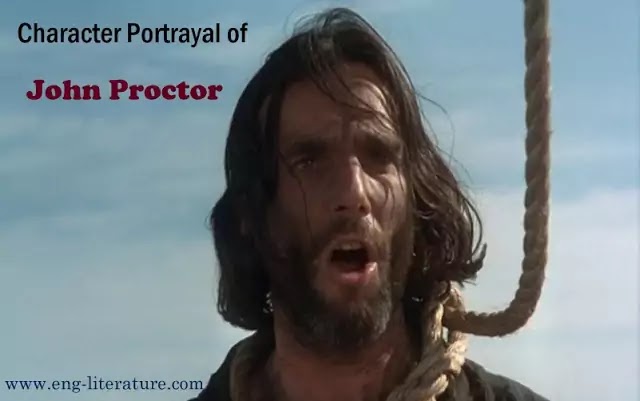
Character Portrayal of John Proctor in Arthur Miller's Play, "The Crucible"

Character Portrayal of John Proctor in Arthur Miller's Play, "The Crucible"
"John Proctor stands unique amongst Miller’s creation not because of any inherent superiority but because of the intensity of his moral response."
In Arthur Miller’s The Crucible, John Proctor is the central character and the protagonist of the play. Miller gives very delicate touches in digging the subtle ties of Proctor’s relationship with his wife, Elizabeth and Abigail. Miller also shows very skillfully Proctor’s attitude towards Puritans, witchcraft, court and toward his friends in the end when he was going to be punished for being a witch.
Although, Proctor is the central figure yet he has been idealized as a hero. He is a blunt, stubborn countryman, though not excessively sensitive yet capable of being tender, especially towards women According to John Mahonery:
“The attention of the playwright is on Proctor’s moral choice.”
Miller, himself, says in his introduction of the play that he wants to draw the image of ‘a guilt ridden man’ who has a sense of guilt that he has betrayed his wife, Elizabeth by playing adultery with Abigail, who is a very cunning fraudulent girl. And this guilt forces him to take positive action at the right moment and consequently suffers a great loss of his life.
Then Proctor is a practical fanner, struggling to manage living for his family. He is a physically strong man, cool tempered and not so easily provoked. He emerges as a down-to-earth man who speaks his mind and is not afraid in confronting those in front of the authority - the authority of society, priest and the court. Only his guilt of all with Elizabeth keeps him indecisive till the very end.
John Proctor is also good independent minded Christian who is fed-up from dogmatic and the strict values of the church only in order to maintain their authority. He also does not care his infrequent presence in church. He openly condemns Parris and his greedy and hellish Sermons. It is Parris’ hellish preaching which prompts John Proctor to stay away from Church and explain his absence as follows:
“1 have troubled enough, I come five miles to hear him preach only hellfire and bloody damnation.., others stay away from church these days because you (Parris) hardly ever mention God anymore.”
He is an honest man and sees himself as a sinner and unworthy to follow the martyrs like Rebecca and Giles.
Proctor never interferes with the affairs of others. Miller gives his social views that man can’t isolate himself from the trials of community, society, and the man, who refuses to be committed to some cause, will face tragic result. If a man is to be a part of society, he must function and participate in all the aspects of society.
Proctor tries to avoid any involvement in Salem witchcraft trials. He is afraid of the disclosure of his secrets of adultery with Abigail which was probably no more than a moment of passion prompted by the impetuosity and it also characterizes many of his other actions and speeches.
John Proctor retains a very strict attitude towards witchcraft. He does not believe in it and takes it as an irrational act. He does not want to be involved in the court probe about witchcraft but at the end he has to do so. When he learns that Elizabeth has been accused, he says:
“Is the accuser always holy now? Were they born this morning as clean as God’s fingers? I’ll tell you what’s walking in Salem vengeance. We are what we always were in Salem but now the little crazy children are jangling the keys of the kingdom and comfort vengeance writes the law!”
But in the end, we see that Procter is accused of being a witch because of his rebellion against the church and the court. He wants to prove the fraudulent behaviour of the girls but he is accused in return. He is sentenced to death if he does not confess to be a witch. At first, because of the pressure on him he becomes agreed to confess and signs it but his innocent soul does not let him to confess, therefore, he tears out confession. He says:
“Because it is my name! Because I cannot have another in my life! Because I am not worth the dust on the feet of them that hang! How may I live without my name? I have given you my soul; leave me my name.”
He does not want to lose his true identity and to be called a witch. Therefore, he sacrifices his body and saves his soul.
Once Proctor abandons the society at its own, but society does not let him maintain himself in the critical junctures of his life. He remains in a critical and complex situation of hope and fear and life and death. He remains caught up in a web of moral dilemmas woven by society. He requires an enormous moral courage to make right choice, the choice which makes all the difference, and we see that Proctor chooses his soul. This is what Miller wants to tell us. He says: 
“My central impulse for writing at all was not the social but the interior psychological question.
Don't for get to share your experience on this article. Thank you.
~~~~~ *~~~~~
Share:

Follow Me in Social Media

Get Free Updates

Tags

A Doll's House (1) A Renouncing of Love (1) Absurd Drama (2) African English Literature (2) Agyeya (1) Alexander Pope (7) American Literature (26) Amitav Ghosh (3) Analyses (22) Anglo-Saxon Period (1) Aravind Adiga (1) Arthur Miller (5) Australian Literature (2) Beowulf (3) Bertrand Russell (2) Bible (1) Biographies (12) Book Review (2) British Literature (106) Broad Notes (94) Character Analysis (2) Charles Dickens (1) Charles Lamb (2) Charlotte Bronte (2) Chetan Bhagat (2) Chinua Achebe (1) Christopher Marlowe (2) Classical Literature (2) Composition (4) Creative Writing (5) D. H. Lawrence (1) Daniel Defoe (1) Diaspora (4) Drama (1) Dream Children: A Reverie (1) E-book Download (12) Edmund Spenser (1) Edward Fitzgerald (1) Edward II (3) Elizabethan Era (2) English Language (15) English Literature (9) English Literature Quiz (8) Escapism (1) Essay (12) Essays (12) Eugene O'Neill (7) Explanations (3) Feminism (3) Francis Bacon (4) Frankenstein (4) Free E-book Download (5) Free PDF Download (4) Genre (1) Geoffrey Chaucer (1) George Eliot (4) George Herbert (1) George Orwell (1) Girish Karnad (1) Hard Times (1) Heart of Darkness (1) Henrik Ibsen (1) Henry Vaughan (2) Historical Novel (6) History of English Literature (22) Indian Drama (2) Indian English Poetry (1) Indian Fiction (4) Indian Writing in English (34) Indo-Anglican Literature (33) Interesting Facts (9) Interpreter of Maladies (2) Jane Austen (2) Jane Eyre (2) Jayanta Mahapatra (2) Jhumpa Lahiri (3) John Donne (5) John Dryden (1) John Keats (4) Joseph Addison (1) Joseph Conrad (1) Keki N. Daruwalla (1) Kenilworth (3) Kim (1) Knowledge and Wisdom (1) Leo Tolstoy (1) Linguistics (2) Literary Criticism (5) Literary Essay (9) Literary Facts (1) Literary MCQ (4) Literary Photo Album (1) Literary Terms (14) Literary Trends (1) Literary Types (7) Lord of the Flies (1) Lyric (1) M. K. Anand (2) Mac Flecknoe (1) Macbeth (7) Mahadevi Verma (2) Man Eater of Malgudi (2) Mark Twain (1) Mary Shelley (4) Mathew Arnold (1) Midnight's Children (1) Modern Poetry (3) Modernism (1) Motivational Short Story (21) My Penning (1) Nayantara Sahgal (1) Notes (25) Novel (60) Novels (6) O' Henry (1) Ode to a Nightingale (1) Ode to the West Wind (1) Oedipus Rex. Oedipus the King (2) Of Friendship (1) On Fame (1) Online Quiz (8) Othello (1) P B Shelley (1) P. B. Shelley (1) Paulo Coelho (2) Philological Notes (10) Phonetics (3) Picaresque Novel (5) Plays (41) Poetry (52) Popular Literature (1) Post Colonial Literature (1) Post Colonialism (1) Pride and Prejudice (2) Prosody (3) Quiz (6) Quotations (6) R. K. Narayan (2) Rabindranath Tagore (2) Raja Rao (1) Random Quiz (6) Rape of the Lock (5) Realistic Fiction (1) Restoration Era (2) Rhetoric (2) Robert Browning (1) Robinson Crusoe (1) Romantic Poetry (2) Romanticism (2) Rubaiyat of Omar Khayyam (1) Rudyard Kipling (1) Salman Rushdie (2) Samuel Beckett (3) Sarojini Naidu (1) Seven Ages of Man (1) Shakespearean Influence (2) Shakespearean Plays (11) Shakespearean Sonnets (4) Sheridan (4) Short Notes (10) Short Stories (9) Soliloquy (1) Songs of Innocence (1) Sons and Lovers (1) Sophocles (1) Sri Aurobindo (1) Substance Writing (1) Summary (8) Sylvia Plath (1) T. S. Eliot (2) Texts (10) The Adventure of Tom Sawyer (1) The Alchemist (1) The Crucible (3) The Emperor Jones (7) The Golden Light (2) The Guide (1) The Mill on the Floss (4) The Namesake (1) The Pulley (2) The Rivals (5) The Shadow Lines (3) The Sunne Rising (5) The Superannuated Man (1) The Town Week (1) The White Tiger (1) The Winter's Tale (2) Things Fall Apart (1) Thomas Hardy (2) Thomas Wyatt (1) Toni Morrison (6) Tragedy (3) Tughlaq (1) Untouchable (2) Waiting for Godot (2) Walter Scott (3) Way of the World (1) William Blake (2) William Golding (1) William Shakespeare (14) William Wordsworth (3) Word Notes & Annotations (1) Word Notes & Anotations (2)