
All About English Literature: Jane Eyre

For Exclusive Notes and Analysis

Showing posts with label Jane Eyre. Show all posts

Saturday, 2 May 2020

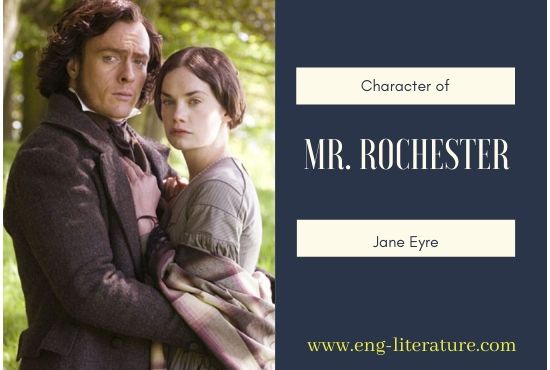
Character Analysis of Edward Rochester in Jane Eyre

Character Analysis of Edward Rochester in Jane Eyre
How is Mr Rochester presented in Jane Eyre?


Mr. Edward Fairfax Rochester does not strike us as a very amiable man when we first meet him; and even afterwards we do not feel that he is adorable as a hero in a novel is generally expected to be. He is by no means a handsome man; and he is no longer young when he falls in love with a girl who is barely half his age. Thus we are likely to frown at the love-affair which develops between him and the eighteen-year-old Jane Eyre.

At the outset, he seems to us to be a serious-minded and harsh man with a sullen disposition. He has always treated his ward, Adele with kindness and generosity, and yet he often becomes impatient when she tries to talk to him freely. His initial conversations with Jane also show him to be a rather staid kind of man or a man who is all the time stiff and even inflexible.

Mr. Rochester’s Reckless Past

There is another unpleasant aspect of his personality, and, in fact, this is an even more unpleasant aspect than his harsh nature and apparently unsocial attitude to life. This unpleasant feature of his character is the dissolute life which he has led in the past. He has had several amours or improper sexual relationships with women. Of course, he gives Jane enough reasons to justify his deviations from the code of social morality. But his account of his past love-affairs certainly leaves an unpleasant taste in our mouths.

Mr. Rochester’s Betrayal of Jane's Trust in Him

Is Mr Rochester a villain? 

In one respect, he is likely to appear to most readers as almost a villain. He has hidden from every inmate of Thornfield Hall, with the sole exception of a maidservant of the name of Grace Poole, the fact that he is an already married man with a wife who is still alive and who is living in that very house in which he resides. His keeping this fact a secret from everybody is no offence, morally or legally. But he becomes guilty of a serious offence, both morally and legally, when he hides the fact of being already married from Jane with whom he has fallen ardently and passionately in love, and when, furthermore, he tries to marry once more and thus commit bigamy.

Mr. Rochester’s Redeeming Qualities

Is Mr Rochester a sympathetic character?

All this shows the dark side of Mr. Rochester's character. But he does have certain redeeming qualities. Beneath his harsh nature, is his capacity to laugh, to make others laugh, to make merry, to entertain people, and to perform acts of kindness. He is extraordinarily kind to Adele even though she is in no way related to him. He has a strong sense of humour, and he can make witty remarks. He keeps his guests amused by devising all sorts of entertainments for them such as charades. His sense of humour is also revealed to us by his assuming the disguise of an old gypsy woman to befool his guests.

Mr. Rochester’s Passionate Love for Jane; and His Constancy in Love

His chief redeeming quality, however, is his passionate love for Jane, and his constancy in love. The whole world, they say, loves a lover. Mr. Rochester is an ardent lover who yearns for Jane even though he does not, for quite some time, let her know about the passion which is raging in his breast. It is when he proposes marriage to her that he shows his fervor in love. He tells her that he loves her as much he loves his own flesh; and he then urges her to say "yes" to his proposal without a moment's delay. There is not only urgency in his proposal of marriage but an intensity of passion. Later, when the marriage ceremony has been abandoned, and when Jane has decided to quit Thornfield Hall, he appeals to her not to forsake him. But her mind is made up. He then entreats, implores her, and even threatens to use violence against her, all because he does not want to lose her. Thus, as a lover, he certainly earns our regard and esteem.

Mr. Rochester : An “Impossible" Character

Mr. Rochester has been regarded by many critics as an "impossible" character, and we partly share this view. He has basically a jovial, almost gay, nature; but outwardly he assumes a look of harshness and even severity. He is an excellent singer, an excellent player on the piano, and an excellent entertainer, and yet his outward solemnity and gloom is a mask which he wears.

Mr. Rochester is a unique kind of man, as Jane Eyre is a unique kind of woman. A man, who is forty years old, has captured the heart and fancy of a girl who is only twenty years old. There must be indeed something fascinating about him. Edward Rochester belongs quite simply to the great family of Mirabeau (a French statesman), stormy, equivocal, powerful, and attractive.
~~~~~*~~~~~
Share:

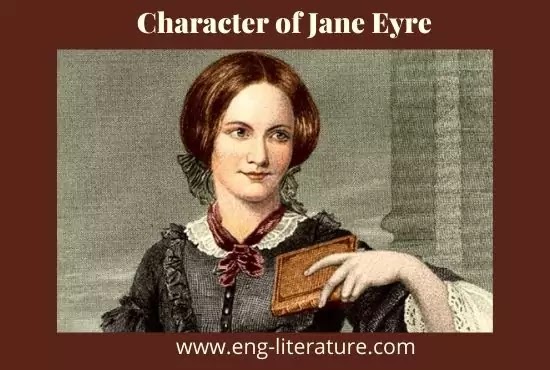
Character of Jane Eyre

Character of Jane Eyre

What kind of character is Jane Eyre?

The portrayal of the heroine Jane Eyre is one of Charlotte Bronte’s greatest achievements in the arena of English fiction. Jane Eyre has been made to live before us in the pages of the novel; and the manner, in which an account of her life and her actions has been written by the author, would leave an indelible mark upon the mind of every reader.

Jane Eyre : Her Spirit of Defiance and Revolt

The first trait of Jane Eyre's character, which we note at the very outset and which she continues to display throughout her career, is her spirit of defiance and revolt. Jane Eyre, as a ten-year-old girl, rebels against Mrs. Reed’s cruel treatment of her. Subsequently, she has to endure the degradation and the humiliation to which she is subjected by Mr. Brocklehurst at Lowood School. She is in no position to defy the director of the school, but she begins to detest and abhor this man. At Thornfield Hall, she tells Mr. Rochester that he has no right to give her orders and commands just because he pays her a salary. At Moor House she refuses St. John's repeated proposal of marriage and does not surrender to him despite the pressure which he exerts upon her.

Also Read:

Jane Eyre : Her Passionate Nature, and Her Constancy in Love

Jane has a passionate nature; and, when she falls under the spell of Mr. Rochester's magnetic personality, she becomes deeply devoted to him. Her love for him is so intense that he seems to her to be the most handsome man, even though he is, by his appearance, one of the most unattractive males. Here she aptly says to herself that beauty lies in the eyes of the gazer or the beholder. She finds Mr. Rochester to be a fascinating man, and her love for him becomes profound. Here we also perceive Jane's unconventional attitude to life, not only because she has fallen in love with a physically unattractive man but because she has fallen in love with a man who is twice her age. Her love for him is not a passing fancy as would have been the case with a girl of a superficial nature. Her love has an abiding quality, and it continues even after she leaves Thornfield Hall and forsakes Mr. Rochester under the compulsions of her conscience. Eventually, of course, she is united with him, and finds perfect bliss in her conjugal life with him.

Jane Eyre : Her Sense of the Dignity of Her Sex

Jane has a strong sense of her dignity, and this sense of her own dignity actually shows her sense of the dignity of her sex. This sense of the dignity of her sex shows that she does not regard woman as a commodity whom a man can acquire by his status or wealth. Here is voice of Jane charged with strong piece of feminism:

“Do you think I am an automaton? — a machine without feelings? and can bear to have my morsel of bread snatched from my lips, and my drop of living water dashed from my cup? Do you think, because I am poor, obscure, plain, and little, I am soulless and heartless? You think wrong! — I have as much soul as you — and full as much heart! And if God had gifted me with some beauty and much wealth, I should have made it as hard for you to leave me, as it is now for me to leave you. I am not talking to you now through the medium of custom, conventionalities, nor even of mortal flesh: it is my spirit that addresses your spirit; just as if both had passed through the grave, and we stood at God's feet, equal — as we are!”

When Mr. Rochester urges her not to forsake him but to live with him as his companion or his mistress, she declines this proposal and quits Thornfield Hall even though she has not ceased love Mr. Rochester. In taking this step, she appears to us as an upholder the dignity of her sex and as a champion of the rights of women.

Jane Eyre : Her Sympathetic Nature and Her Generosity

Jane is basically a sympathetic person. In fact, she is large-hearted generous. Her friendship with Helen Burns at Lowood School is based on her sympathy for that girl who is the very embodiment of piety and humility. The manner, in which Jane distributes her legacy of twenty thousand pounds equally among her three cousins and herself, shows her generosity as well as her desire for family affections and attachments.

Jane Eyre : Her Courage and Fortitude

Jane goes through the vicissitudes of her life with great courage and fortitude. An ordinary girl would have given way to despair, and would have sunk beneath the weight of her misfortunes. An ordinary girl would certainly have succumbed to the temptation of living with Mr. Rochester as his mistress or subsequently, have agreed to marry St. John in order to lead a financially viable, if not prosperous, life. But she gives evidence of her extraordinary powers of endurance under all circumstances. She proves herself to be an enterprising girl capable of taking initiatives.

Emily Montegut, a critic has expressed the view that Jane Eyre, Rochester, and St. John River's are three characters drawn from human nature at its grandest. Superior to her sorry outward appearance, superior to her humiliating situation, and superior to the blows of fate, Jane is one of those women who are equal to all the vicissitudes of life. She loves only strength, energy, and freedom. Another critic describes Jane as one of the most unforgettable heroines of all times, adding that she is a penniless orphan of sharp wit and independent spirit, although outwardly of plain appearance.

Also Read:

Share:

Follow Me in Social Media

Get Free Updates

Tags

A Doll's House (1) A Renouncing of Love (1) Absurd Drama (2) African English Literature (2) Agyeya (1) Alexander Pope (7) American Literature (26) Amitav Ghosh (3) Analyses (22) Anglo-Saxon Period (1) Aravind Adiga (1) Arthur Miller (5) Australian Literature (2) Beowulf (3) Bertrand Russell (2) Bible (1) Biographies (12) Book Review (2) British Literature (106) Broad Notes (94) Character Analysis (2) Charles Dickens (1) Charles Lamb (2) Charlotte Bronte (2) Chetan Bhagat (2) Chinua Achebe (1) Christopher Marlowe (2) Classical Literature (2) Composition (4) Creative Writing (5) D. H. Lawrence (1) Daniel Defoe (1) Diaspora (4) Drama (1) Dream Children: A Reverie (1) E-book Download (12) Edmund Spenser (1) Edward Fitzgerald (1) Edward II (3) Elizabethan Era (2) English Language (15) English Literature (9) English Literature Quiz (8) Escapism (1) Essay (12) Essays (12) Eugene O'Neill (7) Explanations (3) Feminism (3) Francis Bacon (4) Frankenstein (4) Free E-book Download (5) Free PDF Download (4) Genre (1) Geoffrey Chaucer (1) George Eliot (4) George Herbert (1) George Orwell (1) Girish Karnad (1) Hard Times (1) Heart of Darkness (1) Henrik Ibsen (1) Henry Vaughan (2) Historical Novel (6) History of English Literature (22) Indian Drama (2) Indian English Poetry (1) Indian Fiction (3) Indian Writing in English (33) Indo-Anglican Literature (32) Interesting Facts (9) Interpreter of Maladies (2) Jane Austen (2) Jane Eyre (2) Jayanta Mahapatra (2) Jhumpa Lahiri (3) John Donne (5) John Dryden (1) John Keats (4) Joseph Addison (1) Joseph Conrad (1) Keki N. Daruwalla (1) Kenilworth (3) Kim (1) Knowledge and Wisdom (1) Leo Tolstoy (1) Linguistics (2) Literary Criticism (5) Literary Essay (9) Literary Facts (1) Literary MCQ (4) Literary Photo Album (1) Literary Terms (14) Literary Trends (1) Literary Types (7) Lord of the Flies (1) Lyric (1) M. K. Anand (2) Mac Flecknoe (1) Macbeth (7) Mahadevi Verma (2) Man Eater of Malgudi (2) Mark Twain (1) Mary Shelley (4) Mathew Arnold (1) Midnight's Children (1) Modern Poetry (3) Modernism (1) Motivational Short Story (21) My Penning (1) Nayantara Sahgal (1) Notes (25) Novel (60) Novels (5) O' Henry (1) Ode to a Nightingale (1) Ode to the West Wind (1) Oedipus Rex. Oedipus the King (2) Of Friendship (1) On Fame (1) Online Quiz (8) Othello (1) P B Shelley (1) P. B. Shelley (1) Paulo Coelho (2) Philological Notes (10) Phonetics (3) Picaresque Novel (5) Plays (41) Poetry (52) Popular Literature (1) Post Colonial Literature (1) Post Colonialism (1) Pride and Prejudice (2) Prosody (3) Quiz (6) Quotations (6) R. K. Narayan (2) Rabindranath Tagore (2) Random Quiz (6) Rape of the Lock (5) Realistic Fiction (1) Restoration Era (2) Rhetoric (2) Robert Browning (1) Robinson Crusoe (1) Romantic Poetry (2) Romanticism (2) Rubaiyat of Omar Khayyam (1) Rudyard Kipling (1) Salman Rushdie (2) Samuel Beckett (3) Sarojini Naidu (1) Seven Ages of Man (1) Shakespearean Influence (2) Shakespearean Plays (11) Shakespearean Sonnets (4) Sheridan (4) Short Notes (10) Short Stories (9) Soliloquy (1) Songs of Innocence (1) Sons and Lovers (1) Sophocles (1) Sri Aurobindo (1) Substance Writing (1) Summary (8) Sylvia Plath (1) T. S. Eliot (2) Texts (10) The Adventure of Tom Sawyer (1) The Alchemist (1) The Crucible (3) The Emperor Jones (7) The Golden Light (2) The Guide (1) The Mill on the Floss (4) The Namesake (1) The Pulley (2) The Rivals (5) The Shadow Lines (3) The Sunne Rising (5) The Superannuated Man (1) The Town Week (1) The White Tiger (1) The Winter's Tale (2) Things Fall Apart (1) Thomas Hardy (2) Thomas Wyatt (1) Toni Morrison (6) Tragedy (3) Tughlaq (1) Untouchable (2) Waiting for Godot (2) Walter Scott (3) Way of the World (1) William Blake (2) William Golding (1) William Shakespeare (14) William Wordsworth (3) Word Notes & Annotations (1) Word Notes & Anotations (2)

Blog Archive