All About English Literature: Rape of the Lock

For Exclusive Notes and Analysis

Showing posts with label Rape of the Lock. Show all posts

Sunday, 5 April 2020

Summarise the speech of Clarissa in Canto V, "Rape of the Lock" and it's significance


Speech of Clarissa
When Belinda bewails her lot and curses herself for having come to the Hampton Court despite all the 'omens', the grave Clarissa, in a neat little speech exhorts her to moderation and good sense. She points out that all feminine vanities and foibles are in efficacious against death. A beautiful woman may win the praise and adoration of males, wear splendid dress, dance all night, attend theatres, where she is the target of many furtive glances and bows from side-boxes and so on. But vain are all these unless good sense is added to beauty, unless men can say about the woman -'Behold the first in virtue as in face'. It is not possible to prevent small-pox, which is the scourge of beauty or chase old age away by dancing and dressing all night and day. Therefore, since beauty is subject to decay and locks of hair will turn white and 'she who scorns a man, must die a maid', it is better to take things in good grace and good humour. Clarissa exhorts Belinda to show good sense and win the souls of men, instead of indulging in airs, screams and recriminations.

Pope's note on Clarissa and her speech runs thus-"A new character introduced in the subsequent editions to open more clearly the moral of the poem, in a parody of the speech of Sarpedon to Glaucus in Homer." The speech strikes a sad and serious note that runs as undercurrent throughout the whole poem - fragility of feminine beauty and hence the utter worthlessness of feminine pride and vanity. After all it is virtue that counts and 'the first in virtue is the first in face'. This is a bit of moral advice that the grave lady offers to Belinda to open her eyes and make her calm. After all women must marry if they want to be happy and she who scorns a man, must die a maid. Pride and ill-humour cannot win suits. The inevitability of death is the commonplace maxim in the speech of the epic hero Sarpedon and the modern woman of fashion. It is the supreme truth of all times and this binds together all civilizations into a link. 

Thus the speech, as a critic has pointed out,"complicates our response to the satire of the poem. We see that as well as satirising a world Pope also celebrates and mourns it. It is complications of this sort that takes The Rape of the Lock beyond the range of Le Lutrin into the region of great poetry.”

Also Read:

·         Pope's use of Supernatural Machinery in the poem "The Rape of the Lock" 

·         Discuss and comment upon the necessity and value of the game Ombre in Pope's "The Rape of the Lock".


~~~~~*~~~~~
Share:

Description and Significance of Cave of Spleen in Pope's "The Rape of the Lock"

Description and Significance of Cave of Spleen in Pope's "The Rape of the Lock"

Significance of Cave of Spleen
When after the cutting of the lock of hair, the Baron exults over his great achievement and Belinda gives way to rage, resentment and despair, Ariel withdraws and Umbriel, a mischievous and trickstering gnome takes charge of her. In consonance with an epic convention, the poet makes Umbriel go down to the underworld, where in a dark and vapoury region stands the gloomy Cave of Spleen. It was a dismal cave, vaulted with vapour. No cheerful breeze blows over the place; the only wind is the east wind that causes moroseness. Sunlight cannot penetrate into the cave. There Spleen lies on a pensive bed, sighing for ever with Pain at her side and Megrin at head i.e., side pain and headache). Two handmaids attend on her. They are Ill-nature and Affectation. The former is an old maid, with wrinkled skin and is arrayed in black and white clothes. Her hands are full of prayers for different times of the day, while her heart is full of abusive satires. Affectation is slim and sickly. She pretends to be young, paints her cheeks, talks in lisping manners, hangs her body aside in an affected pose, faints on her bed only for show of illness or sinks in exhaustion to show her pride. 

The cave is always filled with vapour and various fantastic images rise in mists in that place. Glaring fiends, snakes standing erect on their 153 coils, pale ghosts, gaping tombs etc. abound in the cave. Human beings changed into various forms under the effect of melancholy throng there. Thus there is the woman who thinks herself to be teapot, holds out one arm and bending the other, there is another who imagines herself as an earthen jar, another as a bottle etc. There is a man who thinks that he has become pregnant.

This episode of the Cave of Spleen is a parody of a well-known epic feature namely descent into the underworld by living men. Thus in Homer's Odyssey ix, Ulysses (Odyssey) descends into the dark Hades and in Virgil's Aeneid vi, Aeneas does the same. The poet derives the description of the Cave of Spleen, from the Cave of Envy in Ovid's Metamorphoses. The various fantastic images that are catalogued here illustrate the unhealthy and distorted lives that men and women live under the effect of hypochondria, ennui, sexual frustration, etc. These indicate the lurking fear of the horrible possibilities that may develop in the beaux and belles under frustration and under which they are always labouring. Thus beneath the outward veneer of gaiety, glitter and beauty of the care-free lives of the beau-monde, there are mental disorders produced by inhibited sex life. There is the figure of III-nature personified as an 'ancient maid', with hands always full of prayer and heart full of satires. This is the threatened fate of a disdainful belle - "she who scrons a man, must die a maid," as Clarissa says. "The whole episode must profoundly affect our view of Belinda herself."

Also Read:

·         Pope's use of Supernatural Machinery in the poem "The Rape of the Lock" 

·         Discuss and comment upon the necessity and value of the game Ombre in Pope's "The Rape of the Lock".

 ~~~~~*~~~~~
Share:

Thursday, 2 April 2020

Discuss and comment upon the necessity and value of the game Ombre in Pope's "The Rape of the Lock".

game Ombre in Pope's "The Rape of the Lock".

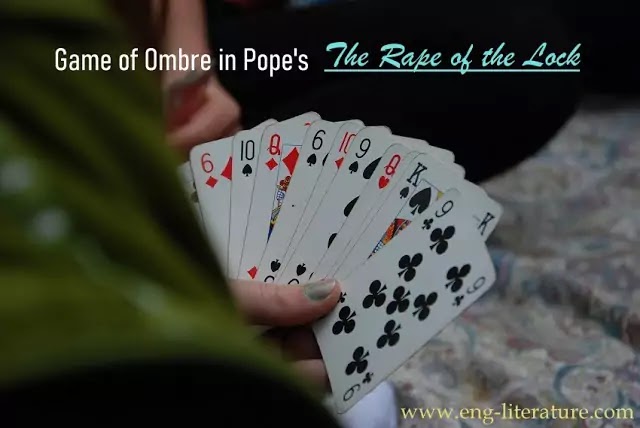
The episode of the game of Ombre that occurs in Canto III of the poem, The rape of the Lock is an after-thought on the part of the poem. It did not occur in the original version of the poem, which was too slight and thin, containing writing a mock-heroic on the trivial thing (the cutting of the lock of a fashionable belle by a frivolous knight), the poem was to be enlarged into a full-fledged miniature epic. The mock-heroic was intended to bring about the wished-for rapproachement between the two families by laughing at the matter.

Thus the episode of the Ombre game was introduced to fulfill the epic feature of the poem. A war is a sine qua non in a poem that pretends to be an epic. It occupies a very important space in the story and is practically the basis of every epic action. Homer, Virgil and Milton have conformed to this convention in their epics. And the wars in Homer and Virgil have been described with all the grandeur and vigour that their imagination was capable of. The days of epic wars were gone. Pope, therefore, adopted a sexual war, - war between two sexes, as one of the chief events of his story. And in the treatment of this, modes of ancient epics and of the medieval knightly tournaments have been blended together. The poem thus becomes a romance and epic rolled into one.

The Rape of the Lock introduces us to the world of frivolity and fashion of card playing in Queen Anne’s time. The game of Ombre has been described here under the imagery of a war and with all the trappings of epic and romantic art. The underlying irony is unmistakable. It has been beautifully observed by a critic that "men no longer fight over a woman but actually fight women and the women are not in the least loth to join in the erotic battle". In this prelude to the war, Pope says -

"Belinda-now, whom thirst of fame invites  
Burns to encounter two adventurous knights 
At Ombre singly to decide their doom."
So it is a duel of sexes and Belinda is the feminine party. It is like an encounter between Baron and his Lady of the romances. The skirmishes or the sex war have been described under the playful imagery of the Kings, Queens, Knaves, Aces of the world of cards. The battle, with the initial rising fortune of the heroine its climax after the fourth trick, and its denouement in the ninth trick is like a vivid drama or an actual fight on me level green. All the trickeries, stratagems, wiles, treacheries, vicissitudes of fortune of a grim battle have been displayed. The pierced battalions united fall in heaps on heaps; one fate overwhelms them all. The whole passage is one of the heights of imaginative poetry. Nay, it is not merely a playful fancy, but a romantic imagination, that invests the ordinary with the unearthly light that diffuses over the whole description.

It is therefore unjust to regard the episode as purely supernumerary, contributing little to the development of the action. It cannot be said that cutting of the lock arises from it. Yet, there is a dark hint in the poem that the defeated Baron might have been actuated by a desire to retrieve his shameful defeat and claims the lock as a trophy of war to be kept forever. Whatever might be its importance in the action, it is not undesirable that Pope makes capital out of the comic detail and implied comparison with the grim earnest wars in the epics. Besides, as the picture of feminine folly and frivolity and the masculine gallantry, the description has a great importance. The maneuvers of the battle of cards are the same as those of the battle of sexes. Thus as a piece of imaginative poetry wedded to the satiric purpose of exhibiting particular follies and vanities (love of card being one) the verses (37-100) describing the erotic battle touch the summit of high poetry. It is only pedantic cavilers who would like the passage cut off the poem like the lock of Belinda's hair.

Also Read:

·         Pope's use of Supernatural Machinery in the poem "The Rape of the Lock" 

·         Discuss and comment upon the necessity and value of the game Ombre in Pope's "The Rape of the Lock".


Please do inform me your view on this article in the comment section. Thank you.
~~~~~*~~~~~
Share:

Wednesday, 1 April 2020

Character Sketch of Belinda in Alexander Pope's "The Rape of the Lock" or Belinda as a Representative Lady of the 18th Century England

Character Sketch of Belinda in Alexander Pope's "The Rape of the Lock"

Pope has presented Belinda as a complex character. He has presented her in different roles and under different shades, some are satirical other ironical but all entertaining. The character of Belinda has created much controversy since the publication of the poem. Some critics consider her treatment fair while others as unfair. There are several aspects of the personality of Belinda as portrayed by Pope in The Rape of the Lock. It will be wrong to regard her purely as a goddess, or as a pretty spoiled child, or as a flirt. She is a combination of all three and yet much more than such a combination. We see her in many different lights. We see her as a vamp, an injured innocent, a sweet charmer, a society belle, a rival of the sun, and a murderer of millions. She has a Cleopatra- like variety. However, the reality lies in between these two extremes we can discuss her character as blow.
Firstly, Belinda is the heroine of the story. It is her character around whom the story of the whole poem is woven. We see her sleeping till noon and her awakening by her lap dog “Shock”. We are present at her toilet and watch the progress of the sacred rites of pride. Then we see her proceeding from the Thames River to the Hampton Court. Then her smiting looks upon the well dressed youths that crowds her. Pope compares Belinda to the sun and suggests that it recognizes in Belinda a rival. Belinda is like the sun not only because of her bright eyes and not only because she dominates her special world. She was as beautiful as every eye was fixed on her alone. She is like the sun in another regard:
Bright as the sun, her eyes the gazers strike.
And, like the sun, the shines on all alike.
Belinda’s exquisite beauty is enhanced by two curling side locks of hair that charmingly set off her ivory white neck and which she has kept to the destruction of mankind:”
Law In these labyrinths his slaves detains,And mighty hearts ate held in slender chains.
Belinda’s charms can work miracles and can make even non-believers kiss the cross.
Secondly, Belinda is a model arid more specifically represents the fashionable, aristocratic ladies of Popes age. Such social butterflies in eighteenth century were regarded as petty triflers, having no serious concern with life, and engrossed in dance and gaiety. Belinda’s fall indicates the decadence of her class. Through her, Pope describes the flippancy and depravity of the English society of his day.

Thirdly, Popes attitude to Belinda is very mixed and complicated; mocking and yet tender, admiring and yet critical. The paradoxical nature of Pope’s attitude is intimately related to the paradox of Belinda’s situation. If Belinda is to find her role of woman, she must lose the role of a virgin, and the more graceful her acceptance of loss the greater the victory she achieves through it. Because Pope is dealing with this paradox, his altitude must be mixed and complicated. It is necessary for Pope to stress Belinda’s divinity. At the same time he does not let us forget Belinda’s mortality. He qualifies her goddess-ship by emphasizing human qualities. The scene at Belinda’s dressing table, where she is both mortal priestess and the goddess worshipped in the mirror, is an example of this device. The very frailty and transience of blushes and chastity emphasize this goddess’s humanity.
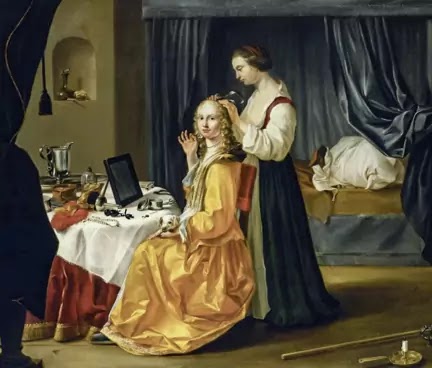
Thus, we get the picture of her shallow outlook about religious faiths and beliefs. She is a worshiper of beauty who prays to the goddess of beauty and offers all the items of cosmetics before her. She is a typical presentation of women’s excessive attention to self decoration and embellishment. She gathers all the fashionable items from all over the world - Indian glowing gems, Arabian perfumes, files of pins, puffs, powders, patches etc. In a satirical passage, Pope describes Belinda in a Confucius mood before her dressing table:
Here files of pains extend their shining rows,
Puffs, powders, patches, bibles, blllet-doux,
Thus, assigned by her maid Betty, Belinda seeks to improve her bod1y charms. However, he does not show any respect for the holly book, Bible. Therefore, the moral bankruptcy of these ladies is further ridiculed when Thalestris points out the need for sacrificing everything, even chastity, for reputation. They consider that virtue might be lost, but not a good name.
To wind up we can say that Belinda’s portrayal is one of the awesome literary creations ever produced in the History of English literature. Pope seeks to throw light upon the fickle minded fashionable ladies of the 18th century England depicting Belinda as the representative character. She is the embodiment of the coquetry, the art, the artifice and the false pride.
NB: Photo Credit google.com
 Please, let me know your view on the above article in the comment section. Thanks.
~~~~~*~~~~~
Share:

Thursday, 5 November 2015

"The Rape of the Lock" by Alexander Pope - Full Text

"The Rape of the Lock" by Alexander Pope - Full Text

Text

The Rape of the Lock: Canto I

By Alexander Pope
Nolueram, Belinda, tuos violare capillos;
Sedjuvat, hoc precibus me tribuisse tuis.

(Martial, Epigrams 12.84)
What dire offence from am'rous causes springs,

What mighty contests rise from trivial things,

I sing—This verse to Caryl, Muse! is due:

This, ev'n Belinda may vouchsafe to view:

Slight is the subject, but not so the praise,

If she inspire, and he approve my lays.


       Say what strange motive, Goddess! could compel

A well-bred lord t' assault a gentle belle?

O say what stranger cause, yet unexplor'd,

Could make a gentle belle reject a lord?

In tasks so bold, can little men engage,

And in soft bosoms dwells such mighty rage?


       Sol thro' white curtains shot a tim'rous ray,

And op'd those eyes that must eclipse the day;

Now lap-dogs give themselves the rousing shake,

And sleepless lovers, just at twelve, awake:

Thrice rung the bell, the slipper knock'd the ground,

And the press'd watch return'd a silver sound.

Belinda still her downy pillow press'd,

Her guardian sylph prolong'd the balmy rest:

'Twas he had summon'd to her silent bed

The morning dream that hover'd o'er her head;

A youth more glitt'ring than a birthnight beau,

(That ev'n in slumber caus'd her cheek to glow)

Seem'd to her ear his winning lips to lay,

And thus in whispers said, or seem'd to say.


       "Fairest of mortals, thou distinguish'd care

Of thousand bright inhabitants of air!

If e'er one vision touch'd thy infant thought,

Of all the nurse and all the priest have taught,

Of airy elves by moonlight shadows seen,

The silver token, and the circled green,

Or virgins visited by angel pow'rs,

With golden crowns and wreaths of heav'nly flow'rs,

Hear and believe! thy own importance know,

Nor bound thy narrow views to things below.

Some secret truths from learned pride conceal'd,

To maids alone and children are reveal'd:

What tho' no credit doubting wits may give?

The fair and innocent shall still believe.

Know then, unnumber'd spirits round thee fly,

The light militia of the lower sky;

These, though unseen, are ever on the wing,

Hang o'er the box, and hover round the Ring.

Think what an equipage thou hast in air,

And view with scorn two pages and a chair.

As now your own, our beings were of old,

And once inclos'd in woman's beauteous mould;

Thence, by a soft transition, we repair

From earthly vehicles to these of air.

Think not, when woman's transient breath is fled,

That all her vanities at once are dead;

Succeeding vanities she still regards,

And tho' she plays no more, o'erlooks the cards.

Her joy in gilded chariots, when alive,

And love of ombre, after death survive.

For when the fair in all their pride expire,

To their first elements their souls retire:

The sprites of fiery termagants in flame

Mount up, and take a Salamander's name.

Soft yielding minds to water glide away,

And sip with Nymphs, their elemental tea.

The graver prude sinks downward to a Gnome,

In search of mischief still on earth to roam.

The light coquettes in Sylphs aloft repair,

And sport and flutter in the fields of air.


       Know further yet; whoever fair and chaste

Rejects mankind, is by some sylph embrac'd:

For spirits, freed from mortal laws, with ease

Assume what sexes and what shapes they please.

What guards the purity of melting maids,

In courtly balls, and midnight masquerades,

Safe from the treach'rous friend, the daring spark,

The glance by day, the whisper in the dark,

When kind occasion prompts their warm desires,

When music softens, and when dancing fires?

'Tis but their sylph, the wise celestials know,

Though honour is the word with men below.


       Some nymphs there are, too conscious of their face,

For life predestin'd to the gnomes' embrace.

These swell their prospects and exalt their pride,

When offers are disdain'd, and love denied:

Then gay ideas crowd the vacant brain,

While peers, and dukes, and all their sweeping train,

And garters, stars, and coronets appear,

And in soft sounds 'Your Grace' salutes their ear.

'Tis these that early taint the female soul,

Instruct the eyes of young coquettes to roll,

Teach infant cheeks a bidden blush to know,

And little hearts to flutter at a beau.


       Oft, when the world imagine women stray,

The Sylphs through mystic mazes guide their way,

Thro' all the giddy circle they pursue,

And old impertinence expel by new.

What tender maid but must a victim fall

To one man's treat, but for another's ball?

When Florio speaks, what virgin could withstand,

If gentle Damon did not squeeze her hand?

With varying vanities, from ev'ry part,

They shift the moving toyshop of their heart;

Where wigs with wigs, with sword-knots sword-knots strive,

Beaux banish beaux, and coaches coaches drive.

This erring mortals levity may call,

Oh blind to truth! the Sylphs contrive it all.


       Of these am I, who thy protection claim,

A watchful sprite, and Ariel is my name.

Late, as I rang'd the crystal wilds of air,

In the clear mirror of thy ruling star

I saw, alas! some dread event impend,

Ere to the main this morning sun descend,

But Heav'n reveals not what, or how, or where:

Warn'd by the Sylph, oh pious maid, beware!

This to disclose is all thy guardian can.

Beware of all, but most beware of man!"


       He said; when Shock, who thought she slept too long,

Leap'd up, and wak'd his mistress with his tongue.

'Twas then, Belinda, if report say true,

Thy eyes first open'd on a billet-doux;

Wounds, charms, and ardors were no sooner read,

But all the vision vanish'd from thy head.


       And now, unveil'd, the toilet stands display'd,

Each silver vase in mystic order laid.

First, rob'd in white, the nymph intent adores

With head uncover'd, the cosmetic pow'rs.

A heav'nly image in the glass appears,

To that she bends, to that her eyes she rears;

Th' inferior priestess, at her altar's side,

Trembling, begins the sacred rites of pride.

Unnumber'd treasures ope at once, and here

The various off'rings of the world appear;

From each she nicely culls with curious toil,

And decks the goddess with the glitt'ring spoil.

This casket India's glowing gems unlocks,

And all Arabia breathes from yonder box.

The tortoise here and elephant unite,

Transform'd to combs, the speckled and the white.

Here files of pins extend their shining rows,

Puffs, powders, patches, bibles, billet-doux.

Now awful beauty puts on all its arms;

The fair each moment rises in her charms,

Repairs her smiles, awakens ev'ry grace,

And calls forth all the wonders of her face;

Sees by degrees a purer blush arise,

And keener lightnings quicken in her eyes.

The busy Sylphs surround their darling care;

These set the head, and those divide the hair,

Some fold the sleeve, whilst others plait the gown;

Share:

Follow Me in Social Media

Get Free Updates

Tags

A Doll's House (1) A Renouncing of Love (1) Absurd Drama (2) African English Literature (2) Agyeya (1) Alexander Pope (7) American Literature (26) Amitav Ghosh (3) Analyses (22) Anglo-Saxon Period (1) Aravind Adiga (1) Arthur Miller (5) Australian Literature (2) Beowulf (3) Bertrand Russell (2) Bible (1) Biographies (12) Book Review (2) British Literature (106) Broad Notes (94) Character Analysis (2) Charles Dickens (1) Charles Lamb (2) Charlotte Bronte (2) Chetan Bhagat (2) Chinua Achebe (1) Christopher Marlowe (2) Classical Literature (2) Composition (4) Creative Writing (5) D. H. Lawrence (1) Daniel Defoe (1) Diaspora (4) Drama (1) Dream Children: A Reverie (1) E-book Download (12) Edmund Spenser (1) Edward Fitzgerald (1) Edward II (3) Elizabethan Era (2) English Language (15) English Literature (9) English Literature Quiz (8) Escapism (1) Essay (12) Essays (12) Eugene O'Neill (7) Explanations (3) Feminism (3) Francis Bacon (4) Frankenstein (4) Free E-book Download (5) Free PDF Download (4) Genre (1) Geoffrey Chaucer (1) George Eliot (4) George Herbert (1) George Orwell (1) Girish Karnad (1) Hard Times (1) Heart of Darkness (1) Henrik Ibsen (1) Henry Vaughan (2) Historical Novel (6) History of English Literature (22) Indian Drama (2) Indian English Poetry (1) Indian Fiction (3) Indian Writing in English (33) Indo-Anglican Literature (32) Interesting Facts (9) Interpreter of Maladies (2) Jane Austen (2) Jane Eyre (2) Jayanta Mahapatra (2) Jhumpa Lahiri (3) John Donne (5) John Dryden (1) John Keats (4) Joseph Addison (1) Joseph Conrad (1) Keki N. Daruwalla (1) Kenilworth (3) Kim (1) Knowledge and Wisdom (1) Leo Tolstoy (1) Linguistics (2) Literary Criticism (5) Literary Essay (9) Literary Facts (1) Literary MCQ (4) Literary Photo Album (1) Literary Terms (14) Literary Trends (1) Literary Types (7) Lord of the Flies (1) Lyric (1) M. K. Anand (2) Mac Flecknoe (1) Macbeth (7) Mahadevi Verma (2) Man Eater of Malgudi (2) Mark Twain (1) Mary Shelley (4) Mathew Arnold (1) Midnight's Children (1) Modern Poetry (3) Modernism (1) Motivational Short Story (21) My Penning (1) Nayantara Sahgal (1) Notes (25) Novel (60) Novels (5) O' Henry (1) Ode to a Nightingale (1) Ode to the West Wind (1) Oedipus Rex. Oedipus the King (2) Of Friendship (1) On Fame (1) Online Quiz (8) Othello (1) P B Shelley (1) P. B. Shelley (1) Paulo Coelho (2) Philological Notes (10) Phonetics (3) Picaresque Novel (5) Plays (41) Poetry (52) Popular Literature (1) Post Colonial Literature (1) Post Colonialism (1) Pride and Prejudice (2) Prosody (3) Quiz (6) Quotations (6) R. K. Narayan (2) Rabindranath Tagore (2) Random Quiz (6) Rape of the Lock (5) Realistic Fiction (1) Restoration Era (2) Rhetoric (2) Robert Browning (1) Robinson Crusoe (1) Romantic Poetry (2) Romanticism (2) Rubaiyat of Omar Khayyam (1) Rudyard Kipling (1) Salman Rushdie (2) Samuel Beckett (3) Sarojini Naidu (1) Seven Ages of Man (1) Shakespearean Influence (2) Shakespearean Plays (11) Shakespearean Sonnets (4) Sheridan (4) Short Notes (10) Short Stories (9) Soliloquy (1) Songs of Innocence (1) Sons and Lovers (1) Sophocles (1) Sri Aurobindo (1) Substance Writing (1) Summary (8) Sylvia Plath (1) T. S. Eliot (2) Texts (10) The Adventure of Tom Sawyer (1) The Alchemist (1) The Crucible (3) The Emperor Jones (7) The Golden Light (2) The Guide (1) The Mill on the Floss (4) The Namesake (1) The Pulley (2) The Rivals (5) The Shadow Lines (3) The Sunne Rising (5) The Superannuated Man (1) The Town Week (1) The White Tiger (1) The Winter's Tale (2) Things Fall Apart (1) Thomas Hardy (2) Thomas Wyatt (1) Toni Morrison (6) Tragedy (3) Tughlaq (1) Untouchable (2) Waiting for Godot (2) Walter Scott (3) Way of the World (1) William Blake (2) William Golding (1) William Shakespeare (14) William Wordsworth (3) Word Notes & Annotations (1) Word Notes & Anotations (2)

Blog Archive