



All About English Literature: Sheridan

For Exclusive Notes and Analysis

Showing posts with label Sheridan. Show all posts

Thursday, 9 April 2020

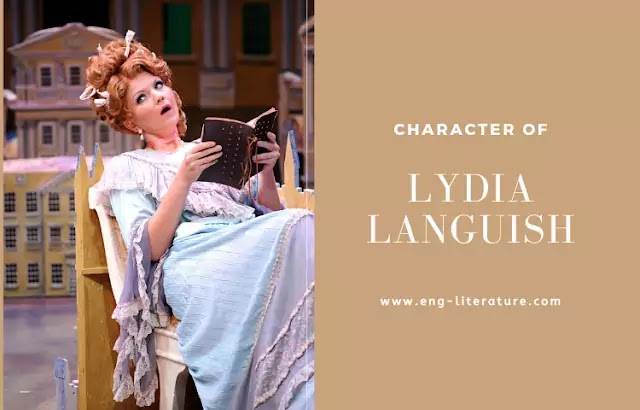
Character Sketch of Lydia Languish in Sheridan's "The Rivals"

Character Sketch of Lydia Languish in Sheridan's "The Rivals"

Introduction:

Miss Lydia Languish is the heroine of the play, The Rivals and is exactly what her name suggests, a silly romantic being, languishing in her comfortable sofa longing for secret marriage and elopement. She has a distinct tendency towards what is called sentimental tenderness. She is portrayed as a whimsical lady who lives in her own dreamland. Since she has romantic inclinations, she is always with thoughts of romantic adventures and escapades in relation to love and marriage. She has beauty and wealth, that bring a number of gallant lovers round her like a swarm of flies but she is a lady of peculiar tastes.

Lydia: A lady of a singular taste:

At the very outset, Fag describes Lydia as a lady of "a very singular taste" and as a lady who likes her lover better as a half pay Ensign than if she knew he was son and heir to Sir Anthony Absolute, a rich baronet. Her peculiar conception of love and marriage arise out of her excessive reading of cheap romances and novels. Talking about her wealth, Fag says, "She has a lap-dog that eats out of gold; she feeds her parrot with small pearls, and all her thread papers are made of bank notes." Thus, we get an impression that she is exceptionally wealthy together with having an odd or singular taste as far as love is concerned.

Lydia: Her idea of love:

Her idea of love includes all thrills and sensations--the secret love affairs, the marriage without the guardian's consent, elopement the news of it in the papers, forsaking the inheritance due to compliance of the guardian in the marriage, and consequent idealisation of poverty in which to live with her lover. These are the imbecilities of a spoilt child, that Lydia is to her bones. And it is to gratify these whims that Captain Absolute feels compelled to assume the character of an Ensign. And, when Beverley's true becomes known to Lydia, she feels terribly disappointed. She is highly disappointed to think of a routine marriage in a church. She nostalgically recalls her secret meetings with her lover in the cold January nights when he used to kneel to her in the snow and used to squeeze and cough in such a pathetic manner. This is further proof of her foolish sentimentality in love.


Lydia: Her rebellious nature:

She poses a problem in her rebellious nature to Mr. Malaprop. She is never able to reconcile herself to the ideas and views of her guardian-aunt. First of all, her foolish copy-book romances lead her to self made troubles, since neither her aunt nor Sir Anthony approves of it. She does not want to abide by her aunt's wishes who wants to marry her to a rich man in accordance with conventional ideas. Therefore, when Mrs. Malaprop asks her, in Sir Anthony's presence, if she will promise to forget her lover who is a fellow "not worth a shilling". Lydia says point blank that she can never forget him. Her rebellious nature is seen even when she turns her face. So that she does not have to see her new suitor.

Contradiction in her character:

The fact that Lydia is unable to see her own absurdities while she can perceive the absurdities of Faulkland and Mrs. Malaprop, is highly contradictory, capricious, whimsical and jealous man while she herself was in a possession of all these qualities. She does not realize her flaws and in turns makes fun of Julia's gratitude towards that man for having saved Julia's life from drowning. Similarly, she can see the contradiction in Mrs. Malaprop's falling in love with Sir Lucius, but is unable to see that her own romantic notions about love and marriage are whimsical and capricious.

Lydia: Her Genuine love for Captain Absolute:

The fact that she reconciles herself at last to a prosaic marriage shows that she has genuine love for Captain Absolute after all. The truth was that, her foolish romantic notions and light heartedness never gave an opportunity to her to find that out. It is only when she rejects him, that she starts realizing his worth and her own love for him. In the end, the news of the duel and the danger to Captain Absolute's life touches her heart and she at once fully understands her own love for him. On hearing the news of the duel, not only does she start impatiently for the place of the duel, but she also prepares herself in the way for the reconciliation which comes directly and smoothly.

Lydia: Her importance in the play:

As we all know, Lydia is the female protagonist of the principal love-story in the play and, so is indispensable to it. Beside this important role as the heroine of the love story, she also contributes her share to the comedy in the play by her absurd romantic notions. Lydia’s role was no doubt, intended by the author to be a target satire in the play.  Another purpose that Lydia serves in the play is that, she offers a contrast to Julia, who is the heroine of the other love-story.

Conclusion:

On the whole, we can say that to Mrs. Malaprop, Lydia poses a problem in her rebellious nature; to Captain Absolute she is an enigma, because he has after all to reconcile her to his true self of an heir to Sir Anthony. Although, she is depicted as a capricious, whimsical person, living in her own world, she gradually wins the love of Absolute, and the sympathy of all, including the audience.


~~~~~*~~~~~

Share:

Character of Captain Jack Absolute in Sheridan's "The Rivals"

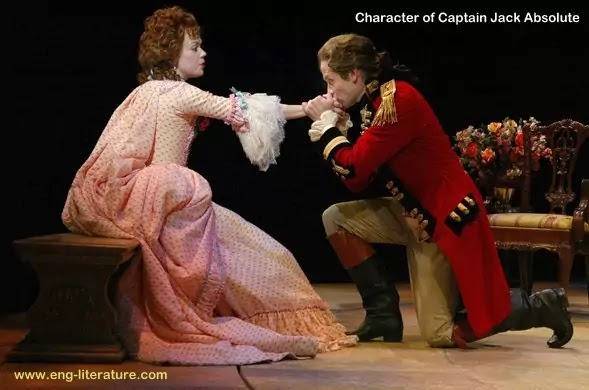
Character of Captain Jack Absolute in Sheridan's "The Rivals"

Introduction:

Captain Jack Absolute is the hero of the play, although he has one of the exceptionally heroic qualities. He is the son of the rich baronet (Sir Anthony) and a Captain in the army. He is the central character of the play and the plot is woven around him. Interestingly enough he is the only normal and balanced character in the play.

A masquerader for the sake of love:

Sheridan has portrayed him as a romantic yet sensible lover; intriguing and fashionable; bold and manly like a captain, and witty, decent, and well behaved. As a gallant youth he has fallen head over ears in love with a beautiful lady, Lydia Languish, who as we know, is a sentimental fool. He is compelled by the peculiar temperament and inclinations of his sweet heart Lydia to pose that he is a poor Ensign of a humble origin. In the words of Fag, love made Jove masquerader, so love compels this young man to hide his real identity from his sweet heart.

A practical, realistic man:

Captain Absolute is the only balanced, practical and realistic character in the play. While Lydia is dying to elope with him and thus lose her marrying against her aunt's wishes, the realist in Captain Absolute does not agree to it. He wants to keep both, the girl as well as his fortune. 

His common sense in love is in clear contrast to Lydia's and Faulkland's sentimentality in love. While Lydia altogether loses head while in love, Faulkland prepares the bitter cup of jealousies and doubts for himself. Captain Absolute says to Faulkland, "Am not a lover and a romantic one too. Yet do I carry everywhere with me such a confounded farrago of doubts, fears, hopes, wishes...ete.”

He is careful to hide his true identity from his beloved. And, he throws dust into Lydia's eyes by still pretending to be Ensign Beverley, and into Mrs. Malaprop's eyes by letting her believe that Ensign Beverley is a different man and that the insulting letter which she had received had been written by that man. Thus he succeeds in befooling both aunt and niece. And, when the revelation comes, although he finds himself in a most embarrassing position, he faces the situation with a rare coolness and courage.

His unique presence of mind:

Captain Absolute shows a unique presence of mind whenever he is in trouble, or there is need for improvisation. He over-reaches both Mrs. Malaprop and Lydia, when to one he gives out as Captain Absolute and to the other as Beverley. In order to keep Lydia-in good humour he acts as the romantic lover admirably and says, "Bring no portion to me but they love 'twill be generous in you Lydia for well you know, it is the only dower your poor Beverley can repay." Similarly, when he encounters his father on his way to the duel, he immediately muffles up his face, changes his voice and in order to escape his father, gives out his name as Saunderson.


His self confidence and composure:

Captain Absolute has remarkable self-confidence and composure. He is seen to assure Sir Anthony that he is the son of Sir Anthony's wife and that he really believes himself to be his son also. He flatters Mrs. Malaprop in a beautiful way saying that he is her most respectful admirer and that he will feel proud to call himself her affectionate nephew, by marrying her niece. To please Lydia, he says that he is her faithful Beverley who "knowing the singular generosity of her temper, assumed that name".

His sound judgment:

Captain Absolute is portrayed as one having a sound judgment of everybody's character. He understands his father in and out-that he is authoritative yet affectionate. Similarly, he thoroughly knows Mrs. Malaprop, whom he describes quite correctly though a little mischievously, in his letter to Lydia. He makes correct estimates of Faulkland and Acres too. He offers his sound criticism and suggestions to Faulkland to get rid of his suspicious nature but on Acres' braggart nature he only laughs. The best judgment he has made in the play is with regard to Lydia's character, because even while he is madly in love with her he does not take her as a monstrosity of virtues.
His ready wit and sense of humour:

Though in this play with comical characters, he is the only one who seems perfectly normal, he is also the reservoir of good humour, which he spills on all occasions. He is not morbid like Faulkland and he is not absurd or ridiculous like Sir Lucius or Acres. He knows fully well the oddities of Acres and Faulkland and while he laughs at their cost, he is never malicious or revengeful. It is his cheerful, gay character, that has won him many friends and their confidence.

The boldness of his character:

A captain in the King's Army as he is, he is not without a soldier's firmness and bravery. His strength of character is shown in the boldness with which he faces all the threats of his father. Even when he is disinherited, he decides not to give up the love-promises he has made. He is also bold enough to accept Sir Lucius' challenge readily without even knowing the reason for it. And, when Sir Lucius continues to threaten him, he confidently draws his sword to face him.

As a contrast with Faulkland:

Captain Absolute is himself aware of the contrast between him and Faulkland. He describes Faulkland as "the most teasing, captious, incorrigible lover", and exhorts him to love "like a man". Captain Absolute is seen to ridicule Faulkland's skepticism and apprehensiveness as a lover. Sheridan has portrayed Faulkland as a whimsical kind of lover o act as a foil to Captain Absolute the protagonist, who as we have seen, is a practical man, one who grapples with realities.

His despair:

We find Captain Absolute in a somewhat depressed state, only on two occasions. The first is when Lydia has broken off with him on discovering his true identity. The other occasion immediately follows this previous one. It is when Sir Lucius goes out of his way to pick up a quarrel with Captain Absolute.

Father-Son Relationship:

Sheridan has portrayed the father-son relationship in such a manner that most of the interesting scenes in this play are those in which Captain Absolute confronts his father. Captain Absolute is anxious to please his father though heartily he is determined not to give up Lydia. He says point blank, "Sir, I must tell you plainly that my inclinations are fixed on another-my heart is engaged to an angel." Sir Anthony is furious to hear this while Captain Absolute maintains his cool. He manages to over-reach his father most of the time. In his battle with words with him, he never lags behind.

Conclusion:

Captain Absolute, the protagonist, has a key role in the play. It is only because Lydia mistakes Captain Absolute for Ensign Beverley, that she falls in love with him, hence it is the crux of the main love-story. He is therefore invincible to the story. He is also a source of rich comedy in the play.


Also Read My Articles on:

·         Discuss the use of Symbolism in Golding's Novel, "Lord of the Flies"

·     Theme of Time as a “destroyer and preserver” in Anita Desai’s Novel, "Clear Light of Day". 

·    Discuss "The Rivals" as an artificial comedy of manners mirroring the Restoration England.

~~~~~*~~~~~
Share:

Wednesday, 8 April 2020

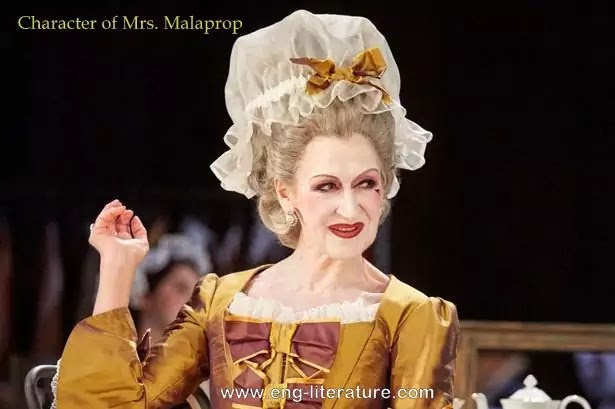
Character Sketch of Mrs. Malaprop in Sheridan's "The Rivals"

Character Sketch of Mrs. Malaprop in Sheridan's "The Rivals"

Introduction:

Mrs. Malaprop is one of the most famous and interesting character of the stage, who has won immortality. Sheridan has aptly named her “Malaprop” because of her silly misuse of words. This “queen of dictionary” is an ignorant, stupid widow. She is the aunt of Lydia Languish. She objects to Lydia's love for a poor, penniless, beggarly young man called Ensign Beverley. She wants her niece to marry Sir Anthony's Absolute's wealthy son Captain Absolute.

Her stupid and fickle-minded of romance:

Malaprop is angry with  Lydia's love for Ensign Beverley, but she herself loves and wants to marry an Irish Baronet Sir Lucius O' Trigger. She carries her love with him in the name of Delia. When Sir Lucius O' Trigger comes to know that his lovely Delia is Mrs. Malaprop, he rejects her saying;

"You, Delia-Pho! Pho! be easy."

He then asks Bob Acres to marry her But Bob Acres also refuses to marry her. At this stage, Sir Anthony Absolute cuts a joke with her saying;

"Come, Mrs Malaprop, don't be cast down-you are bloom yet." Replying to him sharply she says, "Oh, Sir Antony-men are all barbarous."

Her sense of self importance and vanity:

Mrs. Malaprop's sense of self-importance and vanity finds other expressions also. It is said that Mrs. Malaprop is fifty already and she is still not tired of the choicest toilet and fashions in clothes, laces and frills. This unsuccessful attempt on her part to live up to the smartness of Bath is indeed very silly and diverting. This attempt at beautifying herself is to some extent excusable but to think a romantic love affair at this age when she has one foot in the grave is really ridiculous. She is romantic like a young girl of seventeen. She loves to dress up and make herself attractive and presentable to Sir Lucius, which is indeed ludicrous.

The contradiction in her character:

Mrs. Malaprop is Lydia's aunt and her guardian too. Fag is the one who introduces her to the readers by saying that there is an old tough aunt in the way of Lydia Beverley love affair. Later we hear Lydia talking about her as one who has been intercepting Beverley's letters written to her. She commands Lydia with unquestioned authority to forget Beverley and accept Captain Absolute in turn. The contradiction in her character lies in the fact that on the one hand she disapproves the love relationship between Beverley and Lydia, while on the other hand she herself indulges in an affair with Sir Lucius, under a feigned name.

Her stupidity:

A prominent quality in her character is, her stupidity in whatever thing she does or says. This stupidity of hers comes out many times in the forms of unladylike coarseness of conduct. She feels proud in her baseness and she utters her meanness with utter shamelessness to Captain Absolute. The letter in which she was abused by Beverley, she foolishly hands it over to Captain Absolute to read and discuss. Even when Sir Anthony wishes her a husband and Sir Lucas tosses her around, she is rendered an utter simpleton in not at all understanding that she is being befooled.  

It is really amusing to see that with all this coarseness of conduct, she professes the manners and dutifulness to her niece. She says to Lydia, "There is nothing on earth so easy as to forget, if a person chooses to set about it." Further elaborating on the point, she says that when her husband died, she soon forgot him as completely as if he had never existed.


Her views on Education:

Mrs. Malaprop and Sir Anthony debate on the question of educating women. Mrs. Malaprop opposes Sir Anthony's view that girls should not be allowed to read at all. She admits that a girl need not be a "prodigy of learning” and that too much learning does not “become a young woman." She however does not quite agree with Sir Anthony and has her own theory of how a girl should be brought up.

Her strange preaching to Lydia:

We have already talked of the contradiction in her character. She comes out as a lady who does not practice what she preaches. She keeps preaching to Lydia to do this and not to do that. On various occasions she tells Lydia that thought does not become a young woman: “I do not know any business you have to think at all.”

Mrs. Malaprop's Malapropism:

The meaning of the word "Malapropism,” points out the main characteristic of her. Her name consists of the French 'Mal', 'a', and 'propos', which means out of place indicating her inappropriate use of words. She very often is seen to use high sounding, bombastic words, without understanding the meaning for wrong context in which she uses them, and this is what amuses us most about Mrs. Malaprop. She feels proud of what she calls her "nice derangement of epitaph” ("her nice arrangement of epithets".) She indulges in malapropism in the course of the play, as she confuses words that sound similar but have different meanings. For example she uses the word "illiterate" when she means "obliterate"; "extirpate" for "extricate"; "laconically" for "ironically"; “progeny" for prodigy and several other such examples. Sheridan satirizes this lady's tendency to misuse words in her endeavour to impress her listeners, with her command of the vocabulary. Sheridan becomes quite successful in his description of her.
In fact, it is because of this misuse of words that Mrs. Malaprop has become so well-known a character in the history of English drama. Sir Lucius rightly comments on reading her love letter written to him "Here are a great many words pressed into the service of this note that would get their habeas corpus from any court in Christendom." Captain Absolute in his turn refers to her “dull chat with hard words which she does not understand”. According to Julia, "her select words are so ingeniously misapplied without being mispronounced."

Mrs. Malaprop cuts a sorry figure at the end:

She is a typical chaperon of a comic play, who jealously guards her ward, although in her exercise she is neither as cruel nor strong as Sir Anthony. Even when Lydia rebels against her she can at the most ask her to get out of the room. We realize that in spite of all her faults she is a good lady. She is neither malicious nor jealous or greedy of Lydia's money. She is Lydia's well-wisher, and so does not want her to marry a poor Ensign. Mrs. Malaprop can be called stupid, pretentious and over-bearing but she is in no way wicked. Although her conduct is farcical at times, but she is not a weather-beaten she-dragon.

Mrs. Malaprop is actually a pathetic character-Lydia disobeys her orders, Captain Absolute outwits her in the love-game. Her romance with Sir Lucius too comes to an unpleasant end. She cuts a sorry figure at the end because she is publicly humiliated and is made the butt of jokes.

Conclusion:

The Rivals would definitely go bankrupt without Mrs. Malaprop. Her role is significant in terms of contributing humour to the play. Among the 'Dramatis Personae' of the play, she is the most interesting and memorable. She has been honoured by being given a place in the English dictionary, where she has formed a word after her name, i.e. Malapropism. Her depiction in the play is such that the meaning the word "Malapropism”. points out the main characteristic of her. Commenting upon this aspect of Mrs. Malaprop's character, Robert Herring says;

"Sheridan perhaps overdid this trick of misusing word, and certainly Mrs. Malaprop has received to much attention because of it, but it may be noticed that many of her mistakes, such as her choice of the words, 'locality', 'oracular', and 'malevolance' result is a dramatic irony that is wholly amusing."


Also Read My Articles on:

~~~~~*~~~~~
Share:

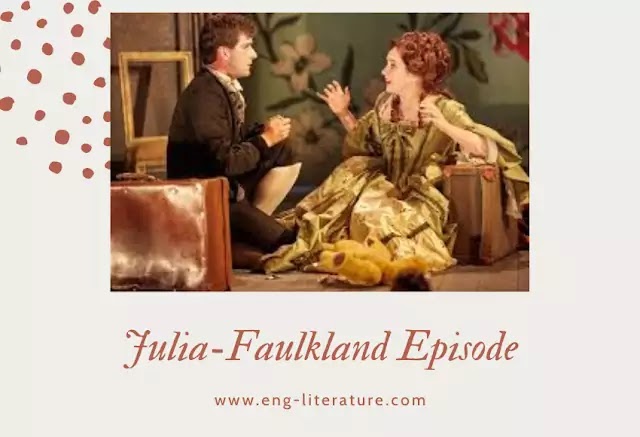
Significance of Julia-Faulkland Episode in Sheridan's "The Rivals"

Significance of Julia-Faulkland Episode in Sheridan's "The Rivals"


The dramatic work of Sheridan marks at once the height of the reaction against sentimental drama. The attack against sentimental excesses in the main plot is unambiguous and straightforward. But the Julia-Faulkland plot has elicited different responses. Therefore it is contended that Sheridan in this plot intends to appease the sentimentalists, and it expresses his compromise with sentiment. As Bevis has pointed out, "Faulkland, in particular, does appear to oscillate between capricious humorist and sentimentalist, depending on which scene or speech or text is under the lens?''. With wit and mild satire he ridicules certain prevailing social vices of the day and only to that extent can we take him to have any social purpose in this work. The Rivals was basically written as a pure and simple comedy, but there are certainly a few sentimental scenes in this play. And, these scenes occur between Faulkland and Julia. The right approach to these scenes could be to regard them not as sentimental in a serious sense but to regard them as a parody of sentimentality.

In The Rivals, love lives in many humorous forms. Cupid's strange way is remarkably displayed in the love story of Julia and Faulkland in the play. Julia, the ward of Sir Anthony Absolute, is betrothed to Faulkland, who once saved her life. Their marriage is settled. But Faulkland, u thoroughly sentimental fool, is often haunted with a sense of uncertainty and suspicion. Very often a doubt about Julia's fidelity to him rules his mind, makes him woeful end wan, and turns him into a hopeless lover, Julia, however, is sober and tolerant enough to bear calmly the whimsicality of her lover. Faulkland tests her sincerity and faith every now and then in order to assure himself that she entirely belongs to him. At last Julia gets tired and feels sadly humiliated by her lover's conduct. She sends off Faulkland with the words that as he seems to be an incorrigible lover, she will remain a maid all through her life.

A brief examination of these sentimental scenes would hence clearly reveal that Sheridan's real intention was to poke fun at the sentimental comedy of the time. We find both Faulkland and Julia talking in a manner which is manifestly absurd. Sheridan ridicules the sentimental husband's jealousy for imaginary lovers of his mistress in the character of Faulkland. The true character of Faulkland is indicated to us by Absolute's description of him as the most "teasing, captious, incorrigible lover”, who carries in his head "a confounded farrago of doubts, fears, hopes, wishes." When Faulkland is described in such a manner, the audience is bound to feel amused at the absurdity of Faulkland's sentimentality. Sheridan ridicules the excessive solicitude and concern which an over-sentimental lover like Faulkland experiences when separated from his sweetheart. Evidently, Sheridan's purpose is to remind us that, even where the passion of love is concerned, a man should exercise a certain degree of self-restraint and self-control, unlike Faulkland. By ridiculing Faulkland, Sheridan aims to instruct his readers that one should by no means give way to the flood of emotion in his heart.

Also Read My Articles on:

·   Discuss "The Rivals" as an artificial comedy of manners mirroring the Restoration England.


·         Justification of the title of Sheridan's Play "The Rival"


The propriety of the Julia-Faulkland episode is questioned in many quarters. It is contended that this episode is a superficial addition, and has unhappily lengthened the play. As a matter of fact, the love-scenes between Julia and Faulkland seem rather drab and dull among the sparkling situations of the play. Moreover, the love-affair of Faulkland and Julia has had a little material link with the main plot of the play. The story of wooing and wedding of CaptainAbsolute and Lydia could have been easily managed without it. In that case the play would be much shorter, and the charge against its undue length could not arise at all

Nevertheless, the importance of this episode cannot be altogether left out. The love of Julia and Faulkland acts as a foil to that of Lydia and Absolute. In this respect, the former is complementary to the latter. Lydia offers a striking contrast to Julia, just as Faulkland does to Captain Absolute, The 'singular taste' of Lydia is better revealed when it is placed by the side of Julia's sober and considerate temperament.

Lastly, the episode is Sheridan's satire on the prevalent distemper of his ago. Through the scenes between Faulkland and Julia, surcharged with the clouds of sentiments, Sheridan seems to caricature the capricious and sentimental love of the youths of his time.

Although Sheridan was a stalwart of anti-sentimental comedy, he could not completely keep of the shackles of the prevailing air of sentimentalism. In The Rivals, Julia-Faulkland episode is a glaring example of the imperceptible influence of the sentimental vein on this advocate of anti-sentimentalism. But the play taken as a whole is certainly anti-sentimental. And "the story and characters of Julia and Faulkland  - have an inherent tendency to satirize or undercut the hyper-sentimentalist”.

Also Read My Articles on:

·   Discuss "The Rivals" as an artificial comedy of manners mirroring the Restoration England.

·         Justification of the title of Sheridan's Play "The Rival"


~~~~~*~~~~~
Share:

Follow Me in Social Media

Get Free Updates

Tags

A Doll's House (1) A Renouncing of Love (1) Absurd Drama (2) African English Literature (2) Agyeya (1) Alexander Pope (7) American Literature (26) Amitav Ghosh (3) Analyses (22) Anglo-Saxon Period (1) Aravind Adiga (1) Arthur Miller (5) Australian Literature (2) Beowulf (3) Bertrand Russell (2) Bible (1) Biographies (12) Book Review (2) British Literature (106) Broad Notes (94) Character Analysis (2) Charles Dickens (1) Charles Lamb (2) Charlotte Bronte (2) Chetan Bhagat (2) Chinua Achebe (1) Christopher Marlowe (2) Classical Literature (2) Composition (4) Creative Writing (5) D. H. Lawrence (1) Daniel Defoe (1) Diaspora (4) Drama (1) Dream Children: A Reverie (1) E-book Download (12) Edmund Spenser (1) Edward Fitzgerald (1) Edward II (3) Elizabethan Era (2) English Language (15) English Literature (9) English Literature Quiz (8) Escapism (1) Essay (12) Essays (12) Eugene O'Neill (7) Explanations (3) Feminism (3) Francis Bacon (4) Frankenstein (4) Free E-book Download (5) Free PDF Download (4) Genre (1) Geoffrey Chaucer (1) George Eliot (4) George Herbert (1) George Orwell (1) Girish Karnad (1) Hard Times (1) Heart of Darkness (1) Henrik Ibsen (1) Henry Vaughan (2) Historical Novel (6) History of English Literature (22) Indian Drama (2) Indian English Poetry (1) Indian Fiction (3) Indian Writing in English (33) Indo-Anglican Literature (32) Interesting Facts (9) Interpreter of Maladies (2) Jane Austen (2) Jane Eyre (2) Jayanta Mahapatra (2) Jhumpa Lahiri (3) John Donne (5) John Dryden (1) John Keats (4) Joseph Addison (1) Joseph Conrad (1) Keki N. Daruwalla (1) Kenilworth (3) Kim (1) Knowledge and Wisdom (1) Leo Tolstoy (1) Linguistics (2) Literary Criticism (5) Literary Essay (9) Literary Facts (1) Literary MCQ (4) Literary Photo Album (1) Literary Terms (14) Literary Trends (1) Literary Types (7) Lord of the Flies (1) Lyric (1) M. K. Anand (2) Mac Flecknoe (1) Macbeth (7) Mahadevi Verma (2) Man Eater of Malgudi (2) Mark Twain (1) Mary Shelley (4) Mathew Arnold (1) Midnight's Children (1) Modern Poetry (3) Modernism (1) Motivational Short Story (21) My Penning (1) Nayantara Sahgal (1) Notes (25) Novel (60) Novels (5) O' Henry (1) Ode to a Nightingale (1) Ode to the West Wind (1) Oedipus Rex. Oedipus the King (2) Of Friendship (1) On Fame (1) Online Quiz (8) Othello (1) P B Shelley (1) P. B. Shelley (1) Paulo Coelho (2) Philological Notes (10) Phonetics (3) Picaresque Novel (5) Plays (41) Poetry (52) Popular Literature (1) Post Colonial Literature (1) Post Colonialism (1) Pride and Prejudice (2) Prosody (3) Quiz (6) Quotations (6) R. K. Narayan (2) Rabindranath Tagore (2) Random Quiz (6) Rape of the Lock (5) Realistic Fiction (1) Restoration Era (2) Rhetoric (2) Robert Browning (1) Robinson Crusoe (1) Romantic Poetry (2) Romanticism (2) Rubaiyat of Omar Khayyam (1) Rudyard Kipling (1) Salman Rushdie (2) Samuel Beckett (3) Sarojini Naidu (1) Seven Ages of Man (1) Shakespearean Influence (2) Shakespearean Plays (11) Shakespearean Sonnets (4) Sheridan (4) Short Notes (10) Short Stories (9) Soliloquy (1) Songs of Innocence (1) Sons and Lovers (1) Sophocles (1) Sri Aurobindo (1) Substance Writing (1) Summary (8) Sylvia Plath (1) T. S. Eliot (2) Texts (10) The Adventure of Tom Sawyer (1) The Alchemist (1) The Crucible (3) The Emperor Jones (7) The Golden Light (2) The Guide (1) The Mill on the Floss (4) The Namesake (1) The Pulley (2) The Rivals (5) The Shadow Lines (3) The Sunne Rising (5) The Superannuated Man (1) The Town Week (1) The White Tiger (1) The Winter's Tale (2) Things Fall Apart (1) Thomas Hardy (2) Thomas Wyatt (1) Toni Morrison (6) Tragedy (3) Tughlaq (1) Untouchable (2) Waiting for Godot (2) Walter Scott (3) Way of the World (1) William Blake (2) William Golding (1) William Shakespeare (14) William Wordsworth (3) Word Notes & Annotations (1) Word Notes & Anotations (2)

Blog Archive