
All About English Literature: M. K. Anand

For Exclusive Notes and Analysis

Showing posts with label M. K. Anand. Show all posts

Saturday, 25 April 2020

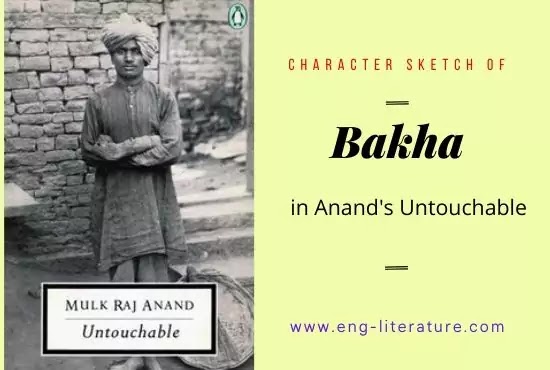
Character of Bakha in Untouchable

Character of Bakha in Untouchable

Character sketch of Bakha from Untouchable


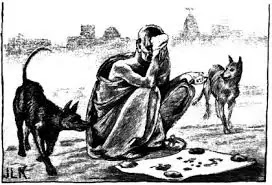
Bakha is the central character in the novel. The novel revolves around his character. Everything is viewed from his point of view. He is a focused character and cynosure. Bakha is a youngman of eighteen, strong and able bodied, the son of Lakha. His father is the Jamadar of all the sweepers in the town and the cantonment, and officially in charge of three rows of public latrines. Bakha is not simply an individual outcaste rather he represents the entire community of the outcaste treated as untouchables and subjected to live most miserably.

Bakha’s Physique

He is healthy both physically and mentally. Anand writes "Each muscle of his body, hard as a rock when it came into play, seemed to shine forth like glass. He must have had immense pent-up resources lying deep in his body..."

Bakha's Divinity

Bakha is fearless and frank. He is distinguished from ordinary scavenger because of his sensitivity, consciousness and self respect. His extraordinary tolerance and humility betray this divinity. As E.M. Foster writes in the Preface, "Bakha is an individual, lovable, thwarted, sometimes grand sometimes weak, and thoroughly Indian. He is an admirable character. He is marked for his fortitude, tolerance, humility, self-respect and broad vision.”


Bakha’s Excellence and Prominence

We admire his sense of self-respect and nobility. Mulk Raj Anand writes "What a dextrous workman! the looker would have said.” Although his job was dirty he remained comparatively clean. He didn't even soil his sleeves handling the commodes, sweeping and scrubbing them. "Bakha is a member of social pariah. He suffers beyond limitation.” He suffers the humiliation and tyranny which he does not deserve. He is conscious of the evils of casteism. He is revengeful. He can revolt against the caste system, tradition and hackneyed rituals. But he cannot fight against the dominant, powerful caste Hindus. Bakha's situation is that of a tiger at bay'. We appreciate Bakha for his extra ordinary zeal, courage and broad vision of a morning of freedom and equality.

Bakha : His Passion for Fashion and Modernity

Mulk Raj Anand portrays Bakha's passion for fashion and modernity. He has a mania for English clothes and he obtains them from Tommies. For this reason Chota and Ram Charan, other outcaste boys in the colony call him jokingly as “Pilpali Saheb”. He smokes Red Camp cigarette and sips tea without blowing it cold.

Bakha’s Vulnerability

Twice Bakha thinks of retaliation : Once when he is slapped by a caste Hindu and later when his sister is molested by a priest. As such moments he appears, we are told. "Superb specimen of humanity", his fine form "rising as a tiger at bay”. The instinctive anger gives way and the slave in him asserts itself. "Untouchable ! Untouchable ! That's the word! Untouchable! I am an untouchable!”

Bakha’s Paradoxical Attributes

The coalescence of paradoxical attributes in his character gives thrust to a dual personality. There are two paradoxical aspects of his character. The first aspect reveals that he surrenders and submits himself to the superiority of the high caste Hindus. He has inherited such traits as a result of thousand years of subjugation. The second aspect of his character is that he has smouldering revenge and vengeance. His spirit of revolt urges him to be an open rebel of caste-ridden society.

Bakha, Correlated with Lakha

Bakha is born in an outcaste family. He was nurtured in the atmosphere of slavery. But he does not accept his life and profession as his inevitable destiny. He always keeps his self-dignity up. But his father, Lakha has submitted himself to the inevitable destiny. Bakha has a sense of civility but Lakha is uncouth and unclean.

Bakha’s Absolute Acceptance of Lot

The ultimate and most violent realizatiom comes when his sister, Sohini’s chastity and modesty is molested by a caste Hindu priest, Pandit Kalinath. He becomes revengeful and wants to kill the debauche. But he is helpless when he feels his limitations. He yields to tradition and kisses the defeat. He has developed a tendency to digest insult. He loves the modesty of his sister more than anything else but is unable to transform his anguish and anger into action.

Bakha ! Inert and Dynamic

Bakha is not an inert character. He is active and aggressive by temperament. His anglophile behavior suggests that he is undergoing a transition from tradition to modernity. He is an iconoclast at the bottom of his heart.  

Bakha  : A Libido  

Bakha does have natural sexual urge. He becomes erotic when he thinks of Ram Charan's sister with whom he shared his childhood. He paints an imaginary naked portrait of her. He enjoys the orgasm with her imaginary picture. Bakha's sexual urge arises up when he stops to see a scantily dressed woman in picture. Sometimes he is obsessed with incestuous feelings and emotions regarding his own sister Sohini.

Conclusion

In brief, Anand has given us one of the immortal characters of literature. The novelist has projected profound psychological insight in the portrayal of Bakha. He is aware and conscious of the social discrimination and injustice. He has the elements of revolt and protest but he has inherited servility of being an underdog of the society. Bakha is also a human being. He has the same blood in his veins as others. If we co-operate with Bakha, he can rise to great heights.

Also Read:


~~~~~*~~~~~

Share:

Sunday, 7 February 2016

Humanism in Mulk Raj Anand's Untouchable

Humanism in Mulk Raj Anand's Untouchable

Humanism is a realistic philosophy. Humanism is the philosophy for those in love with life. Humanists take responsibility for their own lives and relish the adventure of being part of new discoveries seeking new knowledge and exploring new options. A humanist is a pragmatist who gives supreme priority to equal opportunity, justice, welfare, and progress for all without discrimination and prejudice.


Mulk Raj Anand occupies one of the topmost position in Indo-Anglican literature. He belongs to a period in the history of India when the nation was struggling hard to shake off the burden of slavery. He is a novelist with a missionary zeal. He frankly declares that art is a means towards social reforms and upliaftment. Anand’s central pre-occupation” says Dr. K. K. Sharma “is humanism. Anand regards art and literature- as the instrument of humanism.”


Anand’s humanism has been the inspiration and the driving force behind the writing of the novels. His father served in the Indian Army. As a child Anand had mixed freely with the children of the sweeper and under-castes attached to his father’s regiment. These early playmates became the characters of his novels. Besides Anand got the inspiration from Gandhiji’s sympathetic treatment for the Harijans. The philosophy of Marx developed a great change in Anand’s heart during his stay in London.


His all novels like Untouchable, Coolie, Two Leaves and a Bud, Across the Black Waters, The Sword and the Sickle  embrace human experiences and convey a sense of life and character like a coloured glass. He has literally immersed into the flowing, vibrant core of humanity and he feels its grief to the very marrow of his bones. Being a humanist, Anand has skillfully depicted the Indian society which is hostile and callous to the lots of the low-born.


His first novel, Untouchable is an account of a day in the life of its protagonist- Bakha, an untouchable sweeper boy. It delineates the feelings, aspirations and problems of this sweeper boy who undergoes a lot of hardship being a low-caste within Indian society. To comment on Bakha, who is the pariah protagonist of the novel, namely They think we are mere dirt because we clean their dirt” sums up Anand’s understanding of the grim realities of India’s social life.
The evil of untouchability in India has an ancient history. It roots from the four groups of Hindu castes- Brahmins, Kshatriyas, Vaishya, and Sudras. The Sudras represents the lowest of all in the social hierarchy. Untouchable is the story of this prolonged indignity and humiliation of this class of society. The opening of the novel strikes the keynote of the theme of the novel:

“The outcastes’ colony was a group of mud- walled houses that clustered together in two rows, under the shadow both of the town and the cantonment, but outside boundaries and separate from them.”


This novel revolves round Bakha who is a sweeper boy. The author has chosen a conspicuous day from his life and through the presentation of the situation occurring on that particular day, he has drawn our attention towards the plight of low caste people. First situation is the pollution through touch of a caste Hindu. It creates a catastrophe. As Bakha walks along the road eating ‘Jalebi’ and recalling the arrangement he has made for learning English, his gaze is drawn to a woman sitting in a window. He is so deeply lost in his thoughts that he has accidently touched someone passing by. Suddenly he hears,

“keep to the side of the road, o he low-caste vermin… why don’t you call, you swine and announce your approach: Do you know you have touched me and defiled me, you cock- eyed son of a bow- legged scorpion: now I will have to go and take a bath to purify myself.”


Bakha is apparently seized with fear, humility and servility. Bakha now realizes his social status and moral barrier which he himself is unable to break down.


The second major situation in the novel is when Bakha’s sister Sohini is molested by the priest. Ironically Anand makes us realize that hue and cry is raised against the molested and not the molester. Sohini raises an alarm to save herself from being molested by the priest Kali Nath but the priest is very clever and extricates himself from the difficult situation by shouting, “Polluted, Polluted.” The writer here draws our attention towards the unjust and condemnable behaviour of the so called high caste people who can easily go scotfree by turning the blame on to the suffering, sexually exploited girl. Bakha knows the truth of the whole thing that he finds himself incapable of taking revenge.


As a humanist, he believes that man can solve the problem by universal brotherhood love and compassion. Even though the high caste Hindus considered him only as an untouchable, there are also good fellows life Havildar Chart Singh, who gives much love and consideration to him. The Tommies also treated him like a human being, while to the caste Hindu, he is untouchable. Prof. S.Laxmana Murthy quotes the words of Anand that, “the tragedy of my hero (Bakha) lay in the fact that he was never allowed to attain anything near the potential of his qualities of manhood”


Bakha’s world is much too narrow for his aspirations. So he longs for a new world. Anand in the conclusion of Untouchable subtly examines the various possible solutions religious conversion, rapid industrialization and the Gandhian way. The emphasis on the Hutchinson’s religion is on sin, love and equality of birth where as it is on cleanliness, morality and dignity of work in Gandhi’s approach to the problem of the emancipation of the untouchables. Of these, Bakha likes only the idea of cleanliness and equality but he feels flattered by Gandhi’s sympathy. It is only the third solution offered by the poet, Iqbal Nath Sarshar that engages Bakha’s attention- the flush system.


Anand, through his rare excellency, bold experimentation and aesthetic sensibility has made immense contribution to Indian as well as World literature in English. His choice of unconventional subjects and characters has been determined by his Dickensian humanistic philosophy. This novel Untouchable expresses his belief in the dictum ‘man is the measure of all things’. 

Also Read:


 ~~~~~$~~~~~
Share:

Follow Me in Social Media

Get Free Updates

Tags

A Doll's House (1) A Renouncing of Love (1) Absurd Drama (2) African English Literature (2) Agyeya (1) Alexander Pope (7) American Literature (26) Amitav Ghosh (3) Analyses (22) Anglo-Saxon Period (1) Aravind Adiga (1) Arthur Miller (5) Australian Literature (2) Beowulf (3) Bertrand Russell (2) Bible (1) Biographies (12) Book Review (2) British Literature (106) Broad Notes (94) Character Analysis (2) Charles Dickens (1) Charles Lamb (2) Charlotte Bronte (2) Chetan Bhagat (2) Chinua Achebe (1) Christopher Marlowe (2) Classical Literature (2) Composition (4) Creative Writing (5) D. H. Lawrence (1) Daniel Defoe (1) Diaspora (4) Drama (1) Dream Children: A Reverie (1) E-book Download (12) Edmund Spenser (1) Edward Fitzgerald (1) Edward II (3) Elizabethan Era (2) English Language (15) English Literature (9) English Literature Quiz (8) Escapism (1) Essay (12) Essays (12) Eugene O'Neill (7) Explanations (3) Feminism (3) Francis Bacon (4) Frankenstein (4) Free E-book Download (5) Free PDF Download (4) Genre (1) Geoffrey Chaucer (1) George Eliot (4) George Herbert (1) George Orwell (1) Girish Karnad (1) Hard Times (1) Heart of Darkness (1) Henrik Ibsen (1) Henry Vaughan (2) Historical Novel (6) History of English Literature (22) Indian Drama (2) Indian English Poetry (1) Indian Fiction (3) Indian Writing in English (33) Indo-Anglican Literature (32) Interesting Facts (9) Interpreter of Maladies (2) Jane Austen (2) Jane Eyre (2) Jayanta Mahapatra (2) Jhumpa Lahiri (3) John Donne (5) John Dryden (1) John Keats (4) Joseph Addison (1) Joseph Conrad (1) Keki N. Daruwalla (1) Kenilworth (3) Kim (1) Knowledge and Wisdom (1) Leo Tolstoy (1) Linguistics (2) Literary Criticism (5) Literary Essay (9) Literary Facts (1) Literary MCQ (4) Literary Photo Album (1) Literary Terms (14) Literary Trends (1) Literary Types (7) Lord of the Flies (1) Lyric (1) M. K. Anand (2) Mac Flecknoe (1) Macbeth (7) Mahadevi Verma (2) Man Eater of Malgudi (2) Mark Twain (1) Mary Shelley (4) Mathew Arnold (1) Midnight's Children (1) Modern Poetry (3) Modernism (1) Motivational Short Story (21) My Penning (1) Nayantara Sahgal (1) Notes (25) Novel (60) Novels (5) O' Henry (1) Ode to a Nightingale (1) Ode to the West Wind (1) Oedipus Rex. Oedipus the King (2) Of Friendship (1) On Fame (1) Online Quiz (8) Othello (1) P B Shelley (1) P. B. Shelley (1) Paulo Coelho (2) Philological Notes (10) Phonetics (3) Picaresque Novel (5) Plays (41) Poetry (52) Popular Literature (1) Post Colonial Literature (1) Post Colonialism (1) Pride and Prejudice (2) Prosody (3) Quiz (6) Quotations (6) R. K. Narayan (2) Rabindranath Tagore (2) Random Quiz (6) Rape of the Lock (5) Realistic Fiction (1) Restoration Era (2) Rhetoric (2) Robert Browning (1) Robinson Crusoe (1) Romantic Poetry (2) Romanticism (2) Rubaiyat of Omar Khayyam (1) Rudyard Kipling (1) Salman Rushdie (2) Samuel Beckett (3) Sarojini Naidu (1) Seven Ages of Man (1) Shakespearean Influence (2) Shakespearean Plays (11) Shakespearean Sonnets (4) Sheridan (4) Short Notes (10) Short Stories (9) Soliloquy (1) Songs of Innocence (1) Sons and Lovers (1) Sophocles (1) Sri Aurobindo (1) Substance Writing (1) Summary (8) Sylvia Plath (1) T. S. Eliot (2) Texts (10) The Adventure of Tom Sawyer (1) The Alchemist (1) The Crucible (3) The Emperor Jones (7) The Golden Light (2) The Guide (1) The Mill on the Floss (4) The Namesake (1) The Pulley (2) The Rivals (5) The Shadow Lines (3) The Sunne Rising (5) The Superannuated Man (1) The Town Week (1) The White Tiger (1) The Winter's Tale (2) Things Fall Apart (1) Thomas Hardy (2) Thomas Wyatt (1) Toni Morrison (6) Tragedy (3) Tughlaq (1) Untouchable (2) Waiting for Godot (2) Walter Scott (3) Way of the World (1) William Blake (2) William Golding (1) William Shakespeare (14) William Wordsworth (3) Word Notes & Annotations (1) Word Notes & Anotations (2)

Blog Archive