
According to M.H. Abrams, the term dystopia “has
recently come to be applied to works of fiction, including science fiction,
that represent a very unpleasant imaginary world in which ominous tendencies of
our present social, political, and technological order are projected into a
disastrous future culmination”. This definition can be applied to
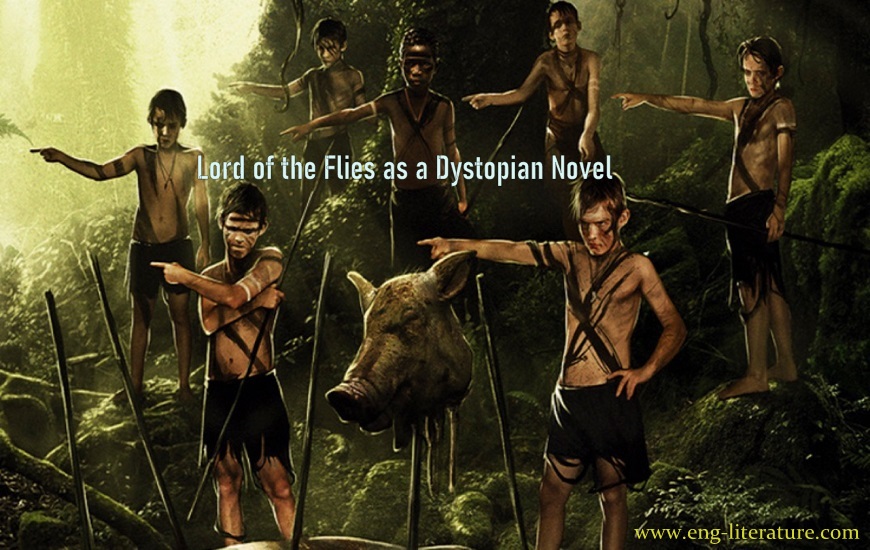
William Golding’s Lord of the
Flies. His boys are plane-wrecked on an unknown desert island. They
are completely isolated and free without any external influences and elderly
supervision. At first they enjoy their newly acquired liberty. Golding shows
how human’s inherent tendency towards evil and aggression progresses gradually
as he frees himself from constraints of civilized life and conditions him to
regress into a state of dystopian savagery.
After the plane crash the boys “find
an earthly paradise, a world in fact like our own, of boundless wealth, beauty
and resource” (Woodward 209). In this world of plenty the boys have a
unique opportunity to start a new society. At first they revel in their freedom
from the authority of the adults. It seems that the island has the potential to
become a world of never ending fun, similar to the “Neverland” in James Barrie’s Peter Pan. However, the boys’ high
spirits do not last for long. The dangers of the fusion of fantasy and reality
start surfacing. Fear of an unseen beast spreads like plague among the boys,
particularly the “littluns.” It
consumes them all and culminates in a mad hysteria and a deep rift between the
boys. The “good island” turns bad
and a potential utopia turns into a definite dystopia (Golding, Lord 26).
Things do not function the way they imagined.
They cannot organise themselves well enough to build proper huts. Jack’s boys
lack responsibility and let the signal fire die in order to go hunting, thus
missing an opportunity to be rescued. This is the beginning of the
disintegration of the boys. Some boys are overtly hostile to others, such as
Roger, the bully who barely refrains himself from stoning Henry, one of the
smaller boys. However, the grip of civilization will soon slacken and there
will be nothing to prevent Roger from committing murder. Hostility among the
boys is best shown on the example of Jack’s behaviour towards Piggy. This boy
never gets the chance to say his real name, but is constantly referred to by
the hateful nickname. The short-sighted fat boy with asthma and a balding head
is constantly derided and insulted despite his intellectual abilities.
The initial juvenile utopian fun is disrupted
by forces coming from the adult world. In order to survive and be rescued all
boys must act with responsibility. First they try to arrange a sort of
democratic society modelled on the principles of the world of adults. They have
elections whereby Ralph is voted chief. However, the choir boys remain under
Jack’s command and he decides that they will assume the role of hunters. They
organise assemblies by Ralph blowing the conch and summoning all the boys.
Every boy is given the right to speak provided that he is holding the conch. Nonetheless,
this democratic idyll soon turns upside down, with Jack crying “Bollocks
to the rules!” (Ibid 79).
When confronted with the fear of the Beast
Piggy’s reason loses the battle and the democracy starts to crumble. He
believes that the world is reasonable, yet reason cannot control the boys’
instinctive violence. Piggy fails to understand the reality of the Beast. He
may have the brains, but the savage, violent, beastly evil in Roger makes those
brains useless when he smashes Piggy’s skull while he is embracing the conch,
their symbol of democracy.
The idea of feasting is important in Golding’s
novel as a symbol of greed and one of the benefits offered by Jack and his gang
of hunters. The boys who revert to savagery put hunting and feasting before the
signal fire and possibility of rescue. This is evident when Jack sticks a pig’s
head on a double-pointed spear as an offering to the Beast. The “Lord” from the title of the novel is
nothing but a pig’s head on a stick, a lord only to flies gathering on it,
symbolising the reversal of hierarchy and authority. Yet on the other hand, the
“Lord of the Flies” may be interpreted as the Devil, or Beelzebub, the “Lord”
of the human inherent evil, which got the upper hand on this island. Therefore,
this symbol is fitting both to the “dystopian misrule of carnival” in
the novel and to the etymological base of Lord
of the Flies referring to Beelzebub or Devil (Crawford 67).
Furthermore, Golding’s dystopian
representation of carnival may be interpreted as a political fable. Even though
Ralph and Piggy possess good will and judgment, they are politically
inadequate. Ralph needs constant reminders of his tasks and goals as a chief.
Moreover, they both participate in the feast and the frantic ritual dance
during which Simon is murdered in the mock-hunt. There is the contrast and
tension between Ralph’s and Piggy’s peaceful liberal democracy and Jack’s
totalitarianism based on violence and oppression reflecting the carnival crowd
behaviour. Golding refers to this issue in his essay “On the Work as a Fable,” saying that after the Second World War he
lost his faith in “the perfectibility of social man”.
For Golding “Man is born in sin. Set him free
and he will be a sinner”. Therefore, since humans are not innately
innocent their progress is unlikely. The violence of the boys is only a
miniature manifestation of what is happening on a large scale in the world of
adults. The sinfulness of the world is obvious in the references to nuclear war
and atrocities committed by men to other men. In Lord of the Flies William Golding conducts a
literary social experiment showing how humans conditioned by the primeval evil,
spoil their chance of a new beginning and create a savage dystopian society. If
we observe the world as a set of concentric circles, then the boys’ island
world is a smaller circle mirroring a larger one. Their microcosmic dystopia
reflects the violent events occurring in the world of adults.