
All About English Literature: The Mill on the Floss

For Exclusive Notes and Analysis

Showing posts with label The Mill on the Floss. Show all posts

Tuesday, 7 April 2020

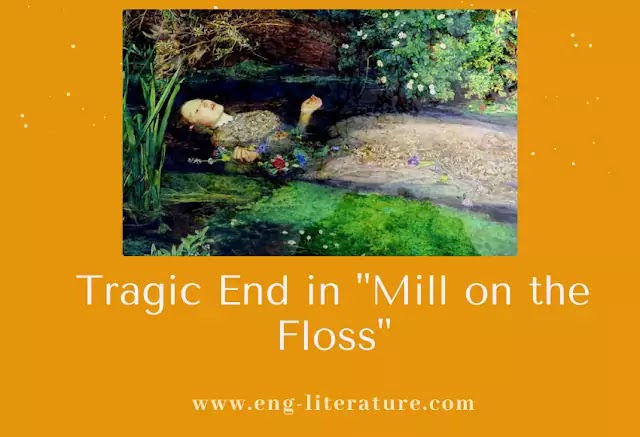
Melodramatic and Arbitrary Tragic Ending of Mill on the Floss

Melodramatic and Arbitrary Tragic Ending of Mill on the Floss

Introduction:

The end of The Mill on the Floss is the most controversial issue of the novel, which has given rise to elaborate studies by various critics. It has been subjected to some scathing criticism because it is alleged to be capricious, arbitrary, unnatural and abrupt. Bulwer-Lytton observes that the end is inadequately prepared. To Henry James, the end is defective and shocking and it might have been an afterthought on Eliot's part. Leslie Stephen calls the end "pathetic" and says that it affects general harmony. F.R. Leavis opines that Eliot has distorted the end in order to give it a typical Victorian dramatic ending. Joan Bennet is of the view that the end indicates the novelist's desire to bring about a sort of poetic Justice. W. J. Harvey regrets that the end is a structural defect and it undermines the moral scheme of the novel. Critics blame that the end does not appear to be inevitable; it seems abrupt and imposed. Eliot cut the knot she was unable to unravel. The end does not flow from incidents.

Though the end may have some defects yet it can be promptly defended and justified on the following grounds:

Tragic Ending From Allegorical Level:

Firstly, the end can be justified at the allegorical level. The novel is, in fact, written in the retrospect. Living in 1850s Eliot portrayed the life of 1830s, characterized by its simplicity and purity, which was no longer there in Eliot's age the short span of twenty years, it was greatly affect urbanization and materialism and lost its purity. The Tullivers stand for that pure life of 1830s. Through the extermination of the Tullivers, she wanted to show the extinction of an epoch the era which was lost — and introduced new material which she did through Wakem who is the representative of materialistic age. So far as Mrs. Tulliver is concerned, she is good for nothing fellow.

At the allegorical level, the end also suggests that lack of harmony in human personality is fatal. Maggie was torn between two extremes - impulsiveness and a strong sense of duty. Some critics observe that Maggie should have been given an opportunity to make a moral choice. But, in fact, the conflict of her mind had become so intense that she could not go either way. Her impulsiveness persuaded her to marry Stephen but her sense of duty asked her to be faithful to Philip and Lucy. If she married Philip, she would be disloyal to her family. So she had to pay for the disharmony in her personality through death.


Tragic Ending From Symbolic Level:

Some critics observe that in spite of being drowned in the Floss, Maggie could have been killed by some other way, but it is wrong. If Maggie and Stephan had drowned during boating, it could not have been convincing enough. Had Tom killed Maggie, it would have been against the theme of the novel, i.e., emotional self-control and it would have been cheap sensational novel. Had Maggie committed suicide, she would have been reduced to the status of a foolish sentiment girl which Eliot did not like. Natural death would have been least artistic. Eliot also wanted to bring about reconciliation between the brother and the sister before death, which would have been impossible in normal circumstances. So it was most suitable way for Maggie's death which Eliot contrived. Then at the symbolic level too Eliot wanted to show that Floss which gave birth to whole of Maggie's miseries, itself put an end to all her sufferings. The flood, in fact, proved baptismal for her.

Comparison with Henry Fielding:

Like Fielding, Eliot wrote with a definite purpose, i.e., to inculcate moral into the people. Maggie sacrificed the virtues of Christian charity for the sake of the impulses of the flesh. Through Maggie's death, Eliot wanted to teach that the love of the flesh was socially as well as morally explosive and led to the valley of death.


Comparison with Jane Austen:


Like Jane Austen, Eliot, too, does not set up fanciful ideals in her novels. She wants to instruct that when ideal is lost, the penalty is death. Maggie wanted to be at the same time dutiful and true to her love, which was a fanciful ideal. It did break and she met a tragic death.

Tragic Ending From Personal Angle:

From the personal point of view to the end can be easily defended. Eliot had a scandalous life with Lewes for about twenty four years. But she never approved of such a life. Her conscience always pricked her. Therefore, she never allowed her women characters to repeat such a lapse and punished them even for the slightest slip. Maggie had biographical resemblances with Eliot. Through pushing her, she, in fact, pushed herself. She did in the novel what she could not do in real life.

Tragic Ending From Symbolic Level:

The end is equally defendable at the social level. Eliot wanted to communicate that when one is socially disrupted and humiliated, it is impossible for one to live a happy and respectable life in the society. Maggie had to meet death for she had already socially died.

Tragic Ending From Structural Point of View:

Lastly, we may justify the end from the structural point view. In fact, Eliot's conception of unity is different from other novelists. In Eliot's case, complex relationship is responsible for creating unity. She creates relations which are complex as well as interdependent and the complexity of these constructs the unity of her novels. But after creating such complex relationship, she is usually unable to unravel and resolve it because it becomes inextricable. Then she cuts the unable to unravel. She involved Maggie in inextricable relationship with Tom, Philip, Lucy, and Stephen to invest the novel a unity. But when she found herself at a loss to resolve it, she achieved her object through the death of Maggie, for, after all, had to reach its tragic end.

Conclusion:


From what has been stated above, we may reach the conclusion that the bitter criticism with reference to the end of the novel, The Mill on the Floss is quite unqualified. In fact, the end seems apt and justified when viewed in the backdrop of the whole scheme conceived by George Eliot.


Also Read My Articles on:

~~~~~*~~~~~
Share:

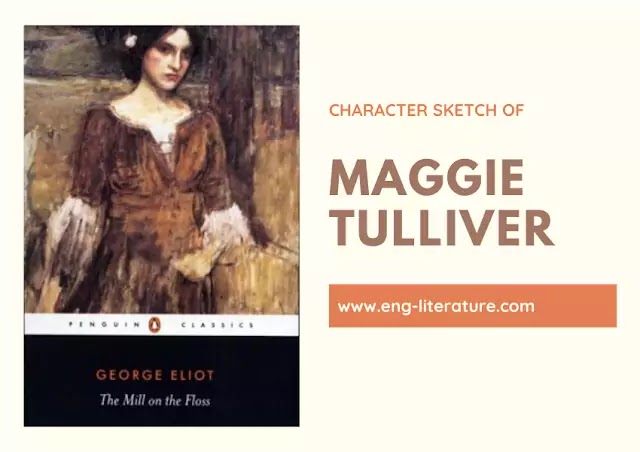
Character Sketch of Maggie Tulliver

Character Sketch of Maggie Tulliver
Introduction:

The realm of English literature Eliot has contributed some immortal figures who have become stuck to the memory of the readers of her novels. Maggie Tulliver, among these unforgettable characters, stands supreme Maggie is the protagonist of The Mill on the Floss. The novel tracks Maggie as she grows from an impetuous, clever child into a striking unconventional young woman. Thus the panorama of Maggie's life is set before us as a child, as a little girl and as a grown up woman. We are made fully acquainted with the basic traits in Maggie's character.

As an Impetuous Child:

When the novel begins, Maggie is presented to us as a clever and impetuous child. Through Maggie, Eliot very beautifully analyses the working of children's mind and the basic springs of their actions. It is her study of child psychology which brings her in tune with such modern psychological novelists like James Joyce and Virginia Woolf.

Her Rationality and Self-righteousness:

Eliot presents Maggie as more imaginative and interesting than the rest of her family and sympathetically in need of love. She loves her brother Tom intensely and desires his whole attention, but Tom by virtue of his nature does not understand her. Actually, both of them are poles apart is embodiment of rationality and self-righteousness Maggie is all love and generosity.

Her Impulsiveness and Sentimental Nature:

Yet Maggie's passionate preoccupations also cause pain for others. Maggie's mother and aunts continually express disapproval with Maggie's rash behaviour, uncanny intelligence and unnaturally dark skin, hair and eyes. Yes it is only Tom's opinion for which Maggie cares and his inability to show her unconditional love, along with his embarrassment at her impetuosity often plunges Maggie into the utter despair particular to immaturity. At one of these occasions when Tom pays more attention to Lucy, his cousin, Maggie becomes infuriated and pushes Lucy into mud. Frightful of the consequences of this rash act Maggie runs away to gypsies and is ultimately brought home in a very miserable condition. At another occasion when her mother and aunts criticise her for being untidy she goes into her attic and cuts her hair and spoils her doll. But soon she realises her mistake, repents and weeps bitterly. All these incidents show her impulsive and sentimental nature right from her childhood.

Imaginative Mind:

Actually, Maggie has an imaginative mind, full of rosy ideas about life. However, when she finds the world inimical to her dreams, she becomes frustrated. But Tom being a practical man does not appreciate these ideas. It is this lack of intellectual communion which drifts her closer to Philip, the son of her father's enemy and Tom's class-fellow. Philip satisfies her intellectual thirst and this develops intimacy among them.

Inspired by a Book:

The most important event of Maggie's young life encounter with a book of Thomas a Kempis's writings during the difficult year of her adolescence and her family bankruptcy. Looking for a "key" with which to understand her unhappy lot, Maggie seizes upon Kempis's writings and begins leading a life of deprivation and penance. Yet even in this lifestyle, Maggie paradoxically practices her humility with natural passion and pride. It is only until she re-establishes a friendship with Philip Wakem. As Maggie continues to meet Philip Wakem Secretly, against her father's wishes, her internal struggle seems to shift.
Her Appearance:

The final books of The Mill on the Floss feature Maggie at the age of nineteen. She seems older than her years and is described as newly sensuous - she is tall with full lips, a full torso and arms, and a crown of jet black hair. Thus, from an ugly duckling she turns into a swan. Maggie's worldliness and lack of social pretension make her seem even more charming to St. Ogg's, as her worn clothing seem compliment her beauty. Maggie has been often unhappy in young adulthood. Having given up her early asceticism, longs for a richness of life that is unavailable to her. Actually the trait that was most marked in her all through life was “the absolute need of some one person who should be all in all to her, and to whom she should be all in all."

Her Romantic Craving:

When Maggie meets Stephen Guest, Lucy Deane's handsome suitor, she feels this wont for sensuousness fulfilled for the first time. Stephen plays into Maggie's romantic expectations of life and gratifies her pride. Maggie and Stephen's attraction seems to exist more in physical gestures than in witty discussion, and it seems to intoxicate them both. Circumstances throw them together and Maggie, with Stephen remains away from St. Ogg's for a few days.

Criticism:

Some critics condemn the whole episode of Maggie.Stephen affair and argue that how is it possible that a Maggie like cultured and sensitive girl could be attracted towards a man like Stephen. But we should not lose the sight of the fact that Maggie is a human being and she errs like humans. Stephen has sexual attraction and Maggie was unable to resist the temptation.

Tragic End:

Again, it was her sense of duty and love for Tom that she went out during flood to save his life. However, both were drowned “in an embrace never to be parted”. Thus “in their death they were not divided.”

Conclusion:

Summing up his scholarly discussion of the novel, Walter Allen comments:


"What gives the novel its ultimate greatness is George Eliot's rendering of the character of Maggie...... Maggie is the unifying principle of the novel, its centre of consciousness. I do not think it at all necessary for readers of novels to identify themselves with characters in them; but I believe it is impossible to read The Mill on the Floss without identifying with Maggie. She is as deeply felt a character as any in fiction and she exists, in her aspirations and the frustration of them, as a permanent criticism of the quality of ordinary life anywhere and in any age".

Also Read My Articles on:

~~~~~*~~~~~
Share:

Sunday, 5 April 2020

How would you consider Eliot's "The Mill on the Floss" as a Modern Tragedy? or Conflict between Love and Duty.

consider Eliot's "The Mill on the Floss" as a Modern Tragedy?

The Mill on the Floss is a tragedy containing a lot of pathetic incidents as well as tragic characters. It is a story of pain and suffering ending in total extermination of Tullivers. 

George Eliot was a realist and portrayed what she herself saw. There was a plenty of tragedy in her age and being a realist she gave a truthful picture of the miseries endured by the people of that age. Moreover, she had tragic outlook. Anything tragic, was bound to strike her.

Also Read:

·         Assess Mark Twain's "The Adventures of Tom Sawyer" as an Autobiographical Novel


Tragedy happens due to different reasons. Firstly, it happens in the form of fate - chance and circumstances beyond the control of common man — or it may also happen due to some accident. Secondly, a tragic flaw in the character of the protagonist causes tragedy. And it can also be a result of certain social beliefs or pressures which cannot be escaped. Lastly tragedy becomes inevitable on account of a deed on action committed by the protagonist.

In George Eliot, tragedy happens on account of all these. She believes that character itself is not responsible for causing the tragedy, all the times — external reasons also count. Still she believes that the character plays a major role i.e. a tragic flaw in the character of the protagonist leads to tragedy.

According to her man he improvises his character in whatever way he wants. She emphasized that one must exert one's maximum to shape the character right. She thinks that one has to face the consequences of one's actions so even the slightest errors ought to be avoided.

She believed that man has two selves. One self calls for duty - one must perform one's duty as accurately as possible - and the other self calls for passion. She thought that the self Calling for duty, in fact, invites goodness whereas the other self who calls for passion invites destruction. To make a choice between these two is very significant. Salvation and destruction wholly depend on our choice. She applies the law of moral retribution — the doctrine that sins bring their wages.

The Mill on the Floss is mainly a tragic story which deals with the suffering of Tullivers and many others related to them. But mainly it deals with the suffering of Maggie - a sensitive girl in a convention bound society.

Maggie suffers from childhood till her death. Her life is very painful and arouses pity while happiness in her life is occasional. Firstly, she suffered on account of her nature and temperament. She was sensitive and impulsive and continues to be so even in her youth. Once she got angry and ran away from home and went to the gypsies. Her impulsive nature is evident from this event. It was the slights of Tom which made her sensitive, especially on this moment. Tom had slighted Maggie and had given attention to Lucy. Maggie, a sensitive girl as she was, is anguished by Tom's behaviour and this makes her run away from home.

Maggie craves for love. She did not get any love from her mother and brother. She wants to love and to be loved. In her childhood it is only her father who shows some affection for her.

Also Read:

·         Discuss the use of Symbolism in Golding's Novel, "Lord of the Flies"

Maggie was out of harmony with her environment. Her mother was always scolding her. The behaviour of uncles and aunts was always disgusting and they didn't let any opportunity let go wasted. She remains lonely and there is nobody who can share her feelings.

She had a delicate conscience and her moral scruples cause her a lot of mental suffering. After her elopement with Stephen, she suffered a lot. Tom refused to accept her had to go to Bob Jackin. Stephen proposed her for marriage she refused it straightaway. She knew that in doing would be able to lead a comparatively better life and society would be forgiving towards her. But she had a strong moral sense. She knew that Stephen was engaged to her cousin Lucy who was considerate towards her. So she didn't want to deprive Lucy of Stephen. Had she married Stephen the tragedy could have been averted. 

Fate is also responsible for her tragedy. Irony of fate plays a very vital role. Maggie makes a friend - Philip - but as the things stand Philip was the son of the enemy of her father.

A lot of problems arise on account of the family affairs her father was rash in decision. His unwise decision to register a case and fight a law suit against Wakem proves fatal. Tulliver is an imprudent and sentimental fellow. Because of this law suit he has to lose his mill and what's more he becomes worker in that very mill. Now the enmity increases and Maggie ultimately suffers because she is not allowed to come near Philip.

There is a conflict in her mind about duty and desire. The duty asks total abandonment of her relationship with him while the passion and desire wanted to be with Philip. As she was loyal to her family she was forced to forget Philip.

The real disaster in her life comes with arrival Stephen. This man was engaged to Lucy. Maggie knew that but as ill luck would have it Maggie and Stephen fall Whether or not Stephen was charming Maggie was towards him. But this allurement finally resulted in her death.

Tom's desertion was also one of the major face bringing about the tragedy in her life. When she came with Stephen after five days Tom refused to accept. Although she was chaste but Tom's strict moral code would never yield, before the tears of his sister. She went from her home with her mother. But on the day when the flood came she was still remembering Tom, and went to help him. But strong tides of the river Floss were more powerful than the innocent aspirations of Maggie. She dies with her brother. But the fact of the matter is that they were joined in death though separate in life.

Thus The Mill on the Floss is truly the tragedy of Maggie. But there are other characters in the novel whose fate is also tragic. 

Philip suffers on account of his deformity. Fate is responsible for his suffering as far as deformity is concerned but these sufferings were aggravated by the desertion of Maggie.

In the same manner Lucy is the victim of circumstances. She is a faithful and considerate young lady. But the tragedy of her life arises because she is herself passive and trustful to others.

Mr. Tulliver suffers because of his own character. He is very obstinate proud and rash. These flaws in his character give rise to the tragedy in his life.

Also Read:

·         Assess Mark Twain's "The Adventures of Tom Sawyer" as an Autobiographical Novel

~~~~~*~~~~~
Share:

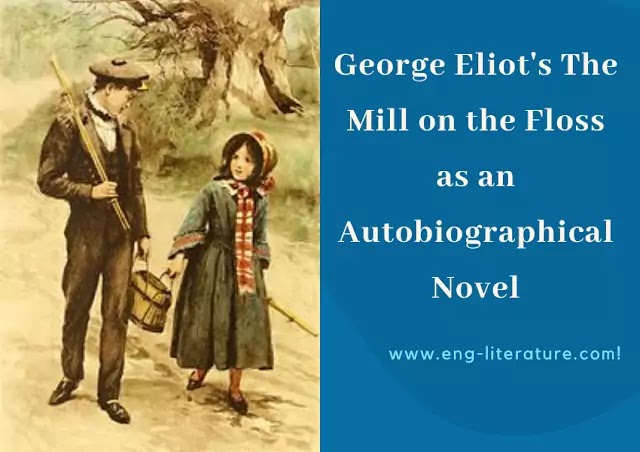
Assess George Eliot's "The Mill on the Floss" as an Autobiographical Novel

Assess George Eliot's "The Mill on the Floss" as an Autobiographical Novel

The ripest fruit of George Eliot's artistic genius The Mill on the Floss — has been regarded by many critics as the most autobiographical novel of the authoress. They argue that the heroine of the novel, Maggie Tulliver, is, in fact, the fictional ego of Marry Ann Evans (George Eliot). W.R. Nicolle goes to the extent of saying:

"So long as George Eliot is read, wise readers will turn to "The Mill on the Floss” as the best, the truest and the most authoritative account of her own complex character”.

Similarly, F. R. Leavis drawing close parallel between Maggie and George Eliot remarked:

"That Maggie is essentially identical with the young Marry Ann Evans we all know."

Yet the novel cannot be termed as an autobiography is the strict sense of the term for it does not project the life of my author in its entirety. We may find the life of the protagonist, Maggie, coinciding in some respects with that of Eliot, but is not sufficient to call the novel wholly autobiographical, as F. R. Leavis believes. The fact is that this identification is soul in ideas than in physical aspects.

The glimpses of Eliot's early life can be found jubilant, exciting and thrilling childhood of Maggie in the company of her brother Tom. Tom, to some critics, image of Eliot's brother Issac. Mr. Tulliver has borrowed from her father Robert Evans. Like Maggie, Eliot too was an unmanageable child who often became the butt of criticism due to her carelessness in dress and address. Just like Maggie, Eliot did have an adventure with the gypsies. In the delineation of Lucy's character, she remembered her own sister Christiana who, contrary to Eliot, was neat and pretty. This resemblance is sounder in nature, habits, liking and disliking of Maggie and Eliot.

However, the only sound incidental identification between Maggie and Eliot is in respect of Stephen-Maggie affair. Just as Maggie had a scandal with Stephen, Eliot had the same with Lewes with whom she kept living for twenty-four years without having any regular marriage. Both were socially disreputed and excommunicated. Both were innocent and had fallen a prey to the fossil conventions of the society. Maggie did not commit any immoral act and Eliot's resolution to live with Lewes was based on human values and laws of human heart. Since Lewes' wife had deserted him, Eliot thought he had a right to establish relation with some other woman. The scandals of both Eliot and Maggie led to their alienation from their brothers Isaac and Tom respectively. Eliot lived with Lewes till his death whereas Maggie was made to renounce Stephen, her love and met an accidental death. But this involves Eliot's moral scheme. Though she had a scandalous life with Lewes, but she never approved of such a life and she punished her women for even the slightest moral lapse. Because she knew that deviation from social conventions leads lo devastation and annihilation. When one meets social death, one dies forever.

Then Maggie's spiritual conflicts are identical with that of Eliot. George Eliot externalised her mental trauma by transmitting it to Maggie. Eliot too, like Maggie, was torn between duty and desire, between doubt and belief. Eliot was not dogmatic because orthodox Christian beliefs did not satisfy her inquisitive nature. She wanted to analyse everything on the bases of intellect. On the other hand, she had a profound sense of the immanence of God. This gave rise to a strong spiritual conflict in her mind which led her to the accusation agnosticism. Bust she was not agnostic. In fact, she never reached the certitude of belief.

Maggie too underwent the throes of this spiritual conflict. She was torn between duty and love. She loved Stephen passionately but at the same time she was morally bound by her duty towards Philip and Lucy. This conflict ultimately claims her life. 

Maggie was an imaginative and sensuous girl who wanted to enjoy all the beauties scattered around her. But at the same time she was also prone to self-sacrifice by nature and placed before her the ideal of renunciation and self-denial. It was because of this ideal that when she had to choose between a life of passionate love with Stephen and her duty to her family and position, she chose the latter. Thus through Maggie, Eliot has given vent to her own convictions because Eliot too believed in the absoluteness of duty. Eliot denounced self-dominance and Maggie was self-sacrificing.

The environment in which both Maggie and Eliot were born was not conducive for their intellectual satisfaction. Both were ahead of their time. Eliot's intellectual potentialities were too much for the environment around her to develop them. Similarly, Maggie's potentialities weakened in discouraging circumstances. She had thirst for knowledge but poverty never gave her way to progress. The mental cuteness, the clinging affectionateness, the ambitious nature, the thirst for knowledge, the love of music etc. are the traits of Maggie which speaks the very soul of Eliot.

As the identification is predominantly in thoughts and convictions etc. the critics prefer to call the novel a spiritual autobiography through which we can peep into the very soul of Mary Ann Evans.
 ~~~~~*~~~~~
Share:

Follow Me in Social Media

Get Free Updates

Tags

A Doll's House (1) A Renouncing of Love (1) Absurd Drama (2) African English Literature (2) Agyeya (1) Alexander Pope (7) American Literature (26) Amitav Ghosh (3) Analyses (22) Anglo-Saxon Period (1) Aravind Adiga (1) Arthur Miller (5) Australian Literature (2) Beowulf (3) Bertrand Russell (2) Bible (1) Biographies (12) Book Review (2) British Literature (106) Broad Notes (94) Character Analysis (2) Charles Dickens (1) Charles Lamb (2) Charlotte Bronte (2) Chetan Bhagat (2) Chinua Achebe (1) Christopher Marlowe (2) Classical Literature (2) Composition (4) Creative Writing (5) D. H. Lawrence (1) Daniel Defoe (1) Diaspora (4) Drama (1) Dream Children: A Reverie (1) E-book Download (12) Edmund Spenser (1) Edward Fitzgerald (1) Edward II (3) Elizabethan Era (2) English Language (15) English Literature (9) English Literature Quiz (8) Escapism (1) Essay (12) Essays (12) Eugene O'Neill (7) Explanations (3) Feminism (3) Francis Bacon (4) Frankenstein (4) Free E-book Download (5) Free PDF Download (4) Genre (1) Geoffrey Chaucer (1) George Eliot (4) George Herbert (1) George Orwell (1) Girish Karnad (1) Hard Times (1) Heart of Darkness (1) Henrik Ibsen (1) Henry Vaughan (2) Historical Novel (6) History of English Literature (22) Indian Drama (2) Indian English Poetry (1) Indian Fiction (3) Indian Writing in English (33) Indo-Anglican Literature (32) Interesting Facts (9) Interpreter of Maladies (2) Jane Austen (2) Jane Eyre (2) Jayanta Mahapatra (2) Jhumpa Lahiri (3) John Donne (5) John Dryden (1) John Keats (4) Joseph Addison (1) Joseph Conrad (1) Keki N. Daruwalla (1) Kenilworth (3) Kim (1) Knowledge and Wisdom (1) Leo Tolstoy (1) Linguistics (2) Literary Criticism (5) Literary Essay (9) Literary Facts (1) Literary MCQ (4) Literary Photo Album (1) Literary Terms (14) Literary Trends (1) Literary Types (7) Lord of the Flies (1) Lyric (1) M. K. Anand (2) Mac Flecknoe (1) Macbeth (7) Mahadevi Verma (2) Man Eater of Malgudi (2) Mark Twain (1) Mary Shelley (4) Mathew Arnold (1) Midnight's Children (1) Modern Poetry (3) Modernism (1) Motivational Short Story (21) My Penning (1) Nayantara Sahgal (1) Notes (25) Novel (60) Novels (5) O' Henry (1) Ode to a Nightingale (1) Ode to the West Wind (1) Oedipus Rex. Oedipus the King (2) Of Friendship (1) On Fame (1) Online Quiz (8) Othello (1) P B Shelley (1) P. B. Shelley (1) Paulo Coelho (2) Philological Notes (10) Phonetics (3) Picaresque Novel (5) Plays (41) Poetry (52) Popular Literature (1) Post Colonial Literature (1) Post Colonialism (1) Pride and Prejudice (2) Prosody (3) Quiz (6) Quotations (6) R. K. Narayan (2) Rabindranath Tagore (2) Random Quiz (6) Rape of the Lock (5) Realistic Fiction (1) Restoration Era (2) Rhetoric (2) Robert Browning (1) Robinson Crusoe (1) Romantic Poetry (2) Romanticism (2) Rubaiyat of Omar Khayyam (1) Rudyard Kipling (1) Salman Rushdie (2) Samuel Beckett (3) Sarojini Naidu (1) Seven Ages of Man (1) Shakespearean Influence (2) Shakespearean Plays (11) Shakespearean Sonnets (4) Sheridan (4) Short Notes (10) Short Stories (9) Soliloquy (1) Songs of Innocence (1) Sons and Lovers (1) Sophocles (1) Sri Aurobindo (1) Substance Writing (1) Summary (8) Sylvia Plath (1) T. S. Eliot (2) Texts (10) The Adventure of Tom Sawyer (1) The Alchemist (1) The Crucible (3) The Emperor Jones (7) The Golden Light (2) The Guide (1) The Mill on the Floss (4) The Namesake (1) The Pulley (2) The Rivals (5) The Shadow Lines (3) The Sunne Rising (5) The Superannuated Man (1) The Town Week (1) The White Tiger (1) The Winter's Tale (2) Things Fall Apart (1) Thomas Hardy (2) Thomas Wyatt (1) Toni Morrison (6) Tragedy (3) Tughlaq (1) Untouchable (2) Waiting for Godot (2) Walter Scott (3) Way of the World (1) William Blake (2) William Golding (1) William Shakespeare (14) William Wordsworth (3) Word Notes & Annotations (1) Word Notes & Anotations (2)

Blog Archive