



“Vayne man” sayd she, “That doest in vaine assay,
A mortal thing so to immortalize
For I myself shall lyke to this decay,
And eek my name bee wyped out likewise.”
The above quoted extract from ‘Sonnet No. 75’ is
ultimately from Edmund Spenser’s book of verse The Amoretti. The beloved harshly mocks at the lover’s
futile efforts to immortalize her name as well as herself. The lover is trying
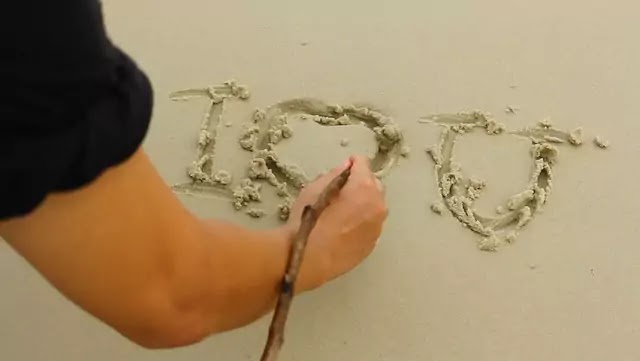
is best to preserve her sweetheart’s name on the sandy shore eternally. The
hungry tides come and wash the name away. The lover does the same job number of
times but gets the same result. In this way, the waves put the water into all
the endeavors made by the lover. On noticing this vain efforts the beloved, in
an ironical tone teases her lover’s excessive pride and vanity. The first
‘vayne’ refers to the boastful person who commits stupid things. The second
‘vaine’ suggests the fruitless and useless attempt. Being a woman of flesh and
blood she is bound to perish. She is well aware that she has no escape from
time’s icy hand. Besides raising a realistic note, her statement is flung at
the lover as a sort of challenge. It further brings out the grim problem, the
mortal nature of youth and beauty in the world of transitoriness.
“Not so” quod I “let baser things devise
To dy in dust, but you shall live by fame.”
In a taunting tone, the poet’s beloved (Elizabeth
Boyle) has laughed at the futile attempt to immortalize the mortal things. The extract
quoted above is the fitting reply to the mistress’ scoffing remark. The lover
argues that things of inferior quality may devise to die in dust. Things that
decay and die are base. This brings to our mind the Scholastic theory of the
nature of substances propounded by St. Thomas Aquinas. It says that base metal such
as iron decays because of its inferiority, but gold because of its sterling quality and integrity shines forever.
Keeping this theory in mind, the poet lover announces that his lady love’s
supreme qualities like pure love, fidelity, beauty, modesty and chastity must
not perish in course of time. These exceptional virtues will remain forever. The lover will immortalize those in his verse.
Art has the power and capacity to conquer over tome and death. Her love being
made of pure stuff will, therefore, know no destruction.
My verse your virtues rare shall etrnize,
And in the heavens wryte your glorious name,
Where whenas death shall all the world subdew,
Our love shall live and later life renew.
This is the concluding couplet of Spenser’s ‘Sonnet
No. 75’ from The Amoretti. The
lines are full of Spenser’s robust optimism and self confidence. Though his
lady love is doubtful about his endeavor to immortalize mortal creature in the
mortal world, the lover bears a strong sense of faith on the wings o poesy. He
assert that though he cannot prevent her physical decay, his eternal verse will
preserve the rare qualities of his paramour. What more can one expect from her
lover? Yes, the lover desires to write her ‘glorious name’ in the heaven so
that it may blaze forever in fiery letters. This love is so full of passion
that it will put new vigour and vitality in the ‘later life’. Definitely, it
will inspire and refresh the minds of the lover and the beloved of the
come-up-ages about the true quality of love. These lines clearly reflect the
perpetual existence of art and love in the world-of-death. As long as art and
love exist, the world too exists.
~~~~~@~~~~~