

All About English Literature: Notes

For Exclusive Notes and Analysis

Showing posts with label Notes. Show all posts

Saturday, 2 May 2020

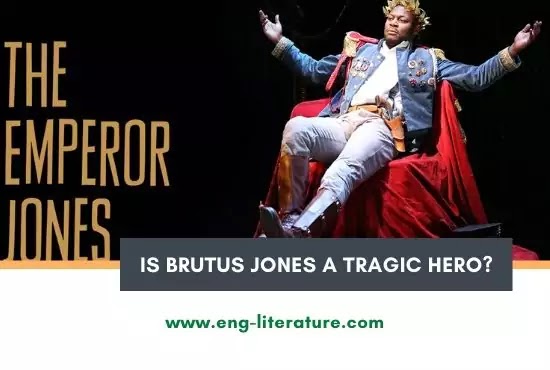
Character Analysis of Edward Rochester in Jane Eyre

Character Analysis of Edward Rochester in Jane Eyre
How is Mr Rochester presented in Jane Eyre?


Mr. Edward Fairfax Rochester does not strike us as a very amiable man when we first meet him; and even afterwards we do not feel that he is adorable as a hero in a novel is generally expected to be. He is by no means a handsome man; and he is no longer young when he falls in love with a girl who is barely half his age. Thus we are likely to frown at the love-affair which develops between him and the eighteen-year-old Jane Eyre.

At the outset, he seems to us to be a serious-minded and harsh man with a sullen disposition. He has always treated his ward, Adele with kindness and generosity, and yet he often becomes impatient when she tries to talk to him freely. His initial conversations with Jane also show him to be a rather staid kind of man or a man who is all the time stiff and even inflexible.

Mr. Rochester’s Reckless Past

There is another unpleasant aspect of his personality, and, in fact, this is an even more unpleasant aspect than his harsh nature and apparently unsocial attitude to life. This unpleasant feature of his character is the dissolute life which he has led in the past. He has had several amours or improper sexual relationships with women. Of course, he gives Jane enough reasons to justify his deviations from the code of social morality. But his account of his past love-affairs certainly leaves an unpleasant taste in our mouths.

Mr. Rochester’s Betrayal of Jane's Trust in Him

Is Mr Rochester a villain? 

In one respect, he is likely to appear to most readers as almost a villain. He has hidden from every inmate of Thornfield Hall, with the sole exception of a maidservant of the name of Grace Poole, the fact that he is an already married man with a wife who is still alive and who is living in that very house in which he resides. His keeping this fact a secret from everybody is no offence, morally or legally. But he becomes guilty of a serious offence, both morally and legally, when he hides the fact of being already married from Jane with whom he has fallen ardently and passionately in love, and when, furthermore, he tries to marry once more and thus commit bigamy.

Mr. Rochester’s Redeeming Qualities

Is Mr Rochester a sympathetic character?

All this shows the dark side of Mr. Rochester's character. But he does have certain redeeming qualities. Beneath his harsh nature, is his capacity to laugh, to make others laugh, to make merry, to entertain people, and to perform acts of kindness. He is extraordinarily kind to Adele even though she is in no way related to him. He has a strong sense of humour, and he can make witty remarks. He keeps his guests amused by devising all sorts of entertainments for them such as charades. His sense of humour is also revealed to us by his assuming the disguise of an old gypsy woman to befool his guests.

Mr. Rochester’s Passionate Love for Jane; and His Constancy in Love

His chief redeeming quality, however, is his passionate love for Jane, and his constancy in love. The whole world, they say, loves a lover. Mr. Rochester is an ardent lover who yearns for Jane even though he does not, for quite some time, let her know about the passion which is raging in his breast. It is when he proposes marriage to her that he shows his fervor in love. He tells her that he loves her as much he loves his own flesh; and he then urges her to say "yes" to his proposal without a moment's delay. There is not only urgency in his proposal of marriage but an intensity of passion. Later, when the marriage ceremony has been abandoned, and when Jane has decided to quit Thornfield Hall, he appeals to her not to forsake him. But her mind is made up. He then entreats, implores her, and even threatens to use violence against her, all because he does not want to lose her. Thus, as a lover, he certainly earns our regard and esteem.

Mr. Rochester : An “Impossible" Character

Mr. Rochester has been regarded by many critics as an "impossible" character, and we partly share this view. He has basically a jovial, almost gay, nature; but outwardly he assumes a look of harshness and even severity. He is an excellent singer, an excellent player on the piano, and an excellent entertainer, and yet his outward solemnity and gloom is a mask which he wears.

Mr. Rochester is a unique kind of man, as Jane Eyre is a unique kind of woman. A man, who is forty years old, has captured the heart and fancy of a girl who is only twenty years old. There must be indeed something fascinating about him. Edward Rochester belongs quite simply to the great family of Mirabeau (a French statesman), stormy, equivocal, powerful, and attractive.
~~~~~*~~~~~
Share:

Tuesday, 28 April 2020

Is Brutus Jones a Tragic Hero?

Is Brutus Jones a Tragic Hero?

Is Brutus Jones a Tragic Hero?
What type of character is Brutus Jones considered in Eugene O Neill's play The Emperor Jones?

The hero of The Emperor Jones is a remarkable creation. He has attained a stature, and is a person of some magnitude. He has not been involved in any physical conflict. It is through his own egotism and pride, through his exploitation of the natives, that he has provoked a revolution. His own hubris has brought about his downfall. But the main interest lies in following his mental reactions, his cogitations, and imaginary fears.

Who is the protagonist of the play The Emperor Jones?

Brutus Jones resembles the heroes of the Greek tragedies in so far as his own pride and egotism have antagonized him with others, and he wishes to belong to the universal order. Like other tragic heroes, Brutus Jones also has his epiphany or the moment of the self-realization. But O'Neill's hero is the twentieth century character involved in conflict with himself. Doris Folk has observed in connection with O'Neill's heroes : "An O'Neill protagonist is not compelled to make choices between alternate actions in order to accomplish another action ; he must make a choice between the alternate images of the self in order to discover the real-self which he often fails to do.”

Thus, O'Neill's heroes are engrossed in their conflict with self-images and real images. They must realize their true-self from which they have been removed. In this process, they clash with other characters.

Also Read:


Doris Falk, further comparing characters in Aristotle and O'Neill, points out that in Aristotle the character reveals a moral purpose. But in case of O'Neill's heroes there is "the ethos or moral : purpose of the character to perpetuate and strengthen an illusion about himself.” Thus every hero including Brutus Jones has created a self-image which he regards as the real image, but it runs against his real image or self. The false image causes hatred of the self and this impels him to run after something illusory, and this is the hero's hubris. O'Neill's hero has neurotic pride which entails his suffering and doom. Brutus Jones' self-image is born of his pride and dishonesty.

Brutus Jones is not an Aristotelian hero. Aristotle laid down the hero of a tragedy must be an exceptional individual, a man of high rank, a king or a prince, so that his fall from his former greatness would arouse the tragic emotions of pity and fear. All Shakespeare heroes fulfill this requirement. But Jones, the central figure in the play is not a hero in the Aristotelian sense. He is a crook with a shady criminal, who freely exploits the natives and by his superior cunning becomes their emperor within two years. No doubt he is superior to the natives in intelligence but he is entirely lacking in that nobility and greatness of soul which the tragic hero should have.

Pride is the fatal flaw in Jones' character. His pride makes him contemptuous of the natives over whom he rules, of the laws which he himself has made, and of his role as an emperor which he calls "a circus show” and which he stages not for love of it, but for the benefit of the ignorant and superstitious negroes. He is contemptuous even of the white Smithers. He is like the enslaved mankind to whom Prometheus had taught the use of fire. His first instinct is to despise all those who are still in bondage, to turn traitor to his own people, and to enslave them, as he himself had been enslaved, by superior knowledge and trickery of the whites.

Jones’s pride and arrogance make him a tyrant. He exploits the natives and extorts money from them, till the repression becomes intolerable and they rise against him in revolt. Their revolt is the direct outcome of his pride and wrong-doing. He knew that the natives were bound to revolt against him sooner or later, and had carefully planned his escape from the island. On the fateful day, he ran away from the palace with great self-confidence, but to no avail. He is ultimately killed by the natives with a silver bullet, the symbol of his pride and greed. 'Thus, it is his pride that is responsible for his downfall and death. But he is not fully purged of his pride because it is a silver bullet alone that has killed him. So his death is not cathartic in the Aristotelian sense either. He is not purged of his faults.

O'Neill has not exalted his hero. He has reversed the tragic process ; instead of going up the spiritual ladder, Jones goes down. The regression of Brutus Jones is akin to Lear's stripping, but Lear gains spiritually what he loses psychologically. Instead of revealing the nobility and grandeur of the human soul, Emperor Jones shows that man is essentially a beast and we find that his progress in civilization has made him a bundle of nerves.
Also Read:

~~~~~*~~~~~
Share:

Saturday, 25 April 2020

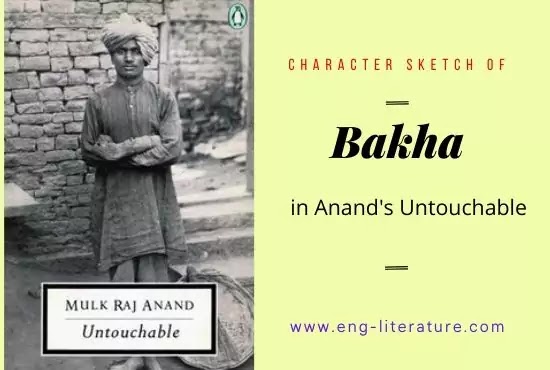
Character of Bakha in Untouchable

Character of Bakha in Untouchable

Character sketch of Bakha from Untouchable


Bakha is the central character in the novel. The novel revolves around his character. Everything is viewed from his point of view. He is a focused character and cynosure. Bakha is a youngman of eighteen, strong and able bodied, the son of Lakha. His father is the Jamadar of all the sweepers in the town and the cantonment, and officially in charge of three rows of public latrines. Bakha is not simply an individual outcaste rather he represents the entire community of the outcaste treated as untouchables and subjected to live most miserably.

Bakha’s Physique

He is healthy both physically and mentally. Anand writes "Each muscle of his body, hard as a rock when it came into play, seemed to shine forth like glass. He must have had immense pent-up resources lying deep in his body..."

Bakha's Divinity

Bakha is fearless and frank. He is distinguished from ordinary scavenger because of his sensitivity, consciousness and self respect. His extraordinary tolerance and humility betray this divinity. As E.M. Foster writes in the Preface, "Bakha is an individual, lovable, thwarted, sometimes grand sometimes weak, and thoroughly Indian. He is an admirable character. He is marked for his fortitude, tolerance, humility, self-respect and broad vision.”


Bakha’s Excellence and Prominence

We admire his sense of self-respect and nobility. Mulk Raj Anand writes "What a dextrous workman! the looker would have said.” Although his job was dirty he remained comparatively clean. He didn't even soil his sleeves handling the commodes, sweeping and scrubbing them. "Bakha is a member of social pariah. He suffers beyond limitation.” He suffers the humiliation and tyranny which he does not deserve. He is conscious of the evils of casteism. He is revengeful. He can revolt against the caste system, tradition and hackneyed rituals. But he cannot fight against the dominant, powerful caste Hindus. Bakha's situation is that of a tiger at bay'. We appreciate Bakha for his extra ordinary zeal, courage and broad vision of a morning of freedom and equality.

Bakha : His Passion for Fashion and Modernity

Mulk Raj Anand portrays Bakha's passion for fashion and modernity. He has a mania for English clothes and he obtains them from Tommies. For this reason Chota and Ram Charan, other outcaste boys in the colony call him jokingly as “Pilpali Saheb”. He smokes Red Camp cigarette and sips tea without blowing it cold.

Bakha’s Vulnerability

Twice Bakha thinks of retaliation : Once when he is slapped by a caste Hindu and later when his sister is molested by a priest. As such moments he appears, we are told. "Superb specimen of humanity", his fine form "rising as a tiger at bay”. The instinctive anger gives way and the slave in him asserts itself. "Untouchable ! Untouchable ! That's the word! Untouchable! I am an untouchable!”

Bakha’s Paradoxical Attributes

The coalescence of paradoxical attributes in his character gives thrust to a dual personality. There are two paradoxical aspects of his character. The first aspect reveals that he surrenders and submits himself to the superiority of the high caste Hindus. He has inherited such traits as a result of thousand years of subjugation. The second aspect of his character is that he has smouldering revenge and vengeance. His spirit of revolt urges him to be an open rebel of caste-ridden society.

Bakha, Correlated with Lakha

Bakha is born in an outcaste family. He was nurtured in the atmosphere of slavery. But he does not accept his life and profession as his inevitable destiny. He always keeps his self-dignity up. But his father, Lakha has submitted himself to the inevitable destiny. Bakha has a sense of civility but Lakha is uncouth and unclean.

Bakha’s Absolute Acceptance of Lot

The ultimate and most violent realizatiom comes when his sister, Sohini’s chastity and modesty is molested by a caste Hindu priest, Pandit Kalinath. He becomes revengeful and wants to kill the debauche. But he is helpless when he feels his limitations. He yields to tradition and kisses the defeat. He has developed a tendency to digest insult. He loves the modesty of his sister more than anything else but is unable to transform his anguish and anger into action.

Bakha ! Inert and Dynamic

Bakha is not an inert character. He is active and aggressive by temperament. His anglophile behavior suggests that he is undergoing a transition from tradition to modernity. He is an iconoclast at the bottom of his heart.  

Bakha  : A Libido  

Bakha does have natural sexual urge. He becomes erotic when he thinks of Ram Charan's sister with whom he shared his childhood. He paints an imaginary naked portrait of her. He enjoys the orgasm with her imaginary picture. Bakha's sexual urge arises up when he stops to see a scantily dressed woman in picture. Sometimes he is obsessed with incestuous feelings and emotions regarding his own sister Sohini.

Conclusion

In brief, Anand has given us one of the immortal characters of literature. The novelist has projected profound psychological insight in the portrayal of Bakha. He is aware and conscious of the social discrimination and injustice. He has the elements of revolt and protest but he has inherited servility of being an underdog of the society. Bakha is also a human being. He has the same blood in his veins as others. If we co-operate with Bakha, he can rise to great heights.

Also Read:


~~~~~*~~~~~

Share:

Thursday, 23 April 2020

Sons and Lovers as an Autobiographical Novel

Sons and Lovers as a Autobiographical Novel

Sons and Lovers as an Autobiographical Novel

Autobiographical novel is primarily comprised of made up events and characters that may be based on the author’s own experience and self. The protagonist might be modeled after the author and do at least some of the things the author has actually done in his or her life. Sons and Lovers is an autobiographical novel, much of which is taken from Lawrence's own early life in the midland coal-mining village of Eastwood. The experience of Lawrence and Paul overlaps a lot.

The autobiographical setting of Bestwood has a close resemblance with Eastwood, the place here Lawrence grew up as a child. Lawrence was born at a mining village in Nottinghamshire. In the novel, Lawrence also showed us the pen picture of coal-miners' life in the English Midlands according to his life experience. His father, a coal miner with little education was a heavy drunkard. The miners did terrible hard labour in the dark and damp pits day and night, thus they risked their life. They became rough and peremptory gradually. Only the wine can make them forget their distress and fatigue temporarily. They ill-treated their wives and children. Meanwhile, their wives brought up children in the narrow and small houses. The thousands of the coal miners' wives had the same predicament as Gertrude's(Paul's mother).

Also Read:
It was the very social background that caused the family conflicts of the Morel couple which stands similar to the Lawrence couple, Arthur and Lydia, Paul’s parents. They had a short period of happiness after their marriage, but the poverty, the hard labour and the low level of education destroyed her beautiful dream. Paul’s father got alcoholic. But his mother, once a school teacher was from a somewhat higher class, who came to think that she had married beneath her, and desired to raise the cultural level of her sons so as to help them escape from the life of coal miners. The conflict between the earthy and coarse, energetic but often drunk father and the refined, strong-willed and up-climbing mother is vividly presented in Sons and Lovers.

Lawrence was very close to his mother so much that even he admitted that his relationship with his mother interfered with his own relationships with women. Lawrence confessed at one point that he looked at his mother in a sexual way. His relationship with his father was very much like Paul's - both young men sided with their mothers and clung to them. They hate and detested their fathers and treated their mothers with love. As a young boy, he was sick and weak and preferred to stay at home with his mother and sisters rather than play with the boys.

There is close resemblance of Lawrence’s girlfriend of Nottingham high School, Jessie Chambers with that of Paul’s beloved Miriam in Sons and Lovers. As a student Lawrence was very intelligent and smart. Jessie was reserved and shy with him, because she felt inferior to him. The Chambers family was impressed Lawrence's knowledge of literature and philosophy. Lawrence cared for Jessie very deeply, but he didn't feel any attraction for her. His relationship with Jessie fluctuated between love and hate.

After Paul’s broken relationship with Jessie, he began another one with Louie Burrows in the last days of his mother's life. His mother died on December 10, 1910; Lawrence was ill and grief-stricken for moths. Prior to his mother's death, Lawrence started to write Sons and Lovers, which he called Paul Morel first. Sons and Lovers is his most autobiographical novel -  Lawrence drew upon his own memories and experiences to write the story of Paul Morel.

Paul bears a very clear and close resemblance with his own creator.  Like Paul, Lawrence was also a weak and sickly boy and he was brought very close to his mother by a serious attack of pneumonia. The persistent atmosphere of disharmony and the regular bickering of the parents had lain a great strain of Lawrence. Like Paul, Lawrence too was an introvert and shrank from life. He too had fits of depression and melancholy and a nameless horror filled his souls.

In conclusion we may say that Sons and Lovers is the most autobiographical novel penned by D. H. Lawrence. There is abundance of autobiographical elements in Sons and Lovers which speaks directly to the modern reader, eliciting both sympathy and empathy as Paul tries to become his own man.

Also Read:


~~~~~*~~~~~
Share:

Wednesday, 22 April 2020

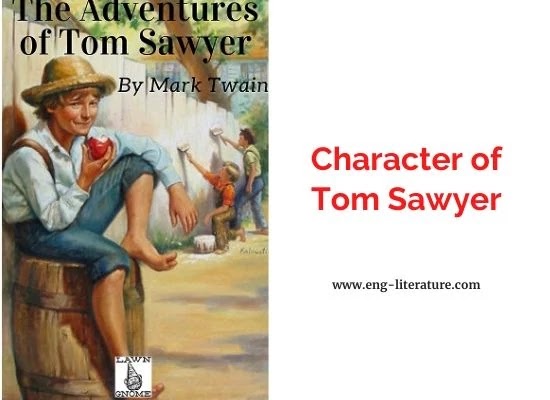
Character Analysis of Tom Sawyer

Character Abalysis of Tom Sawyer

Character Analysis of Tom Sawyer

"Tom was a glittering hero once more—the pet of the old, the envy of the young. His name even went into immortal print, for the village paper magnified him. There were some that believed he would be President, yet, if he escaped hanging."
- Narrator, The Adventures of Tom Sawyer

The title hero of Mark Twain, Tom Sawyer, an approximately 12-13 year old boy living in a small town in Missouri is the titular protagonist of the novel The Adventures of Tom SawyerHis true blood relatives deceased for unknown circumstances. He is cared for by his Aunt Polly, along with Sid and their family feline. He is well-known friends with the social outcast Huckleberry Finn and the neighborhood child Joe Harper. The Mississippi River, which runs very close to the town, is often the center of the excitement. The story is about how Tom grows up in the small town and the adventures he and his friends have.

Tom is lovable and infuriating at the same time. He is a typical little boy who loves adventure, but hates church, school, and chores.
His imagination often gets him into trouble because he follows his impulses. He created a huge debacle in church when the pinch-bug he was playing with wreaked havoc on the sermon. Some of his adventures being the time he ran away to play pirates on the sandbar of the Mississippi River and hanging out in the cemetery with Huck at midnight.
Tom has a huge crush on Becky and will get into trouble just so he can sit by her.Tom is not adept at formal education, yet he is by no means stupid. He bends rules but understands the difference between right and wrong when it counts. This is evident in how he helps Becky when she is in trouble with the schoolmaster.

Tom is a character of unflagging energy and a real zeal for trickery. When the novel begins, Tom is a mischievous child who envies Huck Finn’s lazy lifestyle and freedom. As Tom’s adventures proceed, however, critical moments show Tom moving away from his childhood concerns and making mature, responsible decisions. These moments include Tom’s testimony at Muff Potter’s trial, his saving of Becky from punishment, and his heroic navigation out of the cave. By the end of the novel, Tom is coaxing Huck into staying at the Widow Douglas’s, urging his friend to accept tight collars, Sunday school, and good table manners. He is no longer a disobedient character undermining the adult order, but a defender of respectability and responsibility. In the end, growing up for Tom means embracing social custom and sacrificing the freedoms of childhood.

Tom is throughout a leader in the games and adventures in which he and his friends are involved. He has a romantic imagination and absorbs tales of pirates and heroes like Robin Hood. Tom's leadership ability is tested when he is able to get other children to do his whitewashing for him by making the job seem like a rare privilege.

Yet Tom’s development isn’t totally coherent. The novel jumps back and forth among several narrative strands: Tom’s general misbehavior, which climaxes in the Jackson’s Island adventure; his courtship of Becky, which culminates in his acceptance of blame for the book that she rips; and his struggle with Injun Joe, which ends with Tom and Huck’s discovery of the treasure.
The picaro boy, Tom is a paradoxical figure in some respects—for example, he has no determinate age. Sometimes Tom shows the naivete of a smaller child, with his interest in make-believe and superstitions. On the other hand, Tom’s romantic interest in Becky and his fascination with Huck’s smoking and drinking seem more the concerns of an adolescent. Tom is a memorable character whose mischievous tendencies do not detract from his likability.
~~~~~*~~~~~
Share:

Monday, 20 April 2020

Addison's Prose Style or Addison as an Essayist

Addison's Prose Style or Addison as an Essayist

Addison's Prose Style in Sir Roger at Home

Joseph Addison was a great essayist, a philosopher social reformer and a critic of his age. He followed prose style which was a class by itself and also which made his essays smooth and graceful. J.H. Fowler rightly opined the Addison and his friend Steele could rightly be regarded as the founder of modern English essay and modern English prose, and “the larger share of achievement was Addison's."

Addison had invented an independent style which Dr. Johnson called the "Middle Style." Clarity in subject matter, simplicity in construction lucidity in structure, absence of obscurity, free from rigidity are the hallmarks of Addison's prose style. He never wrote too much decorated sentence. With great care and scrupulosity he avoided the lapse of composition, low words, slang words and the words of common use the colloquial words.

It was his excellent style as an essayist that Addison never depended on any particular theme for his essays. Popular superstitions, ignorance, vices, caprices, pursuits, fashion were all infused into his essays and Addison had represented them very nicely. He was aiming at castigating those vices and follies which were below and beyond the very cognizance of law and the pulpit.

Perfect character portrayal was the remarkable virtue of Addison. In his present essay, Sir Roger at Home. Addison has drawn a life-like character Sir Roger de Coverley with immense care. While we go through the essay we can easily imagine and even can see the old eccentric country gentleman in his homely nature -- how he received his particular friend, Addison : how he kept his guests at ease by allowing them to do thing according to their whim and caprice: how much he loved his servants who were also aged like their master : how he kept old house dog and horse with great care and tenderness though they were useless - and many other pictures along with Sir Roger's dispositions, his likes and dislikes were represented minutely and shrewdly.

Addison's principal literary gifts - a delicate taste, a keen sense of humour an insight into character - are all united in the portrayal of Sir Roger de Coverley. Though Sir Roger was first sketched and was afterwards occasionally touched by Steele, he is in the main Addison's creation.

Addison has been considered the perfect model for those who wish to learn how to write English. Johnson has rightly observed, "whoever wishes to attain an English style, familiar but not coarse, and elegant but not ostentatious, must give his days and nights to the volumes of Addison."

The greatest style is the expression of the highest energy, intellectual and moral. Addison also taught the lesson of neatness, lucidity and precision "He and the Queen Anne essayists" as Hugh Walker says, "have been a permanent force on the side of sanity and restraint of thought and clearness of expression".

To find Addison as an essayist, we should borrow the remark of J.H. Fowler - “It is good to read Addison first because he is full of charm because we soon come to feel an affection for this silent, keen and kindly spectator of men, because he brings back to us vividly the vanished life of the early eighteenth century: because he creates in Sir Roger de Coverley one of the most delightful characters in the whole range of English literature."

It is one of the features of his essays that Addison used allegories, allusions, even anecdotes frequently in his essays. He used them successfully to issue his humour. It is for this reason K. Deighton commented, "As regards Addison's style, of no one could it more truly be said that the style is the man. He has a manner, but not mannerism."

Addison aimed at satirizing all vices, follies and foibles of the then English society. He threw the shafts of satire even to the unnatural fondness for trivialities and frivolities of dress and behaviour.

There is perhaps a little controversy that Addison is one of greatest essayists and critics of his age. The prose style of Addison is unsurpassable. If better to conclude with what E. Albert says, “His style has often deservedly praised. It is the pattern of the middle style never slipshod or obscure, or unmelodious. He has an infallible instinct for the proper, and an infallible ear for a subdued and grace rhythm.”

Also Read:

~~~~~*~~~~~
Share:

Saturday, 18 April 2020

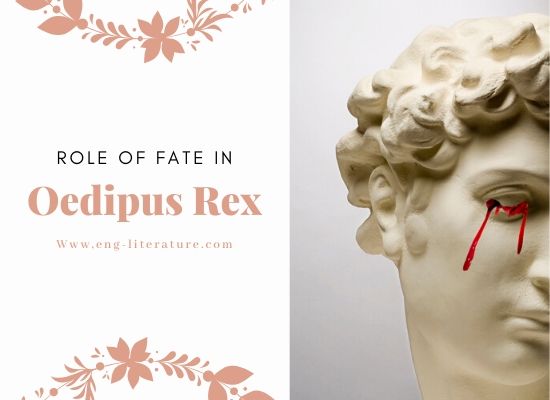
Role of Fate in Oedipus Rex

Role of Fate in Oedipus Rex

Role of Fate in Oedipus the King
In the Greek tragedy Oedipus the King written by Sophocles, the antagonist is fate. “Destiny is character” here. The role of fate is deeply intertwined in the plot. Predestination in Oedipus the King caused havoc despite attempting to escape it. Two characters bring about a fate worse than their original fate as punishment for trying to cheat fate.

The first instance-involving fate occurs when Oedipus sends Creon, Jocasta’s brother, to the temple of Apollo, the god of prophecy and healing, to find the fate of Thebes and how to rid Thebes of the plague the people are suffering from. Oedipus says,
“I acted at once. I sent Creon,
My wife’s own brother, to Delphi—
Apollo the Prophet’s oracle7—to learn
What I might do or say to save our city.”
(Sophocles, 81-84)

It is important to note that Apollo made the prophecy to King Laius, Jocasta’s former husband, and Jocasta, Oedipus’s wife, that they would bear a son who would kill King Laius, and Apollo made the prophecy to Oedipus that he would kill his biological father and sleep with his biological mother.

Fate is next brought into the play when Creon is sent in search of the blind prophet of Apollo, Tiresias. Against his will, Tiresias reveals Oedipus' fate. Oedipus is so anxious to find the murderer of King Laius that he will not give up until the murderer is found. Oedipus relentlessly pursues the truth, unwilling to give up until the truth is found.
After Oedipus repeatedly provokes Tiresias, he reveals what Oedipus is and who Oedipus really is. Tiresias says to Oedipus,
“You cannot imagine…I tell you,
you and your loved ones live together in infamy,
you cannot see how far you’ve gone in guilt.”
(Sophocles, 417-419)

Tiresias is alluding to the fact that Oedipus unknowingly is married to his mother and has produced offspring through her. Oedipus is too blind to comprehend what Tiresias is saying. Tiresias goes on to say, "I pity you, flinging at me the very insults / each man here will fling at you so soon" (Sophocles, 423-424). Tiresias is warning Oedipus that everything he thinks he has is not really his. People will turn against Oedipus and he will lose everything. Oedipus blasphemes against the gods when he tells Tiresias that he does not have the gift of prophecy. This is blasphemy because Tiresias is the messenger between gods and humans, and when Oedipus calls him a liar he is denying the words of the gods.

Upon further provocations, Tiresias tells Oedipus that Oedipus does not know where he is living or who his parents are. Tiresias insinuates that Oedipus is both father and sibling to his children when he says, "And a crowd of other horrors you’d never dream / will level you with yourself and all your children" (Sophocles, lines 485-486). Next Tiresias predicts, "This day will bring your birth and your destruction" (Sophocles, 499).

In his final speech towards Oedipus, Tiresias tells Oedipus that he is the murderer. Tiresias further tells Oedipus that though he is a stranger to Thebes, he will soon discover that he is a native Theban. Oedipus will also discover that he is both father and brother to his children, and both son and husband to his wife. Tiresias aptly foretells that Oedipus will lose everything; that Oedipus will be blind and exiled (Sophocles, 510-525).

After first arguing with Tiresias and then Creon, Oedipus talks to Jocasta, bringing about our third example of fate as an antagonist. Upon learning what the argument was about Jocasta relays that an oracle had come to King Laius and told him that he would "die a victim at the hands of his own son" (Sophocles, 786-787). The king had pierced the infant's ankles and sent him to die. Besides King Laius was killed by highwayman. Jocasta argues that Oedipus should not fear prophecy because of the following,
“Apollo brought neither thing to pass. My baby,
no more murdered his father than Laius suffered,
his wildest fear—death at his own son’s hands.
That’s how the seers and all their revelations.”
(Sophocles, 794-797)

Jocasta should have known that she could not outwit the gods, or fate. Fate next comes into play when Oedipus, who has begun to think he is King Laius' killer, recounts the dinner where the drunken man accused Oedipus of being a bastard. Oedipus goes to the oracle at Delphi to find his destiny. The oracle tells Oedipus as follows:
“You are fated to couple with your mother, you will bring,
A breed of children into the light no man can bear to see—
You will kill your father, the one who gave your life!.”
(Sophocles, 873-875)

After hearing the oracle's prediction, Oedipus flees Corinth to protect Merope and Polybus and to escape his destiny, which gives us our fifth instance of fate.

The change in the curse was brought about by Jocasta, who feared the oracle's prophecy. Jocasta sent the infant, Oedipus, to his death. In doing this Jocasta was attempting to cheat fate. Jocasta thought that if she killed the baby, she could change her husband's destiny. The added prophecy that Oedipus would lie with his mother and produce cursed offspring is a result of Jocasta's attempt to cheat fate. Oedipus is really an innocent victim of fate.

Again fate is seen when the messenger brings news that Polybus has died a natural death. Both Oedipus and Jocasta rejoice briefly in this news for it further proves that oracles are wrong Yet, Oedipus still has fear of prophecy for he will not return to Corinth as long as Merope is alive, for fear that he will lay with her. The messenger tells Oedipus that Merope is not Oedipus' true mother, as he himself gave Oedipus to her and to Pelops as a gift (Sophocles, 1113-1119). It is a strange twist of fate this messenger both took Oedipus to Corinth, but also is one of the final puzzle pieces in Oedipus' true identity.

When the shepherd arrives on the scene he is forced by Oedipus to verify that Oedipus is the child of Jocasta and King Laius. Oedipus' is now forced to realize that he has not escaped his fate. The entire prophecy has been fulfilled. After finding Jocasta's body, "And there we saw the woman hanging by the neck" (Sophocles, 1396), Oedipus does the following:
“He rips off her brooches, the long gold pins
holding her ropes—and lifting them high,
looking straight up into the points,
he digs them down the sockets of his eyes, crying.”
(Sophocles, 1403-1406)

In the end of the play Oedipus is blind, ruined, and exiled just as Tiresias foretold when he said,
“You are the scourge of your own flesh and blood,
And the double lash of your mother and your father’s curse
Will whip you from this land one day, their football
Treading you down in terror, darkness shrouding
Your eyes that now can see the light.”
(Sophocles, 474-479)

Fate came out victorious in the end. In the Greek vision Fate cannot be altered or cheated. Even the gods cannot change Fate. Instead of claiming one victim, many were ruined. If Jocasta had not tried to cheat fate, perhaps King Laius would be the only death. Instead King Laius and Jocasta are both dead, Oedipus is ruined and his children are cursed by this incestuous pollution. Fate is a force not to be reckoned with.

Is Oedipus responsible for his own fate? Considering all the facts ,we can say that Oedipus is neither a free agent nor a mere victim of fate. The major events of his life are determined by the tragedy of fate, but his own acts such as fleeing from Corinth, killing an old man, marrying an aged woman, without knowing his whole identity, showing over-confidence and milking the shepherd for information all have contributed in precipitating the disaster.

Also Read:

~~~~~*~~~~~
Share:

Is Tess a Pure Woman ?

Is Tess A Pure Woman ? English Literature
When Tess of the d'Urbervilles was first published, it caused a storm. Many people found the sub-title of the book offensive. They did not understand how Tess could be subtitled a pure woman when her sexual and criminal guilt were beyond dispute. In a note Hardy regretted the fact that his critics had ignored the meaning of the word "pure" in nature, together with all aesthetic claims upon it, not to mention the spiritual interpretation afforded by the finer side of their own Christianity.
Hardy regarded Tess as a pure woman, and rightly so. It is clear from events preceding the seduction that Tess in no way encourages Alec in his amorous advances. From the beginning she shows a natural modesty and a chaste independence of mind and body. She is distressed when Alec feeds her with strawberries. She wipes off the kiss he gives her on her second journey to "The Slopes." She strong-mindedly decides to walk the last few miles, rather than sit next to him on the carriage. Owing to her dependence on Alec's mother, and his mother's dependence on him because of that lady's blindness, Tess becomes more pliable under Alec's hands than a mere companionship would have made her.
Alec D'Urberville is a man skilled in the arts of seduction. Even though he could never have led Tess to a wholehearted surrender, his tactics bewilder her, and undermine the security of her defence. It seems likely also that she was not very well aware of the physical act to which it was all leading. She was ill-prepared to fight culpable passions, the existence of which she did not know about. Later she puts much of the blame on her mother: "Why didn't you, warn me?”
Alec had subtly worn down her mental defenses, though certainly the point of conscious submission. On the journey home on Alec's horse after the fight with one of her companions, Tess, is in a physical exhaustion. She is indescribably weary. She had risen at five every morning of that week and had been at work the whole of each day. On this evening she had, in addition, walked the three miles to Chasehorborough, waited three hours for her neighbours without eating or drinking, then walked a mile of the way home and had undergone the excitement of quarrel. It was now nearly one o'clock. Tess naturally falls into a sleep when Alec returns and attempts the seduction, she is neither physically mentally in a condition to resist, and she hardly understands what, he is doing till it is too late.
There is some ambiguity on the fact why Tess stayed "some few weeks" after her seduction though some critics are of the opinion that during this period she had no sexual relationship with Alec. But the language used by Hardy to describe this stay offers a basis for the assumption that the sexual relationship did exist even after the first seduction. If she had not surrendered at all even on the first occasion, she would surely have run away immediately.
Mrs. Durbeyfield reacts in the "natural" way to Tess's sad expen "Tis nature after all, and what do please God!" Sex is a natural activity Tess is a child of Nature. We see her growth to womanhood, her "luxuriance of aspect", and "fullness of growth" not as isolated facts, but as part of the "brimfulness of Nature itself." Throughout the novel Hardy emphasis the neutrality or innocence of Nature, Nature is neither benevolent nor malevolent. Nature is not a force for good or for evil. In this sense, Tess is innocent. The physical surrender of a passionate girl is natural, innocent in the simple animalistic course of events. She did not surrender her heart: indeed her heart was almost unaware of what was happening. Hardy takes many opportunities to point out the strangeness of society's artificial, unnatural code. Tess is weighed down by a consciousness of guilt. But Hardy asserts that she is deluded by the conventional attitudes of society,
Tess's purity with regard to the murder of Alec d'Urberville is a more difficult problem. She kills him willingly and knowingly. Alec has been instrumental in bringing about Tess's destruction. His actions have caused her untold suffering and have completely wrecked her happiness. Tess has begun to believe that Angel Clare would never return, and also because of the overpowering feeling that Alec is her only true husband in any substantial sense. Only by Alec's death could that physical claim be obliterated: only by killing him could she finally repudiate all that he had done.
We are firmly convinced that morally and spiritually Tess is absolutely stainless and pure. Purity is of the spirit, and with a spiritual reference, the word "pure" may be unconditionally applied to her. Purity is not to be taken in the narrow sense o f the body, it is the spirit that really matters. Tess has a strong conscience which she always hearkens to. Her inner voice tells her o f the dangers going to the new family in The Chase. Her final surrender to Alec is beyond her control. She is not her true self, the sufferings o f her family have destroyed all the willpower and strength that she possesses. "She is as moral as any prude. Her behaviour, her thoughts, her desires, on all perilous occasions - with d'Urberville, early had late, with Clare, with her other admirers - are unimpeachable, considered from the most critical code and point of view. Moreover, her shame and remorse are infinite….”
~~~~~*~~~~~
Share:

Follow Me in Social Media

Get Free Updates

Tags

A Doll's House (1) A Renouncing of Love (1) Absurd Drama (2) African English Literature (2) Agyeya (1) Alexander Pope (7) American Literature (26) Amitav Ghosh (3) Analyses (22) Anglo-Saxon Period (1) Aravind Adiga (1) Arthur Miller (5) Australian Literature (2) Beowulf (3) Bertrand Russell (2) Bible (1) Biographies (12) Book Review (2) British Literature (106) Broad Notes (94) Character Analysis (2) Charles Dickens (1) Charles Lamb (2) Charlotte Bronte (2) Chetan Bhagat (2) Chinua Achebe (1) Christopher Marlowe (2) Classical Literature (2) Composition (4) Creative Writing (5) D. H. Lawrence (1) Daniel Defoe (1) Diaspora (4) Drama (1) Dream Children: A Reverie (1) E-book Download (12) Edmund Spenser (1) Edward Fitzgerald (1) Edward II (3) Elizabethan Era (2) English Language (15) English Literature (9) English Literature Quiz (8) Escapism (1) Essay (12) Essays (12) Eugene O'Neill (7) Explanations (3) Feminism (3) Francis Bacon (4) Frankenstein (4) Free E-book Download (5) Free PDF Download (4) Genre (1) Geoffrey Chaucer (1) George Eliot (4) George Herbert (1) George Orwell (1) Girish Karnad (1) Hard Times (1) Heart of Darkness (1) Henrik Ibsen (1) Henry Vaughan (2) Historical Novel (6) History of English Literature (22) Indian Drama (2) Indian English Poetry (1) Indian Fiction (4) Indian Writing in English (34) Indo-Anglican Literature (33) Interesting Facts (9) Interpreter of Maladies (2) Jane Austen (2) Jane Eyre (2) Jayanta Mahapatra (2) Jhumpa Lahiri (3) John Donne (5) John Dryden (1) John Keats (4) Joseph Addison (1) Joseph Conrad (1) Keki N. Daruwalla (1) Kenilworth (3) Kim (1) Knowledge and Wisdom (1) Leo Tolstoy (1) Linguistics (2) Literary Criticism (5) Literary Essay (9) Literary Facts (1) Literary MCQ (4) Literary Photo Album (1) Literary Terms (14) Literary Trends (1) Literary Types (7) Lord of the Flies (1) Lyric (1) M. K. Anand (2) Mac Flecknoe (1) Macbeth (7) Mahadevi Verma (2) Man Eater of Malgudi (2) Mark Twain (1) Mary Shelley (4) Mathew Arnold (1) Midnight's Children (1) Modern Poetry (3) Modernism (1) Motivational Short Story (21) My Penning (1) Nayantara Sahgal (1) Notes (25) Novel (60) Novels (6) O' Henry (1) Ode to a Nightingale (1) Ode to the West Wind (1) Oedipus Rex. Oedipus the King (2) Of Friendship (1) On Fame (1) Online Quiz (8) Othello (1) P B Shelley (1) P. B. Shelley (1) Paulo Coelho (2) Philological Notes (10) Phonetics (3) Picaresque Novel (5) Plays (41) Poetry (52) Popular Literature (1) Post Colonial Literature (1) Post Colonialism (1) Pride and Prejudice (2) Prosody (3) Quiz (6) Quotations (6) R. K. Narayan (2) Rabindranath Tagore (2) Raja Rao (1) Random Quiz (6) Rape of the Lock (5) Realistic Fiction (1) Restoration Era (2) Rhetoric (2) Robert Browning (1) Robinson Crusoe (1) Romantic Poetry (2) Romanticism (2) Rubaiyat of Omar Khayyam (1) Rudyard Kipling (1) Salman Rushdie (2) Samuel Beckett (3) Sarojini Naidu (1) Seven Ages of Man (1) Shakespearean Influence (2) Shakespearean Plays (11) Shakespearean Sonnets (4) Sheridan (4) Short Notes (10) Short Stories (9) Soliloquy (1) Songs of Innocence (1) Sons and Lovers (1) Sophocles (1) Sri Aurobindo (1) Substance Writing (1) Summary (8) Sylvia Plath (1) T. S. Eliot (2) Texts (10) The Adventure of Tom Sawyer (1) The Alchemist (1) The Crucible (3) The Emperor Jones (7) The Golden Light (2) The Guide (1) The Mill on the Floss (4) The Namesake (1) The Pulley (2) The Rivals (5) The Shadow Lines (3) The Sunne Rising (5) The Superannuated Man (1) The Town Week (1) The White Tiger (1) The Winter's Tale (2) Things Fall Apart (1) Thomas Hardy (2) Thomas Wyatt (1) Toni Morrison (6) Tragedy (3) Tughlaq (1) Untouchable (2) Waiting for Godot (2) Walter Scott (3) Way of the World (1) William Blake (2) William Golding (1) William Shakespeare (14) William Wordsworth (3) Word Notes & Annotations (1) Word Notes & Anotations (2)