





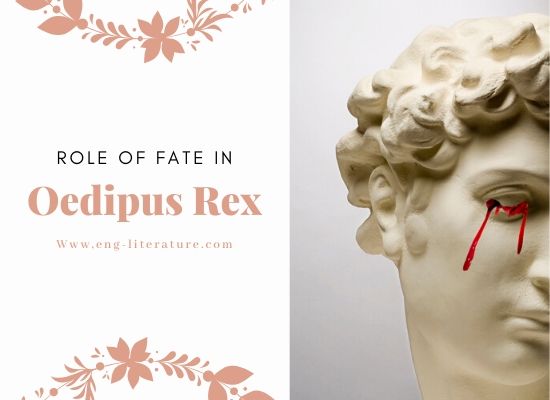
Role of Fate in Oedipus the King
In the Greek
tragedy Oedipus the King written by
Sophocles, the antagonist is fate. “Destiny is character” here. The role of fate is deeply intertwined in
the plot. Predestination in Oedipus the King caused havoc despite attempting to escape it. Two
characters bring about a fate worse than their original fate as punishment for
trying to cheat fate.
The first
instance-involving fate occurs when Oedipus
sends Creon, Jocasta’s brother, to the temple of Apollo, the god of prophecy
and healing, to find the fate of
Thebes and how to rid Thebes of the plague the people are suffering from.
Oedipus says,
“I acted at
once. I sent Creon,
My wife’s own brother, to Delphi—
Apollo the Prophet’s oracle7—to learn
What I might do or say to save our city.” (Sophocles, 81-84)
My wife’s own brother, to Delphi—
Apollo the Prophet’s oracle7—to learn
What I might do or say to save our city.” (Sophocles, 81-84)
It is
important to note that Apollo made the prophecy to King Laius, Jocasta’s former
husband, and Jocasta, Oedipus’s wife, that they would bear a son who would kill
King Laius, and Apollo made the prophecy to Oedipus that he would kill his
biological father and sleep with his biological mother.
Fate is next brought into the play when Creon is sent in
search of the blind prophet of Apollo, Tiresias. Against his will, Tiresias
reveals Oedipus' fate. Oedipus is so anxious to find the murderer of King Laius
that he will not give up until the murderer is found. Oedipus relentlessly
pursues the truth, unwilling to give up until the truth is found.
After
Oedipus repeatedly provokes Tiresias, he reveals what Oedipus is and who
Oedipus really is. Tiresias says to Oedipus,
“You cannot
imagine…I tell you,
you and your loved ones live together in infamy,
you cannot see how far you’ve gone in guilt.” (Sophocles, 417-419)
you and your loved ones live together in infamy,
you cannot see how far you’ve gone in guilt.” (Sophocles, 417-419)
Tiresias is
alluding to the fact that Oedipus unknowingly is married to his mother and has
produced offspring through her. Oedipus is too blind to comprehend what
Tiresias is saying. Tiresias goes on to say, "I pity you, flinging at me
the very insults / each man here will fling at you so soon" (Sophocles,
423-424). Tiresias is warning Oedipus that everything he thinks he has is not
really his. People will turn against Oedipus and he will lose everything.
Oedipus blasphemes against the gods when he tells Tiresias that he does not
have the gift of prophecy. This is blasphemy because Tiresias is the messenger
between gods and humans, and when Oedipus calls him a liar he is denying the
words of the gods.
Upon further
provocations, Tiresias tells Oedipus that Oedipus does not know where he is
living or who his parents are. Tiresias insinuates that Oedipus is both father
and sibling to his children when he says, "And a crowd of other horrors
you’d never dream / will level you with yourself and all your children"
(Sophocles, lines 485-486). Next Tiresias predicts, "This day will bring
your birth and your destruction" (Sophocles, 499).
In his final
speech towards Oedipus, Tiresias
tells Oedipus that he is the murderer. Tiresias further tells Oedipus that though he is a stranger to
Thebes, he will soon discover that he is a native Theban. Oedipus will also
discover that he is both father and brother to his children, and both son and
husband to his wife. Tiresias aptly foretells that Oedipus will lose
everything; that Oedipus will be
blind and exiled (Sophocles, 510-525).
After first
arguing with Tiresias and then Creon, Oedipus talks to Jocasta, bringing about
our third example of fate as an antagonist. Upon learning what the argument was
about Jocasta relays that an oracle had come to King Laius and told him that he
would "die a victim at the hands of his own son" (Sophocles, 786-787).
The king had pierced the infant's ankles and sent him to die. Besides King
Laius was killed by highwayman. Jocasta argues that Oedipus should not fear
prophecy because of the following,
“Apollo
brought neither thing to pass. My baby,
no more murdered his father than Laius suffered,
his wildest fear—death at his own son’s hands.
That’s how the seers and all their revelations.” (Sophocles, 794-797)
no more murdered his father than Laius suffered,
his wildest fear—death at his own son’s hands.
That’s how the seers and all their revelations.” (Sophocles, 794-797)
Jocasta
should have known that she could not outwit the gods, or fate. Fate next comes into play when Oedipus, who has begun to think he is King Laius' killer, recounts
the dinner where the drunken man accused Oedipus
of being a bastard. Oedipus goes to the oracle at Delphi to find his destiny.
The oracle tells Oedipus as follows:
“You are
fated to couple with your mother, you will bring,
A breed of children into the light no man can bear to see—
You will kill your father, the one who gave your life!.” (Sophocles, 873-875)
A breed of children into the light no man can bear to see—
You will kill your father, the one who gave your life!.” (Sophocles, 873-875)
After
hearing the oracle's prediction, Oedipus
flees Corinth to protect Merope and Polybus and to escape his destiny, which
gives us our fifth instance of fate.
The change
in the curse was brought about by Jocasta, who feared the oracle's prophecy.
Jocasta sent the infant, Oedipus, to his death. In doing this Jocasta was
attempting to cheat fate. Jocasta
thought that if she killed the baby, she could change her husband's destiny.
The added prophecy that Oedipus would lie with his mother and produce cursed
offspring is a result of Jocasta's attempt to cheat fate. Oedipus is really
an innocent victim of fate.
Again fate is seen when the messenger brings
news that Polybus has died a natural death. Both Oedipus and Jocasta rejoice briefly in this news for it further
proves that oracles are wrong Yet, Oedipus still has fear of prophecy for he
will not return to Corinth as long as Merope is alive, for fear that he will
lay with her. The messenger tells Oedipus that Merope is not Oedipus' true
mother, as he himself gave Oedipus
to her and to Pelops as a gift (Sophocles, 1113-1119). It is a strange twist of
fate this messenger both took Oedipus to Corinth, but also is one of the final
puzzle pieces in Oedipus' true
identity.
When the
shepherd arrives on the scene he is forced by Oedipus to verify that Oedipus
is the child of Jocasta and King Laius. Oedipus' is now forced to realize that
he has not escaped his fate. The
entire prophecy has been fulfilled. After finding Jocasta's body, "And
there we saw the woman hanging by the neck" (Sophocles, 1396), Oedipus
does the following:
“He rips off
her brooches, the long gold pins
holding her ropes—and lifting them high,
looking straight up into the points,
he digs them down the sockets of his eyes, crying.” (Sophocles, 1403-1406)
holding her ropes—and lifting them high,
looking straight up into the points,
he digs them down the sockets of his eyes, crying.” (Sophocles, 1403-1406)
In the end
of the play Oedipus is blind,
ruined, and exiled just as Tiresias foretold when he said,
“You are the scourge of your own flesh and blood,
And the double lash of your mother and your father’s curse
Will whip you from this land one day, their football
Treading you down in terror, darkness shrouding
Your eyes that now can see the light.” (Sophocles, 474-479)
“You are the scourge of your own flesh and blood,
And the double lash of your mother and your father’s curse
Will whip you from this land one day, their football
Treading you down in terror, darkness shrouding
Your eyes that now can see the light.” (Sophocles, 474-479)
Fate came out victorious in the end. In the Greek vision Fate cannot be altered or cheated. Even
the gods cannot change Fate. Instead of claiming one victim, many were ruined.
If Jocasta had not tried to cheat fate, perhaps King Laius would be the only
death. Instead King Laius and Jocasta are both dead, Oedipus is ruined and his
children are cursed by this incestuous pollution. Fate is a force not to be
reckoned with.
Is Oedipus responsible for
his own fate? Considering
all the facts ,we can say that Oedipus is neither a free agent nor a mere
victim of fate. The major events of his life are determined by the tragedy of fate, but his own acts such
as fleeing from Corinth, killing an old man, marrying an aged woman, without
knowing his whole identity, showing over-confidence and milking the shepherd
for information all have contributed in precipitating the disaster.
Also Read:
~~~~~*~~~~~