All About English Literature: Frankenstein

For Exclusive Notes and Analysis

Showing posts with label Frankenstein. Show all posts

Saturday, 11 April 2020

Character Sketch of Monster or Creature in Frankenstein

Character-Sketch-Monster-Creature-Frankenstein

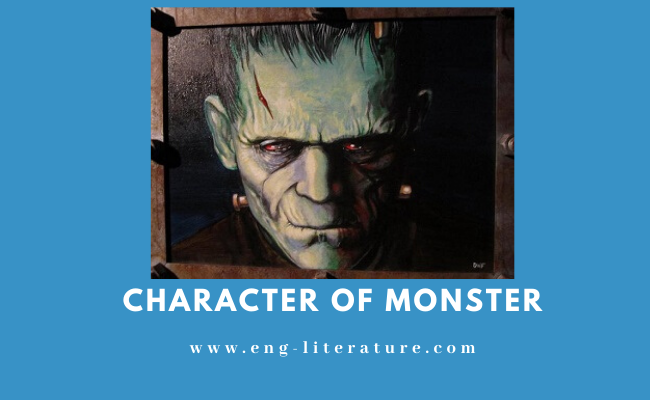
The monster of Frankenstein is a controversial creature: he is furious, full of hatred and commits hideous crimes and inflicts horror and grief upon Victor and his family. However, it is worth noting that he is not born with such qualities. Since his first moments in life, the creature witnesses fear in the eyes of his creator, who flees directly after beholding his loathsome appearance in the dark laboratory. After wandering off the woods, alone and with no knowledge, the creature is faced with scorn and violence from the villagers. Because he cannot understand their behaviour, the monster draws him back to the woods and lurks there.

So far the monster’s experience with humans is not pleasurable; therefore he keeps his presence secret in the cottage near the village. By watching the cottagers closely, the creature acquires knowledge of how to read and speak. Furthermore, by examining the physical appearance of the cottagers and noticing his, he is able to recognise his hideousness, and, is therefore, able to understand the human violent attitude toward him. Soon, he starts to feel affection toward the family for their love and appreciation toward each other: “the gentle manners and beauty of the cottagers greatly endeared them to me; when they were unhappy, I felt depressed; when they rejoiced, I sympathized in their joy”.

After spending a deal of time with this family, the creature attempts for acceptance but he is faced with the same attitude of refusal. Also, when he saves a girl from drowning, his hideous appearance provokes fear and a man starts shooting at him. By this, the monster changes, he explains his cruelty: “I am malicious because I am miserable. I am not shunned and hated by all mankind? ... If I cannot inspire love, I will cause fear”.

In his early times, the creature is shown full of emotions and affection. And because of his loneliness, he longs for companion: “if any being felt emotions of benevolence towards me, I will return hundred and hundredfold; for that one creature’s sake I would make peace with the whole kind!” When Victor destroys the female companion, the creature is filled with immense anger and evil.

Like Victor, the creature has two sides: he is good and evil at the same time. At the end, he regrets his crimes and while his evil side is apparent that of his creator remains concealed due to egotism.
~~~~~*~~~~~
Share:

Friday, 10 April 2020

Frankenstein: It's Background for writing this novel

Frankenstein: It's Background for writing this novel

Intro:

Marry Shelley's Frankenstein is a unique novel in the canon of English literature. The novel seeks to find the answers to questions that no doubt perplexed Mary Shelley and the readers of her time. Mary Shelley presents a unique character in Victor Frankenstein and his creation, the monster.

Technological Advancement of the Early 19th Century:

Marry Shelley also is keenly aware of the concern that technology was advancing at a rate that dizzied the mind of early 18th century readers. Perhaps this novel is addressing that issue of advances created by men, but which fly in the face of "natural" elements and divine plans. Mary Shelley crafts her exquisite novel in a way to direct attention to the treatment of the poor and uneducated as a major theme throughout the book. She would have learned these precepts from her father William Godwin, a noted writer and philosopher.

The American and French Revolutions:

To understand Shelley's time period, one must delve into the period that preceded Shelley's. Mary was born in 1797, after the American and French Revolutions. Europe was a tense place for fear of potential political revolutions during much of the period from 1770-1800. The English upper class feared that the French Revolution might spill over to their country. Many felt that change was necessary to ensure equality among the masses. The wars that Napoleon waged, begun in 1805, essentially quashed any real hope of building a better Europe. However, the seeds of discord were sown for the dissolution of social and class barriers in England and mainland Europe. The cries of "liberty, fraternity, and equality," were left on the impressionable minds of men everywhere. It was thought that man could achieve greater personal liberty, without the threat of overbearing governments. Men also reasoned that brotherhood in a common cause whether it is social, class, or academic-would lead to a better country and a better government.

Criticism of English Foreign Policy at Home by Liberal Thinkers such as Lord Byron and Percy Shelley:

England benefited from being linked to Europe, but the English Channel served to slow the pace of the revolution that swept the European continent. English political and social institutions were keenly aware of the wave of feelings that revolution had created in France and the United States. Since English rule was now less dependent on the monarchy than before, the power structure of the United Kingdom was more widely distributed than her European counterparts. The balance that England achieved made for an uneasy peace at home. England was at war with France from 1793 to 1815.

The English government made deals with other monarchs in Prussia, Russia, and Austria to keep England from entering into any alliance that might compromise English control of the high seas. The result was criticism of English foreign policy at home by such liberal thinkers such as Lord Byron and Percy Shelley. Both of these men had seen the results of England's turning the other cheek from the repression that they saw in Austria and Italy. Byron and Shelley felt that the Tory party in England had not done enough to ensure the freedom of the people at large and had essentially "gotten in bed" with the more conservative Austrians and Italians.

Rising of a New Social Class due to the Industrial Revolution:

The Industrial Revolution also gave rise to a new European Society, the middle class. As more businesses moved from home or cottage-based operations, factories became the next place where conflict would be waged between the working poor and their employers. New towns sprang up with a new set of problems for local governments. Few checks and balances existed for factory owners or governments. As a result, town life was forbidding and dangerous. The countryside yielded little relief from city life, as small farmers had to make a living on small plots of land, in contrast to large landowners. Usually, the old gentries had ruled the land for many years previous, and they controlled the larger portions of land, thus regulating its use. The poor enjoyed a better standard of living than previously, but the concerns of the poor and the gap between the rich and poor became more pronounced during this period.

The Repression of the People at Home by the English Government:


The English government repressed the people at home, fearing a latent revolution and fearing the liberals in the government who supported social and economic reforms. Mary Shelley writes about the ideal society where people aided each other and the less fortunate. Liberal-minded men would ensure that the conditions of those who labored on the farm or in the factory would be tolerable and fair. The Shelley's, both Mary and Percy, adopted these ideas.

The proper treatment of the Frankenstein's housekeeper, Justine Moritz, is indicative of Mary's own views of how the labouring class should be treated. Also, the whole De Lacey story line details the French government's imprisonment and banishment, for unclear reasons, of a family who aided a Turkish merchant in their home country. As a result of their assistance, the family has all of their possessions confiscated, and the male members of the family are sent to prison. Shelley suggests that governments are too powerful and that charges of treason are too easily leveled, without the benefit of a proper trial and circumstantial evidence. The savior is Safie, who uses her own wealth to rescue the De Lacey's from certain poverty.

~~~~~*~~~~~
Share:

Mary Shelley's Frankenstein as a Gothic Novel

Mary Shelley's Frankenstein as a Gothic Novel

Introduction:


According to Wheeler the ‘gothic’ was a pejorative term “used to denigrate objects, people, and attitudes deemed barbarous, grotesque, coarse, crude, formless, tasteless, primitive, savage, and ignorant”. In terms of literature, gothic referred  to a type of fiction characterised by gloomy setting, supernatural events, villains, mystery, suspense and other tropes. Mary Shelley's Frankenstein is by no means the first Gothic novel. Instead, this novel is a compilation of Romantic and Gothic element combined into a singular work with an unforgettable story. It is the outcome of a dream that the 19 years old novelist experienced.

Other Popular Gothic Works:


The first Gothic horror novel was The Castle of Otranto by Walpole, published in 1754. Perhaps the last type of novel in this Emily Bronte's Wuthering Heights, published in 1847. In between 1847, several other novels appeared using the Gothic horror central story telling device, The Mysteries of Udolpho (1794) and (1794) by Ann Radcliffe, The Monk (1796) by Matthew G. Melmouth, The Wanderer (1820) by Charles Maturin,  Dracula (1897), by Bram Stoker.

Gothic Setting:

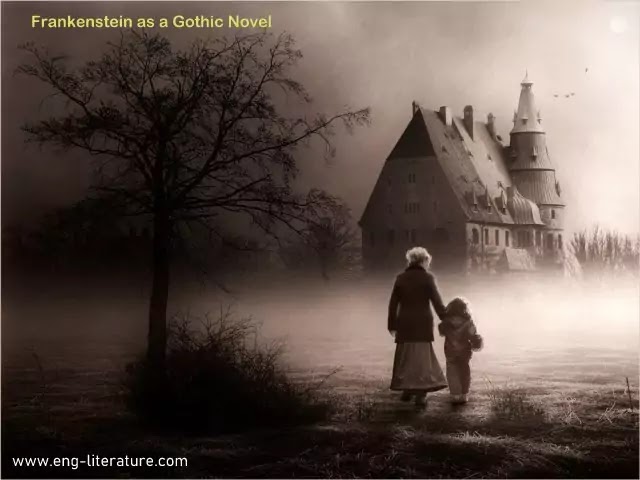
The fine settings within the novel are striking and distinctively Gothic. Spooky castles, ominous portents, mystery, and suspense: these are all elements of a Gothic novel. Appropriately, the creature first breathes on a "dreary night of November." Victor creates his monster in a remote laboratory at Ingolstadt, while the second "monster" is begun in a desolate area of Scotland. Elizabeth is killed on a stormy night, the perfect time for a dramatic murder. The supernatural event, Frankenstein's creation is one element the author utilizes to support the Gothic genre. The setting around the creation creates an ominous mood.

Monster’s Birth; Ominous Dream:

Additionally, the monster's birth results in Shelley's use of another element of the Gothic genre, Victor's overwrought emotion. The rain and absence of tight are metaphors for sorrow and distress; the metonymies further the cheerlessness of the conception scene. The ominous dream, a common component of Gothic novels, serves as a presage of the monster's savage homicide of Victor's true love. November, a bleak and gloomy month, marks the beginning of wintry weather, a time of isolation and cold--the rain pattered dismally against the panes, and the candle was nearly burnt out Victor dreams that he saw Elizabeth, in the bloom of health, walking. “I embraced her, but as I imprinted the first kiss on her lips, they begin livid with the hue of death?" The supernatural event, portent dream, overwrought emotion and metonymy of gloom and horror combine to create the haunting and poignant tale that is Frankenstein.

Ugliness of Monster:

Furthermore, the dark setting and the paranormal being are gothic elements that are used by the author to launch fear. The gothic theme of ugliness is dominant in the novel. In Frankenstein, the creature is described as ugly and hideous in appearance: “his eyes, if eyes they may be called, were fixed on me. His jaws opened, and he muttered some inarticulate sounds, while a grin wrinkled his cheeks”

Presence of Darkness:

Another feature of Gothic fiction present in the novel is darkness. The atmosphere of obscurity and doom is dominant in Frankenstein. In chapter five, Victor is surrounded by darkness and rain. He is forced to escape due to heavy rain and ambiguity. He says: “I felt impelled to hurry on, although wetted by the rain which poured from a black and comfortless sky”

Wet, Obscure and Stormy Weather:

Furthermore, the wet setting, pervaded by the utmost darkness, heralds the doom of the protagonist: “I foresaw obscurely that I was destined to become the most wretched of human beings”. The author uses wet and stormy weather, darkness and obscurity, which are elements from the Gothic fiction, to increase the suspense for readers and to arrange the appearance of the creature.

Haunting:

Haunting is a crucial element in the plot. Jerrold E. Hogle states that “the hauntings associated with the Gothic often arise from the antiquated settings”. Victor is chased by his modern achievement in antiquated and sublime landscapes like the Arctic and the isolated island.

Unknown and Distant region:

Also, far away places that seem mysterious to the readers function as part of the Gothic novel's setting, Frankenstein is set in continental Europe, specifically Switzerland and Germany, where many of Shelley's readers had not been. Further, the incorporation of the chase scenes through the Arctic regions takes us even further from England into regions unexplored by most readers.

Bridge between Mortal and Supernatural World:

In the Gothic novel, the characters seem to bridge the mortal world and Supernatural world, Dracula lives as both a normal person and as the undead, moving easily between both worlds to accomplish his aims. Likewise, the monster seems to have some sort communication between himself and his creator, because the monster appears wherever Victor goes. The monster also moves with am superhuman speed with Victor matching him in the chase towards the North Pole. Thus, Mary Shelley combines several ingredients to create memorable novel in the Gothic tradition.

Theme of Death:

Finally, the Gothic takes the theme of death in an interesting direction overcoming the limits of mortality is a major concern. On a certain level, Victor's interest in creating life is an extension of this desire to escape death. By assembling the body parts of the dead, Victor makes a "monster" who is part human and part ghost. Like a tormented spirit, his creation haunts the living.

Conclusion:

Though Mary Shelley's Frankenstein, written in the early 19th century, certainly contains many components of a Gothic novel, it cannot be correctly grouped under that genre. Shelley employs various literary devices to support the elements, a supernatural event, portent dream, overwrought emotion, and metonymy of gloom, which classify Frankenstein as a Gothic novel.


~~~~~*~~~~~
Share:

Thursday, 9 April 2020

Character Sketch of Victor Frankenstein: Hero or Villain?

Character Sketch of Victor Frankenstein: Hero or Villain?

Introduction:

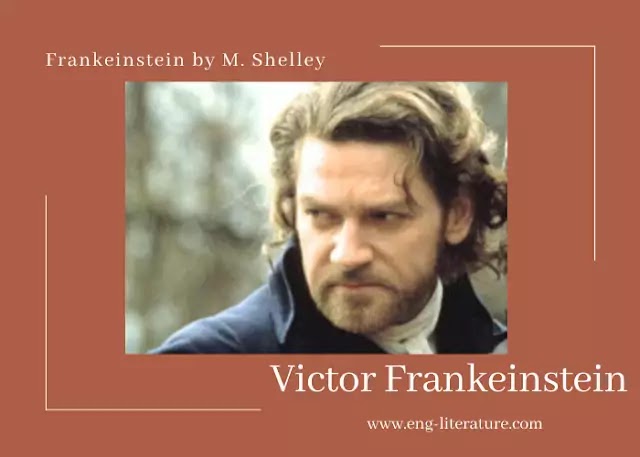
Undoubtedly, the creator of the monster is the protagonist of Mary Shelley’s gothic novel Frankenstein. The name “Victor” is derived from Paradise Lost by John Milton, a great influence on Shelley. Milton frequently refers to God as "the Victor" in Paradise Lost, and Shelley sees Victor as playing God by creating life. In addition to this, Shelley's portrayal of the monster owes much to the character of Satan in Paradise Lost. Victor was also a pen name of Percy Shelley's, as in the collection of poetry he wrote with his sister Elizabeth, Original Poetry by Victor and Cazire.

Victor : His Family and Childhood:

Victor is the oldest son of Alphonse and Caroline Beaufort Frankenstein. Victor by birth is a Genevese, and his family is one of the most distinguished of that republic. Victor, was born in Naples, Italy. Victor was adored by his parents. Though Victor says that there can be no happier childhood than his, he confesses that he had a violent temper as a child. His temper was not directed at other people, however : it manifested itself as a passionate desire to learn the secrets of heaven and earth. His friend Clerval, by contrast, was fascinated by ques morality, heroism, and virtue.

Victor : His education and interest:

Victor shares their desire to penetrate the secrets of nature, to search for the philosopher's stone and the elixir of life. The quest for the that becomes his obsession. Though he acknowledges that such a discovery would bring one great wealth, what Victor really longs for is glory. Victor is also preoccupied with the question of how one might communicate with, or even raise, the dead. When he is seventeen, Victor's family decides to send him to the University of Ingolstadt, so that he might become worldlier. Victor develops a consuming interest in the structure of the human frame: he longs to determine what animates it, what constitutes “the principle of life." Seized by a "supernatural enthusiasm," he begins explore life by studying its inevitable counterpart: death.

Creation of Monster:

On a chill night of November, Victor finally brings his creation to life. Victor's creats a horrible Monster instead of a beautiful man. Upon the opening of the creature's "dull yellow eye," Victor feels violently ill, as though he has witnessed a great catastrophe. Though he had selected the creature's parts because he considered them beautiful, the finished man is hideous : he has thin black lips, inhuman eyes, and a sallow skin through which one can see the pulsing work of his muscles, arteries, and veins. The beauty of Frankenstein's dream disappears soon.

Aslo Read:


Victor : His abandonment to the Monster:

Victor becomes a victim of his own creation that hounds at every step. Even though Victor abandons his own creation, the creation does not abandon him. In Victor's discarding his own creation, there is a double edged critique of William Godwin's concept of Utopia, where children would be produced by what he calls social engineering and rules out the need of sexual intercourse between man and woman as well as Mary Shelley's criticism of parental neglect.

Victor assumed God-like attitude:

Shelley’s novel Frankenstein also reveals the flaws of human character as depicted in the character of Victor Frankenstein.  It revealed man’s tendency to become arrogant and to act like God when he already knows so much.  When Victor assented to the monster that he will create him a partner, he already assumed to have God like capabilities with what he knows about science.  As it was wrong in the beginning, a series of tragedy followed with Victor’s bride Elizabeth being murdered by the monster during their wedding night.  He became filled with revenge as what the monster was; that he became preoccupied about chasing the monster to avenge Elizabeth Lavenza’s death.

Victor's tragic end:


At the end of the novel, having chased his creation ever northward, Victor relates his story to Robert Walton and then dies. Even as he is dying, he will not admit fully to his mistakes and the reader is left wondering whether it is Victor who is the true monster.

Victor : Selfish and isolated individual:

Like the monster he has created, Victor is an isolated individual. His alienation from society is self-imposed. However, his ambition leads him to become arrogant and extremely single-minded. He neglects his family and friends, abandons his creation and fails to take responsibility for his actions which leads to the deaths of many of those who should be near and dear to him.

Is he a hero or villain?

Now here a big billion question lies how would we regard Frankenstein - as a hero or as a villain? Surely Frankenstein is the most misunderstood character in the whole arena of English literature.

Frankenstein cannot be properly categorized as a hero. Although he does possess some heroic qualities, he is not a perfect hero. A hero should be selfless, a characteristic that Frankenstein lacks. For example, when Justine is charged with the death of William, Victor Frankenstein’s younger brother, Frankenstein believes that the true murderer is himself as he is convinced that his creature killed William and therefore Frankenstein feels guilty for William’s death. Frankenstein claims that he would rather take the blame than allow innocent Justine to take the blame. Frankenstein never vouches for Justine.

At the same time, Frankenstein cannot correctly be considered a villain. Even though he is selfish, he also exhibits concern and care for his family and friends. His love for his family is displayed through his actions and words. To be more specific, when his family is mourning the death of his brother and he is traveling back to his home in Geneva, he describes his desire to “console and sympathize with my loved and sorrowing friends”.

Since Frankenstein cannot justifiably be declared as either a hero or villain, he would be classified as an anti-hero. In addition, Frankenstein demonstrates qualities that anti-heroes possess. Anti-heroes are social outcasts, a trait that Frankenstein has convinced us he has obtained. While Frankenstein does care about his family and has a friend, his social circle does not really extend beyond them. The creation of his monster itself also demonstrates his anti-hero qualities, specifically the rebellious quality.

Summing-up:

Victor is presented to us as the Promethean rebel, the seeker of knowledge, and this in itself, may be laudable. His sin seems to be an attempt to usurp the role of God in creating life and his refusal to take responsibility for what he creates. If he suffers, he suffers for his daring and trespass. It catapults his mind inexorably into misery, remorse, agony and anguish.

Aslo Read:


~~~~~*~~~~~
Share:

Follow Me in Social Media

Get Free Updates

Tags

A Doll's House (1) A Renouncing of Love (1) Absurd Drama (2) African English Literature (2) Agyeya (1) Alexander Pope (7) American Literature (26) Amitav Ghosh (3) Analyses (22) Anglo-Saxon Period (1) Aravind Adiga (1) Arthur Miller (5) Australian Literature (2) Beowulf (3) Bertrand Russell (2) Bible (1) Biographies (12) Book Review (2) British Literature (106) Broad Notes (94) Character Analysis (2) Charles Dickens (1) Charles Lamb (2) Charlotte Bronte (2) Chetan Bhagat (2) Chinua Achebe (1) Christopher Marlowe (2) Classical Literature (2) Composition (4) Creative Writing (5) D. H. Lawrence (1) Daniel Defoe (1) Diaspora (4) Drama (1) Dream Children: A Reverie (1) E-book Download (12) Edmund Spenser (1) Edward Fitzgerald (1) Edward II (3) Elizabethan Era (2) English Language (15) English Literature (9) English Literature Quiz (8) Escapism (1) Essay (12) Essays (12) Eugene O'Neill (7) Explanations (3) Feminism (3) Francis Bacon (4) Frankenstein (4) Free E-book Download (5) Free PDF Download (4) Genre (1) Geoffrey Chaucer (1) George Eliot (4) George Herbert (1) George Orwell (1) Girish Karnad (1) Hard Times (1) Heart of Darkness (1) Henrik Ibsen (1) Henry Vaughan (2) Historical Novel (6) History of English Literature (22) Indian Drama (2) Indian English Poetry (1) Indian Fiction (4) Indian Writing in English (34) Indo-Anglican Literature (33) Interesting Facts (9) Interpreter of Maladies (2) Jane Austen (2) Jane Eyre (2) Jayanta Mahapatra (2) Jhumpa Lahiri (3) John Donne (5) John Dryden (1) John Keats (4) Joseph Addison (1) Joseph Conrad (1) Keki N. Daruwalla (1) Kenilworth (3) Kim (1) Knowledge and Wisdom (1) Leo Tolstoy (1) Linguistics (2) Literary Criticism (5) Literary Essay (9) Literary Facts (1) Literary MCQ (4) Literary Photo Album (1) Literary Terms (14) Literary Trends (1) Literary Types (7) Lord of the Flies (1) Lyric (1) M. K. Anand (2) Mac Flecknoe (1) Macbeth (7) Mahadevi Verma (2) Man Eater of Malgudi (2) Mark Twain (1) Mary Shelley (4) Mathew Arnold (1) Midnight's Children (1) Modern Poetry (3) Modernism (1) Motivational Short Story (21) My Penning (1) Nayantara Sahgal (1) Notes (25) Novel (60) Novels (6) O' Henry (1) Ode to a Nightingale (1) Ode to the West Wind (1) Oedipus Rex. Oedipus the King (2) Of Friendship (1) On Fame (1) Online Quiz (8) Othello (1) P B Shelley (1) P. B. Shelley (1) Paulo Coelho (2) Philological Notes (10) Phonetics (3) Picaresque Novel (5) Plays (41) Poetry (52) Popular Literature (1) Post Colonial Literature (1) Post Colonialism (1) Pride and Prejudice (2) Prosody (3) Quiz (6) Quotations (6) R. K. Narayan (2) Rabindranath Tagore (2) Raja Rao (1) Random Quiz (6) Rape of the Lock (5) Realistic Fiction (1) Restoration Era (2) Rhetoric (2) Robert Browning (1) Robinson Crusoe (1) Romantic Poetry (2) Romanticism (2) Rubaiyat of Omar Khayyam (1) Rudyard Kipling (1) Salman Rushdie (2) Samuel Beckett (3) Sarojini Naidu (1) Seven Ages of Man (1) Shakespearean Influence (2) Shakespearean Plays (11) Shakespearean Sonnets (4) Sheridan (4) Short Notes (10) Short Stories (9) Soliloquy (1) Songs of Innocence (1) Sons and Lovers (1) Sophocles (1) Sri Aurobindo (1) Substance Writing (1) Summary (8) Sylvia Plath (1) T. S. Eliot (2) Texts (10) The Adventure of Tom Sawyer (1) The Alchemist (1) The Crucible (3) The Emperor Jones (7) The Golden Light (2) The Guide (1) The Mill on the Floss (4) The Namesake (1) The Pulley (2) The Rivals (5) The Shadow Lines (3) The Sunne Rising (5) The Superannuated Man (1) The Town Week (1) The White Tiger (1) The Winter's Tale (2) Things Fall Apart (1) Thomas Hardy (2) Thomas Wyatt (1) Toni Morrison (6) Tragedy (3) Tughlaq (1) Untouchable (2) Waiting for Godot (2) Walter Scott (3) Way of the World (1) William Blake (2) William Golding (1) William Shakespeare (14) William Wordsworth (3) Word Notes & Annotations (1) Word Notes & Anotations (2)