



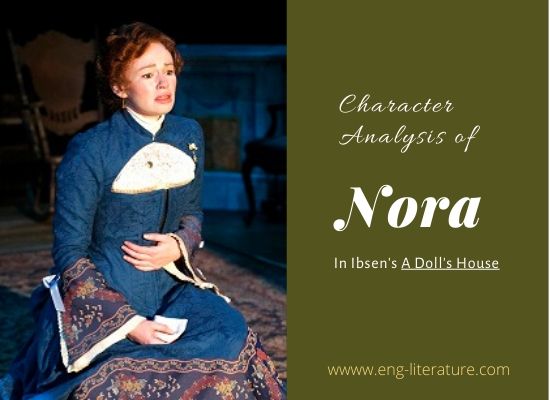
Character
Analysis of Nora
Nora,
the protagonist is the doll in Henrik
Ibsen’s play, “A Doll’s House”.
In order to be an ideal wife, she surrenders herself submissively and calmly to
her husband, Torvald Helmer. She
is very shy and reserve and tires to wrap her into the shell to hide her
personality thus makes her character
more complicated and complex. Although
they belong to a middle class family, suffering from economic problems still
they are managing to live happily.
Nora,
the heroine in Ibsen’s drama “A Doll’s House” is a true
representative woman of Victorian era as throughout the play Ibsen has portrayed her as a loving,
caring and devoted daughter, mother and wife. From the beginning of the play we
get the impression of Nora as an
organized woman who lovingly takes care of her house. She keeps the house clean
and places the things orderly.
Nora
is a cheerful woman who enjoys her life as we see her in the beginning
celebrating Christmas with acute enthusiasm. She is a sympathetic woman who
also cares about subservient. She brings a gift for her maid on the occasion of
Christmas which shows that she is a good human being by nature.
Nora
lives in the world of imagination. Now that her husband’s salary has been
increased she is much excited thinking that there would be no economic problems
thereafter. “Now that you’re to earn a big salary".(Ibsen, Act 1) Torvald, on the other
hand does not like her habit of spending much money and therefore calls her
“spendthrift”.
In
spite of all his positive traits Nora
believes that borrowing can be a solution of their financial problem at the end
of the month “We can borrow till then” (Ibsen, Act 1) while borrowing money became a cause of their break
up. She could have resolved the issue by disclosing it to her husband before
giving a chance to Krogstad, a selfish person.
Though
Nora was a young woman, living in
the world of imagination she loved her husband from the core of heart and she
tried to mould herself according to his wishes. She loves him so much that she
enjoys being dependent on him and asks him to choose thing for herself. “I
really can’t think of anything-unless, Torvald” (Ibsen, Act 1). One aspect of
her love surfaces when she takes loan for her husband’s health through forgery.
Here she commits forgery out of her love because the doctors had clearly
declared that Torvald’s improvement was not possible unless he had been taken
to some airy place.
After
taking the loan, a woman who was enjoying her life as a Doll wife has turned into a practical woman who struggles day and
night to pay back the loan she has taken. She used to work late at night to
earn money. “Often I was desperately tired; but all the same it was a
tremendous pleasure to sit there working and earning money.” (Ibsen, Act1)
Nora
is a caring mother who thinks it her responsibility to impart manners to her
children. When she finds that she has done something wrong and has violated the
rules of the society, her conscious pricks her that she is not a suitable
mother. Through this Ibsen has
highlighted the fact that it was a male -dominated society which implies that
mothers are totally responsible for upbringing their children. If the child is
morally not strong then the blame will go to the women of the society.
Apart
from her positive traits in her personality we also come to know that she was a
deceptive person who tries to do things according to her own wishes. She is a
kind of a person who hides things from her husband.
As
in the beginning of the play, her husband asks her not to eat sweets she lies
to him by saying that “I shouldn’t think of going against your wishes”.(Ibsen,
Act1) This shows she is a liar who tells lies frequently in her daily life and
is not ashamed of it.
There
is another instance of her lying when Helmer, after seeing Krogstad coming out
of his home, asked Nora “has there
been anyone here?” (Ibsen, Act2) she replied with “no”.
Nora’s
crisis begins when her husband takes the charge of Bank Manger. Mr. Helmer is
determined to fire out Krogstad, a dishonest person in his bank who once forged
signature for some illegal purpose. But on the other hand, Krogstad also came
to know that Nora had forged her
father’s signature in order to get money from him. At this revelation, he plans
to exploit Nora in order to retain his position in the bank.
So
when Krogstad comes to know that Helmer is going to dismiss him from his post
which, he starts blackmailing Nora
and threatens that he will reveal her crime if her husband fired him.
Naturally, Nora tries to influence
her husband but he could not understand the real matter taking Nora as a simple child who cannot
understand the secrets of business.
Despite
her utmost efforts to save Krogstad’s current position, the latter discloses Nora’s act of taking loan to her
husband through a letter. When Helmer discovers that Nora has forged her father’s name he is ready to disclaim his wife
without realizing her passion and that she took loan, after all, for his
treatment purpose. At Helmer’s harsh reaction against her act of borrowing, Nora sees that her husband is not worth
of her love and immediately leaves him.
In
terms of her moral character Nora does not prove herself to be
immoral at anytime. At times she thinks of taking loan from Mr. Rank but soon
she changes her mind when it appears that Mr. Rank has some loving passions for
her in his heart. In fact, she does not like to take privilege from her lover.
This is the main reason that she adopted a risky way of getting loan by an act
of forgery which proves to be catastrophic for her marital life.
Of
all the qualities and characteristics of
Nora, the most important aspect of
her personality is that she is a loving, caring and loyal to her husband
irrespective of the economic problems. Though Nora knows about the cannons of society that a Victorian woman
cannot take loan without the permission of her husband but she loves her
husband so much that she ignores such a serious issue and handles it as a
courageous woman. Her love was so pure that she had been struggling throughout
her life. Nora always tries to make
her husband happy. In fact, she becomes a doll in the hands of her husband.
Nora
has always been treated by her husband as his property, as his possession, as
his doll-wife. She can no longer live in the doll’s house in which she has been living for eight years, obeying
every wish and whim of her husband. Her decision to leave her husband is
certainly heart-breaking for us. It is a painful renunciation on her part. Nora is leaving not only her home and
her husband but also her children.
In
short Nora grows in stature, and is
purged by suffering. When everything lies in ruins around her, she emerges
strong and independent; she is in the process of attaining complete maturity at
the same time, her action at the end points to a freer and more honest humanity
in a healthier society. In this sense she is a modern tragic heroine and the
play is a modern tragedy.
~~~~~*~~~~~