




In
his classic drama The Crucible,
Arthur Miller chronicles the horror of the Salem witch trials, an embarrassing
episode of colonial America’s history. At first reading, one might only view
Miller’s work as a vivid account of the tragedy of theocracy in America’s late
seventeenth century. However, with an understanding of the period in which
Miller penned his work, one can easily view the witch trials of The Crucible as an authentic
allegory of the “Red Scare” of the 1950s in America by drawing parallels in
settings, characters, and the pervasive paranoia of both societies.
To
begin with, although centuries apart, the two periods have several dramatic similarities
in regards to setting. Seventeenth century colonial America was a mysterious,
quite often frightening destination for those who had risked the perils of a
voyage from England to make a life for themselves to a New World. For these Puritan
settlers of The Crucible, their new home of Salem touches “the edge of the wilderness”
and appears “[…] dark and threatening, over their shoulders night and day, for out
of it Indian tribes marauded from time to time” (Miller 5). In
comparison to these colonial emigrants in search of a land where they could
enjoy a life free of persecution are the many European emigrants who flooded
American soil in the late 1940s and early 1950s. These “modern day” emigrants,
like their colonial counterparts, arrived on a new continent, one quite alien
from the European countries that many of them had fled. Certainly, Miller had
not only the obvious comparison of setting but also the distinct similarities
of characters in mind when he structured his allegory.
Furthering
the argument to support The Crucible
as an allegory is the uncanny resemblance between the antagonists and protagonists
from Miller’s work and the real life villains and heroes of the “Red Scare”. Obviously, Judge Hathorne
and Deputy Governor Danforth’s unyielding authority in the Salem witch trials
is reminiscent of all who held position of power on the Committee for Un-American Activities. Just as twentieth
century Senator Joseph McCarthy and his cronies believed that any semblance of
Communism was a threat to America’s freedom, Danforth fears that “there
is a moving plot to topple Christ in the country!” and that this plot
must be eradicated (Miller 98). In addition to these narrow-minded antagonists
from both periods are the “free thinkers,” who choose not to
implicate any of their contemporaries in these “witch hunts.” Certainly
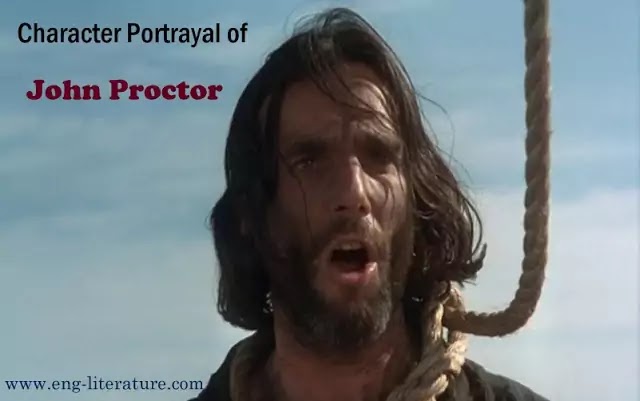
the outspoken John Proctor who “speak[s] [his] own sins” but will
not “judge
another” because he “has no tongue for it,” is symbolic
of Arthur Miller himself as well as those of the artistic community who refused
to implicate their friends as “reds” when the paranoia over
communist infiltrators continued to mount (Miller 141).
Finally
and most importantly, it is this paranoia, common to both stories, that offers the
strongest argument for the fact that Miller intends his work as an allegory. Post World War America was still
recovering from the evils of Hitler when the threat of Communism began to seep
into American society. Sadly, Senator McCarthy, with the zealous belief that
the slightest hint of communism would rob America of its freedoms, became so
fanatical that he and his committee succeeded in frightening most American
citizens. Just as McCarthy compiled his “black list” of artists, who had done
absolutely nothing un-American, Reverend Hale of Miller’s work feeds the colonists
hysteria with his pronouncement that “[…] the Devil is alive in Salem, and we dare
not quail to follow wherever the accusing finger points” (Miller 71).
Ironically, in both cases, the very leaders who set out to protect the beliefs
and rights of their people instead violated those rights to the extreme by
feeding the hysteria with their paranoid attitudes.
Arthur
Miller’s play certainly depicts a tragic time in American history while
offering the audience a vivid account of the misguided notions of a theocracy.
However, there is no doubt that Miller’s ulterior motive in writing this
account was to have it serve as an allegory for the traumatic “witch
hunts” of the 1950s. Through
his obvious parallels in characters and setting as well as the treatment of the
paranoia from both periods, Arthur Miller has created a masterful allegory in
his play The Crucible.
~~~~~*~~~~~