All About English Literature: Christopher Marlowe

For Exclusive Notes and Analysis

Showing posts with label Christopher Marlowe. Show all posts

Saturday, 19 March 2016

Consider Marlowe's Edward II as a Tragedy

Edward II as a Tragedy
Consider Marlowe's Edward II as a Tragedy

The tragedies of Marlowe are known for their grand design, extravagance grandeur, ‘rant and bluster’, the monomaniac characters with their single obsession of power, the passion for their boosting up of self in a way that we marvel at them, and a certain ruthlessness which defies human sentiment. His last celebrated tragedy Edward II is concerned with the tragic fall of a historical king, Edward II.

Aristotle in his Poetics defines tragedy as an imitation of an action that is serious and complete and of certain magnitude... not of narrative through pity and fear affecting the proper purgation of these effects.” Marlowe’s Edward II surely abides by certain points of Aristotelian definition of tragedy.

As per as technical excellence is concerned, Marlowe Edward II does not appeal as Shakespeare’s tragedies do. Whereas Shakespeare’s tragedies deal with lofty universal ideal, Marlowe’s Edward II is all about frustration and weakness. The dictum “Character is destiny” is absolutely applicable to the tragedy of Edward II. Shakespeare’s tragic heroes are great men not only in the sense that they are kings and generals, but because they gain a great moral character in spite of having hamartia (characteristic flaw). Hamlet is a man of lofty ideals; Macbeth and Othello are men of outstanding qualities; King Lear has the nobility of soul. Accordingly they evoke pity and fear. Marlowe’s Edward II is a king of different nature.  He is not only a fool but a coward.

It is the character of Edward II that has marred the play being a great tragedy. He does not at all impress us as a true tragic figure. He suffers because of his fond infatuation for his ‘minion’ Gaveston. There is hardly any redeeming feature in his character. He insults his Lords, humiliates the Bishop and insults his wife, Queen Isabella. He is utterly weak and irresolute. Shakespeare’s Hamlet is also irresolute which is born of high philosophy. Excessive thinking paralyses his will to act. But Edward II is not capable of thinking at all. Shakespeare’s Richard II is weak and insufficient like Edward II. Still he has fineness of temperament, a beauty in his nature which makes his fate not only piteous but tragic. But King Edward hardly possesses any greatness.


The great tragedies of Shakespeare involve a moral conception, a dramatic conflict between good and evil from which goodness ultimately wins. In Edward II, there is a real dramatic conflict between the king and his favourites on the one side and his rebel Lords on the other. This conflict continues till the end of the play with varying vicissitude. At one stage, the King is able to defeat his rebel Lords. But in the end he is defeated and finally executed by the treachery of his own disloyal Queen. Neither in Tamburlaine nor in Dr. Faustus there is any conflict between the two forces.

The success of Edward II as a tragedy rests immensely on Marlowe’s handling of the plot, rather than the effective structural design of the play to achieve his cathartic effect. The play has a well-designed plot. It is truly a great tragedy based on history, “With history well-preserved and history well-dramatised.”

Edward II is most remarkable for its two famous Scenes: The Abdication (Deposition) Scene and the Murder (Death) Scene. In writing about the Abdication Scene Charles Lamb commented “The reluctant pangs of abdicating Royalty furnished hints which Shakespeare scarce improved in his Richard II.” On the Murder Scene he remarked “It moves pity and terror beyond any scene ancient and modern; with which I am acquainted.” Indeed these two scenes perfectly bring out the catastrophe of the play.

After judging all the merits and demerits of Edward II as a tragedy, we may say that it is one of the finest specimens in whole range of English literature. Lets conclude in the voice of Charlton “Greatly inferior in structure and corrupted by vulgar interpolations as it is that play has wider human significance and contains the sublimest of Marlowe’s writing.”
~~~~~$~~~~~      
Share:

Saturday, 12 March 2016

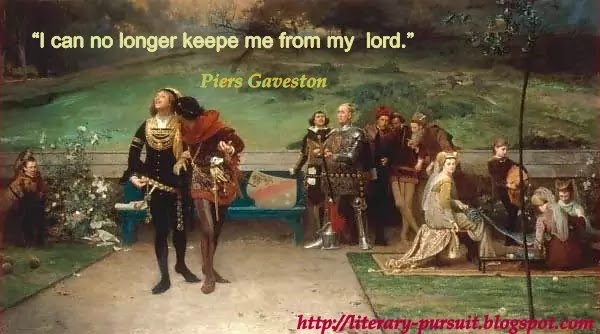
Character Analysis of Piers Gaveston in Christopher Marlowe's "Edward II"

Character Analysis of Piers Gaveston in Christopher Marlowe's "Edward II"

King Edward’s “French minion”, Gaveston is a remarkably well delineated Marlovian character. It is important from the point of view of the conflict in the play - the conflict between the sovereign and the barons of the realm. He is the central of all ruptures. But it’s not Gaveston alone who ignites the trouble; there is something in the nature of Junior Mortimer which flames and sets it on conflagration. The character of Gaveston has limited individual drawbacks, which have been exaggerated by the opposition.

In structure the character of Gaveston is simple and not of complex in the sense. His faults and foibles float on the surface. Had King Edward bestowed his mad affection on him we would hardly have been recognized on the street. He is proud, egoistic and with a vein of hatred for the barons.

According to the historical source, Gaveston came of a blue blood family. His father Arnold Gaveston was a Gascon Knight in the realm of Edward I. In an early age, Gaveston was banished from the kingdom for exercising corrupt influence on the Prince (Edward II). But when Edward II had become the King he recalled his once-bosom friend, Gaveston. Titles were heaped upon him. He was made the Earl of Cornwall and was married to King’s niece Margaret de Clare. The infuriated barons killed him finally in June 1312, for they could hardly break the rise of a mere upstart.

Whatever we may say against the King and his minion it cannot be denied that the two were genuinely responsive as friends. They were iron and magnet as they were in sphere in the mutual attraction. They were two bodies no doubt but one soul. Gaveston pines for the King with a note of earnestness:
                                      
                                     “Renowned Edward, how thy name
Revives poor Gaveston.”

Gaveston is the most hated personality in the play. No one views him sympathetically except the king. Mortimer Junior regards him peevishly: “swol’n with venom of ambitious pride.” Warwick calls him “ignoble vassal”. Lancaster calls him “base and obscure Gaveston”. Queen Isabella calls him “villain” for robbing her husband from her. Bishop of Coventry wishes him to be “dead”. Even Senior Mortimer regards him “traitor Gaveston”. It is significant to note that Gaveston himself has hatred within him:
                                      “The Earl of Lancaster I do abhor.”

Thus we find that hatred is not a one way traffic in the play but tow way traffic. Hatred breeds hatred and this is the crop that they reap in Edward II. Hatred coupled with egoism becomes the sole cause of the ruin of those who are involved in it.

The egoism and haughtiness of Gaveston is the remarkable trait of his character. He does not care anybody else except the King. He frankly states “My knee shall bow to none but to the king”. He jeers and boos at the persons of the exalted rank, who in turn take umbrage at his behavior. But such thing does not deserve the sword to be drawn for killing him. Does he deserve death for being an incorrigible egotist? The answer surely would be a big “no”. He has been more sinned against than sinning.

Gaveston is the man of poetic fancy and so is the king. By nature they are frolic loving souls. As a friend Gaveston knows the taste and temperament of the king and wants to entertain him:
                                                 
                                          “I must have wanton poets, pleasant wits,
                                            Musicians, that with touching of a string,
                                            May draw the pliant king which way I please.”

From the perspective of portrayal, Gaveston’s character can be easily called a flat character. He remains the same from the beginning to the end. But in spite of being flatness his character is not dull. It is because of his being intensely drawn by Marlowe.

Is Gaveston a ‘base’ character often accused by Junior Mortimer in the play? There is hardly any baseness in him. Really the base character is that of Mortimer himself. A little introspection on his part would clearly reveal the fact. To be ambitious is not base, but he is not more ambitious than Mortimer. Who does not love status and wealth? It is a common human weakness to which he is prone.

To sum up, the character of Gaveston has been drawn in a way so as to form the crux of the events. Again his character shed light on the character of the king. The events are ignited by the fuel added by Gaveston. The barons may hate them and the Queen too, but the readers and the audience do not. Though the character of Gaveston cannot be called an ideal one for his hubris, yet it does not mean he is given death sentence. If the barons could be proud of their power and pelf, why not Gaveston who has the privilege of the love of the King?    
~~~~~@~~~~~
Share:

Follow Me in Social Media

Get Free Updates

Tags

A Doll's House (1) A Renouncing of Love (1) Absurd Drama (2) African English Literature (2) Agyeya (1) Alexander Pope (7) American Literature (26) Amitav Ghosh (3) Analyses (22) Anglo-Saxon Period (1) Aravind Adiga (1) Arthur Miller (5) Australian Literature (2) Beowulf (3) Bertrand Russell (2) Bible (1) Biographies (12) Book Review (2) British Literature (106) Broad Notes (94) Character Analysis (2) Charles Dickens (1) Charles Lamb (2) Charlotte Bronte (2) Chetan Bhagat (2) Chinua Achebe (1) Christopher Marlowe (2) Classical Literature (2) Composition (4) Creative Writing (5) D. H. Lawrence (1) Daniel Defoe (1) Diaspora (4) Drama (1) Dream Children: A Reverie (1) E-book Download (12) Edmund Spenser (1) Edward Fitzgerald (1) Edward II (3) Elizabethan Era (2) English Language (15) English Literature (9) English Literature Quiz (8) Escapism (1) Essay (12) Essays (12) Eugene O'Neill (7) Explanations (3) Feminism (3) Francis Bacon (4) Frankenstein (4) Free E-book Download (5) Free PDF Download (4) Genre (1) Geoffrey Chaucer (1) George Eliot (4) George Herbert (1) George Orwell (1) Girish Karnad (1) Hard Times (1) Heart of Darkness (1) Henrik Ibsen (1) Henry Vaughan (2) Historical Novel (6) History of English Literature (22) Indian Drama (2) Indian English Poetry (1) Indian Fiction (3) Indian Writing in English (33) Indo-Anglican Literature (32) Interesting Facts (9) Interpreter of Maladies (2) Jane Austen (2) Jane Eyre (2) Jayanta Mahapatra (2) Jhumpa Lahiri (3) John Donne (5) John Dryden (1) John Keats (4) Joseph Addison (1) Joseph Conrad (1) Keki N. Daruwalla (1) Kenilworth (3) Kim (1) Knowledge and Wisdom (1) Leo Tolstoy (1) Linguistics (2) Literary Criticism (5) Literary Essay (9) Literary Facts (1) Literary MCQ (4) Literary Photo Album (1) Literary Terms (14) Literary Trends (1) Literary Types (7) Lord of the Flies (1) Lyric (1) M. K. Anand (2) Mac Flecknoe (1) Macbeth (7) Mahadevi Verma (2) Man Eater of Malgudi (2) Mark Twain (1) Mary Shelley (4) Mathew Arnold (1) Midnight's Children (1) Modern Poetry (3) Modernism (1) Motivational Short Story (21) My Penning (1) Nayantara Sahgal (1) Notes (25) Novel (60) Novels (5) O' Henry (1) Ode to a Nightingale (1) Ode to the West Wind (1) Oedipus Rex. Oedipus the King (2) Of Friendship (1) On Fame (1) Online Quiz (8) Othello (1) P B Shelley (1) P. B. Shelley (1) Paulo Coelho (2) Philological Notes (10) Phonetics (3) Picaresque Novel (5) Plays (41) Poetry (52) Popular Literature (1) Post Colonial Literature (1) Post Colonialism (1) Pride and Prejudice (2) Prosody (3) Quiz (6) Quotations (6) R. K. Narayan (2) Rabindranath Tagore (2) Random Quiz (6) Rape of the Lock (5) Realistic Fiction (1) Restoration Era (2) Rhetoric (2) Robert Browning (1) Robinson Crusoe (1) Romantic Poetry (2) Romanticism (2) Rubaiyat of Omar Khayyam (1) Rudyard Kipling (1) Salman Rushdie (2) Samuel Beckett (3) Sarojini Naidu (1) Seven Ages of Man (1) Shakespearean Influence (2) Shakespearean Plays (11) Shakespearean Sonnets (4) Sheridan (4) Short Notes (10) Short Stories (9) Soliloquy (1) Songs of Innocence (1) Sons and Lovers (1) Sophocles (1) Sri Aurobindo (1) Substance Writing (1) Summary (8) Sylvia Plath (1) T. S. Eliot (2) Texts (10) The Adventure of Tom Sawyer (1) The Alchemist (1) The Crucible (3) The Emperor Jones (7) The Golden Light (2) The Guide (1) The Mill on the Floss (4) The Namesake (1) The Pulley (2) The Rivals (5) The Shadow Lines (3) The Sunne Rising (5) The Superannuated Man (1) The Town Week (1) The White Tiger (1) The Winter's Tale (2) Things Fall Apart (1) Thomas Hardy (2) Thomas Wyatt (1) Toni Morrison (6) Tragedy (3) Tughlaq (1) Untouchable (2) Waiting for Godot (2) Walter Scott (3) Way of the World (1) William Blake (2) William Golding (1) William Shakespeare (14) William Wordsworth (3) Word Notes & Annotations (1) Word Notes & Anotations (2)

Blog Archive