
All About English Literature: Historical Novel

For Exclusive Notes and Analysis

Showing posts with label Historical Novel. Show all posts

Thursday, 30 April 2020

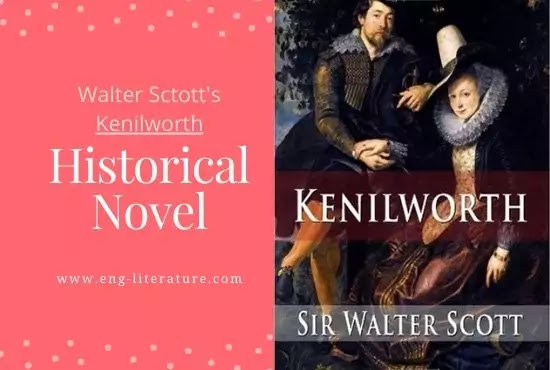
Kenilworth as a Historical Novel

kenilworth as a historical novel
Walter Scott's Kenilworth as a Historical Novel

Scott's conception of historical novel is different from the common and traditional concept of history. Generally speaking, a historical novelist enlivens the great historical episodes in his novel but Scott is not so much interested in historical episodes as he is interested in historical characters. He never showed history in the making: he chose to show characters as they were made by history. He wanted to produce the spirit of English history more than the flesh and form.

Kenilworth is a historical novel in the sense that it is set against a historical background. The time is that of Queen Elizabeth's reign. The characters bear historical names, and the main events are also distilled from history. Above all, the spirit of Elizabeth's age is exhibited most artistically and realistically.

A number of historical inaccuracies can be mentioned in Kenilworth. Scott always treated history with perfect disregard of inconvenient facts and dates. There are many illustrations of this in Kenilworth. Robert Dudley was the fifth son of the Duke of Northumberland, who was executed by Queen Mary for his attempt to crown his son, Lord Guildford Dudley, the husband of Lady Jane Grey. In the year 1550, Robert Dudley had married Amy Robsart when he himself was but nineteen years old. The ceremony contained no element of secrecy, Edward VI himself being present.

Thus in1560, Dudley had been married for ten years but Kenilworth represents the marriage as of recent occurrence, and Amy's father and lover in distress because they had not yet been able to find tidings of her whereabouts. Dudley was not at this time Earl of Leicester, title being conferred on him in 1563, three years after Amy's death, when Elizabeth put him forward as a suitable husband for Mary Queen of Scots.

There are, as historical evidence, letters, written by the then Spanish ambassadors in England. In 1559, De Feria wrote to Philip of Spain that Elizabeth was "enamoured of my Lord Robert Dudley, and will never let him from her side. His wife has a cancer on the breast and the Queen only waits till she dies to marry him."

Another letter written by De Quandra in 1560, states that Cecil had told the writer, "Dudley had made himself master of the business of State and of the person of the Queen.....and that they were thinking of destroying Lord Robert's wife ..... They had given out that she was very ill, but she was not ill at all; she was very well, and taking care not to be poisoned."

The conclusion of Kenilworth is mysterious. It is different from the historical records. Leicester determines to kill his wife but relents; his servants go beyond their orders and kill her before their master can prevent them. In real life, however, Varney and Foster have no share in the tragedy and no evidence against them has been found. Scott in his notes has accepted this fact. He says. "If faith is to be put in epitaphs, Anthony Foster was something the very reverse of the characters represented in the novel."

Scott has also altered Sir Walter Raleigh out of history. Though the gallant incident of the cloak is the traditional and his historical account of this celebrated statesman's rise at court, but Raleigh's pride and boldness have been put to a stake in the novel. In his descriptions of the Cumnor Hall and the Kenilworth Castle, Scott makes use of his poetic gifts; his imagination overpowers his sense of fact. The bedsteads with their furniture, chairs, stools, cushions, carpets, pictures have been described with capitalized details.

Scott was competent to deal with history. He knew a lot of English history. He was called the 'glutton of books,' as he had read almost all the great romances, old plays, and epic poetry. He had the contemporary life, such as most of Miss Edgeworth's. His handling of history in Kenilworth may not be precisely historical, but it is plausibly historical. He aims at depicting the manners and customs' of the time of Queen Elizabeth.

The main interest in Scott's historical novels is often not historical and the historical interest is at least always divided with purely fictitious interest. In Waverley, the hero and heroine are historical ; and the same is true of Old Mortality, Ivanhoe, The Fortunes of Nigel and The Abbot. Kenilworth is different only in appearance. Amy Robsart bears a historical name but she is really the typical tragic heroine, and Leicester is the conventional villain with some facts taken from Dudley's life for a historical semblance. The attention is thus distracted from Elizabeth, Mary, James, Cromwell, and the young Stuart Pretenders. In adopting this method of dealing with history, which was in part Shakespeare's also, Scott was able to give within the vaguely defined boundaries of fact and legend, a very free play to his imagination.

Hence Kenilworth is realistic when it deals with lowly life, but the prevailing mood is romantic with historical bias. It is not a pure history; it is a beautiful blend of history and romance.
 ~~~~~*~~~~~
Share:

Sunday, 29 March 2020

19 Important Short Answer Type Questions & Answers from Toni Morrison's "Jazz"

19 Important Short Answer Type Questions & Answers from Toni Morrison's "Jazz"
 “Don't ever think I fell for you, or fell over you. I didn't fall in love, I rose in it.”
                                                                    ― Toni Morrison, Jazz

Here are few short questions and answers from Jazz that might help you:

1.What is the symbolic significance of the title 'Jazz'?
Ans. Jazz is called Jazz because it is structured on a little musical form called ... Jazz. The novel has alternating character voices that act like solos, repeating refrains that keep it flowing in one general direction, a feeling of dissonance and harmony at the same dang time -- all of which are attributes of a musical form called Jazz.

2. Tell with reference to Jazz, what is Harlem Renaissance?
Ans. The Harlem Renaissance was the name given to the cultural, social, and artistic explosion that took place in Harlem between the end of World War I and the middle of the 1930s. During this period Harlem was a cultural center, drawing black writers, artists, musicians, photographers, poets, and scholars.

3. Why was the Jazz music called the devil's music?
Ans. The reason why jazz was called "the devil's music" was because "Jazz" used to be a slang word associated with sex. Also, jazz originally came out of the brothels. So the more "wholesome" members of society did not want anything to do with it.

4. What is the effect of Jazz on the lives of poor people?
Ans. Music is an art, entertainment and medicine for the soul and body. It is intrinsic to all cultures. Jazz was invented by Blacks and made for the poor people. Faced with racism, discrimination and segregation, the poor black people have always found comfort and a sense of peace in Jazz music.

5. Define feminism.
Ans. Feminism is a range of movements and ideologies that share a common goal: to define, establish, and achieve equal political, economic, cultural, personal, and social rights for women. This includes seeking to establish equal opportunities for women in education and employment. A feminist advocates or supports the rights and equality of women.

6.  Interpret 'Don't ever think I fell for you, or fell over you. I din't fall in love, I rose in it.'
Ans. This line is from Toni Morrison's novel "Jazz". In this line, Joe Trace addresses Dorcas directly in his imagination. Dorcas is already dead, but his is explaining how he felt and still feels about her. He does not regret the relationship because he freely chose it.

7. Interpret 'When they fall in love with a city, it is forever and it is like forever.'
Ans. The context here is the arrival of Joe and Violet in Harlem in 1906, when they arrived as part of the great migration north of black people, who were escaping the racism of the South. They all fell in love with Harlem as a place where the possibilities for them seem endless. So their love for Harlem will last forever.

8.  Interpret 'A son ain't what a woman say. A son is what a man do.'
Ans. This line is, in fact, Henry's ultimatum that Golden Gray intends to live as his son, the young man will have to become less of a prince, accept the physical rigors of rural life and self-identify as a black person. This line also suggests that masculine identity wholly depends on man's ability to act, to exercise his will.

9.  Who is Violet?
Ans. Violet is a fifty-six year old woman living in Harlem with her husband Joe. She is nicknamed "Violent" after she invades Dorcas' funeral to dishonor the girl's face with a knife. An orphan raised by her grandmother in rural Virginia, Violet herself has no children and, after several miscarriages, she longs for a child.

10.  Why does Violet release her encaged birds?
Ans. Violet releases her encaged birds after Dorcas dies. She rejects what she holds dear, both in terms of the birds and in terms of her relationship with Joe.

11. Why does Violet plan to get herself a boyfriend?
Ans. Violet's husband Joe had a young girlfriend named Dorcas whom Joe killed at a party. Violet is mean enough and good looking enough to think that even without hips or youth she can punish Joe by getting herself a boyfriend in her own house. She thinks it will dry his tears up and give her some satisfaction as well.

12.  Who is Joe Trace?
Ans. Joe Trace is Violet's husband. He is a good looking man in his late fifties. He works hard, shuttling between a job as a waiter and a cosmetic salesman. He loves his wife but is hurt when she closes herself off from him because of her depression. A sympathetic character, Joe is nonetheless a murderer and adulterer, cheating his wife and then killing his lover.

13.  Name the parents of Joe Trace.
Ans. No one knows the real names of Joe's parents. When Joe is in school, he is asked to supply a last name for himself and he comes up with Trace because his adoptive mother has told him "O honey (your parents) disappeared without a trace." Joe's mother is rumored to live around the town of Vienna, Virginia and is named Wild.

14.  Why is there tension between Joe and Violet?
Ans. Joe and Violet are husband and wife. However, there is always tension between their relationship. The main reason is the presence of "other" in both characters. Moreover, both have grown up motherless. Violet's eccentricity and depression on one hand and Joe's love and murder of Docras on the other hand create tension between their relationship.

15. Why are Joe and Violet subject of ridicule in their community? 
Ans. Joe and Violet are ridiculed in their community because they are old black couple. Both have grown up motherless. Moreover, Violet makes little money as an unlicensed hairdresser, arriving at her clients' residences.

16. Why is Violet referred to as the “Bird Lady”?
Ans. Violet is called the “Bird Lady” because she keeps a parrot and lots of other birds in her apartment. She communicates with the birds and her parrot says “I love you.”

17. Why does the narrator describe Joe and Dorcas’ relationship as “one of those deep down, spooky loves”?

Ans. Joe and Dorcas’ relationship is labeled “spooky” because it was unusual and unnatural. There was more than a 30 year difference in their ages. After Joe shot Dorcas he cried everyday about it and was unable to resume a normal life. To protect him, Dorcas refused to name Joe as the person who shot her. After her death, the love continued and became more intense.

18. Why does Dorcas’ aunt Alice refuse to turn Joe over to the police?
Ans. Alice Manfred doesn’t want the police involved because the police have traditionally been an enemy of the African-American community. The police are considered as dangerous as the criminals. She doesn’t want them in her house sitting in her chairs. Furthermore, she has heard of Joe’s tears and knows that he will punish himself.

19. Compare and contrast Violet with Dorcas.
Ans. Violet is attractive but very dark-skinned. She is 50 years old, has hard edges to her personality, and is starting to act crazy. Violet no longer talks to Joe because she has time only for her birds. Violet is very thin, yet very strong, and Dorcas on the other hand is very light-skinned with long hair. These are two pluses. She is not particularly attractive, but she is 18-years-old. Dorcas is feeling the full impact of her sexuality and is eager for intimacy. It is easy for Dorcas and Joe to share their deepest secrets. Violet is independent, but Dorcas is extremely vulnerable and needs Joe’s protection.

~~~~~*~~~~~
Share:

Toni Morrison's Depiction of Urban Life in Her Novel, "Jazz"

Toni Morrison's Depiction of Urban Life in Her Novel, "Jazz"

The fictional representation of the American city African American literature is often characterized by a stark manifestation of its hierarchical colour division. Interestingly, African American novels are replete with images of post-bellum migration to the city and the ghettozation of the “nigger.” Toni Morrison’s Jazz powerfully captures a vision of an urban locale in which racial spaces are viscerally demarcated for the blacks through long conditioning, though in reality no physical marker separates the white and black worlds. Such a traumatic awareness of their pariah status makes the blacks in Morrison’s Jazz perpetually reposition themselves.
This constitution of difference evidently replicates throughout the cityscape where both race and class create their respective unique spaces. These factors perhaps compel critics like Anne-Marie-Paquet-Deyris to view in the city an inimical force that denatures the Black communal voice: “As a new composite, the City is conditioned by the Great Migration from the rural South which started in the 1870s and climaxed between 1910 and 1930. Whatever traces of this former history survive in the text remain fragmentary or else unarticulated. They sometimes even lead to literal dead ends” (African American Review, Summer 2001). This perspective assumes that the displacement necessitated by the northward migration has resulted in an irreparable loss of the community’s historical narratives.
Deyris’s take is problematic because there is nothing to warrant the assumption that the community invested unstintingly in a consolidated historical voice prior to the urban relocation. Whatever was lost owing to the migration to the city had been more than compensated by the enormous opportunities it offered for liberal engagement with black individualism and collective group action, as has been superbly delineated in Morrison’s Jazz. Particularly for the black woman, this relocation to the urban centre was a proven blessing in that they no longer were confined to the domestic space or whatever socio-cultural environment was assigned to them. Violet has a high degree of professional mobility within the contours of black space. Ironically, it is Joe, the former master woodsman in Vesper County, who is reduced to a salesman of cosmetics in the city. The black women in the novel through continual engagement with their surroundings display sensitivity to the urban cartography. Delimiting such territory contributes to a simultaneous creation of a personal environment which facilitates a smooth transition to the social life of the city.
It cannot be denied, however, that no matter how liberating such spaces turn out to be, a sense of fear haunts the avenues of action available to the black people. The insertion of an additional ‘n’ that bizarrely transforms Violet’s name to the sobriquet “Violent” ironically touches upon the primeval drive for survival. Nevertheless, the availability of such linguistic play bespeaks a luxury hardly possible in the pre-urban time frame. Further, such a creative possibility ties in meaningfully with the shift in signification, later, from “Sth” to “Sweetheart” which is richly evocative of a mood of fruition and fulfillment that was woefully absent prior to the transitional phase marked by the text.
The sheer ebullience of the narrative in Jazz then significantly attests to the intellectual mobility of the community itself. In having Dorcas fall prey to her own whims and venalities the novel subtly underwrites the endurance and invincibility of the matriarchal vision that sustains the black narrative. Violet serves the role of a cultural link bridging the Past of the community in the country with the present in the City, as it were, and appropriately she even exhorts Felice to “make [the world] up the way you want it to [be]”. It is amply clear from the text that these communal narratives both sustain and empower the beleaguered black population through the transition phase. The colour division has ironically helped evolved a space and culture in the city that is uniquely and vociferously black. Of course, the mushrooming of several interest groups and associations later such as the National Negro Business League and the Civic Daughters forum point to the project of consciousness raising that is already underway. And the possibility of the central narrative voice being gender-neutral is unmistakably belied by the intimate access this voice has to spaces such as the Salem Women’s Club. These associations with their palpable presence in the narrative signify discourses that clearly reject stereotypical notions of the Negro as being regressive.
Thus, Morrison’s Jazz forcefully registers the nascent stirrings of group action at a certain historical moment, which though not politically strident, hold out the possibility of exploding into an organized revolt against the hegemonic forces.
Feel free to share your response. Thank you and good bye for now.
~~~~~*~~~~~
Share:

Saturday, 28 March 2020

Justify the Appropriateness of the Title of Morrison's Novel "Jazz" or Thematic and Symbolic Importance of Music.

Justify the Appropriateness of the Title of Morrison's Novel "Jazz"

The novel borrows its title from Jazz music and the idea of music is discussed throughout the novel. As the name of the novel implies music operates both thematically and formally to provide structure to the book. The Jazz music of the 1920s situates the narrative in a specific cultural and historical moment, when a black aesthetic style was gaining ground in New Orleans and New York. Both the city and the woods of Virginia are described as having their own music and rhythm and the pace of narrator’s storytelling ranges from upbeat and fast to slow and “bluesy”.
Music also speaks to the individual characters on a deep level, as when Alice Manfred worries about the sinful powers of the music. Alice Manfred and the Miller sisters interpret Jazz music as the anthem of hell. The passion and pleasure that Dorcas and violet find in the music is contrasted with the musical treatment of Joe’s crime. When he stalks and shoots Dorcas, it is at a party where loud music is being played to incite passion, “boil” the blood and “encourage” misbehaviour. However, music can also be restorative, as Felice facilitates the healing process between Joe and Violet by bringing over her records and watching them dance.
For the entire novel, music is the weapon that the city wields to control its citizens. The seasons and weather are determined by the presence of clarinet players in the street. Music also bears a sadness that can be juxtaposed to violet’s ribaldry and Joe’s flared passion. Wild’s disappearance takes place as her body is replaced with a trace of music and this sound haunts Joe’s memory for the rest of his life. Similarly, the “blues man” who walks the streets becomes the “black-and- blues man” and finally, the “black therefore - I’m-blues man,” providing a critique of racism. The “blues” songs that the characters evoke are largely the consequence of suffering brought about by America’s racist traditions.
Jazz music is also a reference to the racial segregation prevalent in America of that time. “Cultural mourning” connotes the response of African Americans not only to the lost lives and lost possibilities produced by slavery but also the loss of cultural productions through appropriation by white culture. In her 1992 novel, Jazz, Morrison re-claims black music both by re-conceptualizing the Jazz Age and by employing the literary equivalents of its musical forms.
If one of the most notable things about the early decades of the 20th century was the overlapping of various modes of artistic development in response to an interval of dynamic social and cultural changes, one of the most regrettable features of histories of the period has been the tendency to maintain a segregated perspective, restricting the contributions of artists of the Harlem Renaissance to the “Coloured only” side of a long-perpetuated division in cultural and aesthetic analysis. For example, in Modem and Modernism: The Sovereignty of the Artist 1885-1925 (1985), Frederick R. Karl traces the common aesthetic roots of modernist literature, painting, and music without mentioning a single African-American artist in any of those mediums. More recently, revisionist scholars of the immensely fertile period that encompassed both the Jazz Age and the Harlem Renaissance have corrected such narrow views, not only underscoring the conjoined contribution of musicians, writers, and painters of the period but acknowledging the vital cross-fertilization that occurred among artists of different races and mediums. Thus, focusing on the artistic vitality of New York City during the second decade of this century, Ann Douglas emphasizes the “free and creative borrowings across race, class, and gender lines”.
Despite such cross-fertilization however—or perhaps because of it—not only jazz music but, more broadly, the Jazz Age to which it gave its unique aesthetic stamp was rapidly appropriated by white culture. As Douglas adds, “to appropriate something is to abstract it by taking it out of its matrix, its indigenous original context, in order to resituate it in a plan of one’s own making, a place alien to its natural habitat and design”.
In conclusion, we can say that with the writing of Jazz, Morrison takes on new tasks and new risks. Jazz does not fit the classic novel format in terms of design, sentence structure, or narration. Just like the music this novel is named after, the work is improvisational. In this work, she is influenced not only by the Jazz, blues, and gospel music she was reared on, but also by the folklore, tall tales and ghost stories that her family told for entertainment. The result is a writing style that has a unique mix of the musical, the magical, and the historical.
Don't forget to drop your views and queries in the comment section. Thank You.
~~~~~*~~~~~
Share:

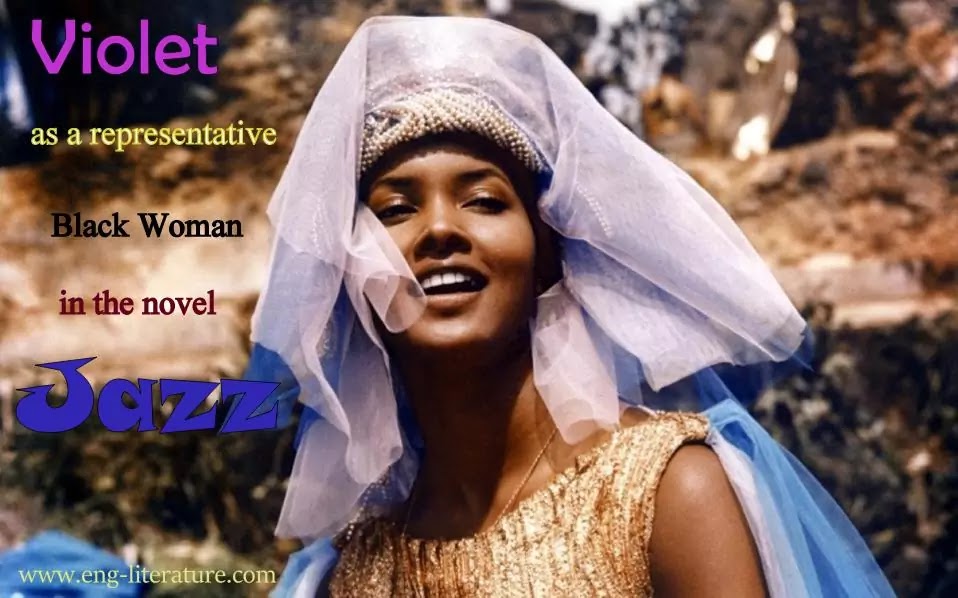
Character Sketch of Violet in Toni Morrison's Novel, "Jazz" or Consider Violet as a Representative Black Woman Character of Morrison.


In Jazz Violet Traces is the central character through which Morrison describes the woes of the black women. Violet is a fifty six year old woman living in Harlem with her husband Joe. Hopelessly scrawny with very dark skin, Violet is beautiful if one looks at her long enough. She has a reputation in Harlem for being odd and she does not quite fit with the other ladies. She becomes sullen and taciturn with her husband and explodes into violence at his lover’s funeral, earning herself the nickname “Violent”.
Violet was raised by her mother, Rose dear, in Vienna, Virginia, as one of five Children. Her father would leave the family for long stretches of time and when the family’s belongings were repossessed, Violet’s mother committed suicide by throwing herself down a well. On becoming an Orphan Violet was raised by her grandmother in rural Virginia. When Violet married Joe Trace she sought to escape the hard- knocks lifestyle of her childhood by moving to the city. Neither she nor Joe had wanted children, but as Violet grows older, she begins to feel a deep longing for something to love. Her relationship with Joe becomes strained when she falls into depression. When she finds out that Joe has cheated on her with Dorcas, Violet projects all of her anger, sadness and frustration by slashing Dorcas’s face at her funeral as she lies in her open casket. In the months that follow, Violet searches for peace and longs to heal herself and her marriage, discovering, finally, that she has to “make it” by taking ownership of her happiness and refusing to be a victim.

Violet is considered “crazy” by her community for sitting in the street, as well as for “stealing” a baby and attempting to disfigure Dorcas’s body at the funeral. Rodrigues sees Violet as “the one whose psyche has been deformed by twenty years in the City, so that people call her ‘Violent.”
Prior to her attempt to stab Dorcas at the funeral, in an incident that causes at least part of the community perceive Violet as crazy, she allegedly “steals” a baby from the charge of a young girl who had gone back into her house to get a record for her mother. When asked who took the child, the girl responds, “A woman! I was gone a minute. Not even one! I asked her... I said . . . and she said okay.” 
Violet’s own relationship to reproduction has been over determined by the economics of slavery; her response to Rose Dear being tipped out of her chair by the men who took virtually all of her family’s belongings. Motherhood was simply not something she considered as a Possibility: “The important thing, the biggest thing Violet got out of that was never to have children. Whatever happened, no sm dark foot would rest on another while a hungry mouth said, Mama?”
Violet’s marginal positions in the salon community operates as an analogue both for women such as Alice denouncing the disorderly, raucous, and sometimes revengeful lyrics of female blues singers like Gertrude, Ma Rainey and Bessie Smith, as well as for women’s peripheral involvement in early jazz performance. Violet is an unlicensed hairdresser, and thus not privy to the talk that takes place among the legally licensed beauticians all their customers at the salon.  
Along with her “crazy” actions, Violet’s “wayward mouth” ostracizes  her from mainstream community circles of women and men, a situation perhaps analogous to the social unacceptability of the ‘dangerous’ sexually some classic blues lyrics. Her position as an outcaste, however, allows her intracuIt “double consciousness” for she is able to identify both Alice, an upstanding member of the community, and prostitutes at the same time because much as the sexually charged women’s classic blues allowed for the articulation and survival of an African American female communal voice,
Alice, however, does not want to hear about the connection between sexuality and violence in the urban African American community and the seemingly deterministic cultural narratives engendered by the economics of slave which are encoded in the classic blues “race record” to which the narrator subjects characters throughout the novel when Violet asks Alice why she does not want to hear about these women, she responds: “black women were armed; black women were dangerous and the less money they had deadlier the weapon they chose”.
Both Violet and Alice have been subject to sexual jealousy of other women and the desire for revenge. Through their conversation Violet points out to Alice that she “wasn’t born with a knife,” asking if she had never “picked up”. It brings to mind the lynch the South which contributed to “the wave of black people running from want and violence”,
So we can say that the context of the female character in the novel is that of suppressed Black society. Nearly all the female Black characters are morally strong. Violet is the true representative spokesperson of strong willed ebony of the Afro-American Community.
~~~~~*~~~~~
Share:

Friday, 27 March 2020

Discuss Toni Morrison's use of Symbols in her Novel, "Jazz" or Theme and Motif of Morrison's "Jazz"

Discuss Toni Morrison's use of Symbols in her Novel, "Jazz"

Jazz is a historical novel by Pultizer and Nobel Prize winning American author, Toni Morrison. The novel forms the second part of Morrison’s Dantesque trilogy on Africa American history, beginning with Beloved and ending with paradise. Morrison is a modern novelist and in this novel she has presented a hoard of new themes and motifs and has made an extensive use of symbolism.
One of the main themes of the novel is violence. Jazz begins with a recap of Dorcas’s murder and Violet’s attack on her corpse. The couple that kills and then defaces the young girl seem immediately to be evil and immoral characters but surprisingly Morrison goes on to flesh them out and to explain, in part that their violent acts stem from suppressed anguish and disrupted childhoods. Morrison traces the violence of the City characters back to Virginia, where generations of enslavement and poverty tore families apart. Subtly, Morrison suggests that the black on black violence of the City carries over from the Physical and psychic violence committed against the race as a Whole. She interweaves allusions to racial violence into her story with a neutral tone that lets the historical facts speak for themselves. Further, her descriptions of scenes are often filled with violence as she discusses buildings which are cut but a razor-like line of sunlight. Even her narrative is violently constructed with stories wrenched apart, fragmented, and retold in a way that mirrors the splintered identities of the novel’s Principal characters.
Mothers are almost always absent from the lives of Morrison’s characters, having abandoned their children, died or simply disappeared. The absence of mothers also reflects the “motherland”, as the African-American community searches for a way to make America its home despite the horrors of dislocation and slavery. The mother also signifies common cultural and racial heritage that eludes the characters as they struggle to define themselves, The word “mama” rests on the tip of the characters’ tongue and is an unconscious lament for a lost home or feeling of security. During one of Violet’s visits, Alice Manfred blurts out “O Mama” and then covers her mouth, shocked at her own vulnerability. Dorcas also refers to her mother out of nowhere as she lies on her death bed. Thinking, “I know his name but Mama won’t tell,” Morrison ever-presents in the lives and history of her characters, doubles as a kind of mother on the text, tending to the community of black Harlem.
Jazz immerses its reader in the psyche and history of its African American characters. The book attempts to mirror from an anthropological and fictional standpoint, the concerns of this community and the roots of their collective search for identity. The narrator does not travel far from the self contained universe of black Harlem and does not focus on the lives of any white character, save for Vera Louise Gray, The legacy of slavery reverberates throughout the story and the influx of blacks to the City reflects a distancing from this past.
Migration is also a theme of the novel: Almost all of Morrison’s characters migrate to New York City from other parts of the country in an attempt to escape economic and social prejudice and in search of a new beginning in Harlem. The motif of migration goes hand in hand with the numerous allusions to birds and recurs frequently in the narration of the character’s histories. Malvonne’s nephews William the Younger exemplifies a constantly shifting and itinerant black population with his sudden departure from New York for “Chicago or was it San Diego, or some other city ending with O.” His restlessness indicates an inability to establish roots or a Connection in one place and echoes the “homelessness” of Morrison’s Principal characters.
Next to migration, another recurrent theme or motif of the novel is orphans. The absence of a strong parental presence in jazz ties together many of Morrison’s characters and connects their shared sadness to one cause. Raised by aunts, grandparents and adoptive parents, Violet, Joe and Dorcas all experience a feeling of displacement and feel that they are handed over with no control. Unable to Control the fact that they are orphans and placed in homes without any choice in the matter, characters are relocated in a way that resonates with the paternalistic adoption of slaves. Their true parents would be the tie to a history and would provide an identity for the characters. Thus, the lack of parents creates the characters’ sense of displacement and their obsessive desire to find a stable and complete identity.
Morrison has also made an extensive use of symbolism in this novel Symbolism is a device which enriches a work of art and imparts greater meaning to it. The most important symbol used in the novel is music. As the name of the novel implies, music operates both thematically and formally to provide structure to the book. The jazz music of the 1920s situates the narrative in a specific cultural and historical moment when a black aesthetic style was gaining ground in New Orleans and New York. Both the City and the woods of are described as having their own music and rhythm and the pace of the narrator’s storytelling ranges from upbeat fast to slow and “bluesy.” Music also speaks to the individual characters on a deep level, as when Alice Manfred worries about the sinful powers of the music.
However, music can also be restorative, as Felice facilitates the healing process between Joe and Violet by her records and watching them dance.
There are some minor symbols as well like the Red-wing birds. According to the local Virginia lore, Wild’s proximity is always indicated by the flight of red-winged birds from nearby trees. The workers in the sugar cane fields establish their own set of symbols in the natural world based on shared stories and experiences. The collective recognition of a red-wing bird as a herald of Wild’s presence illustrates the richness of a community’s bonds. Unlike Violet’s caged birds, the birds in Virginia have not lost their instinct of flight and like the woman that they shadow, they represent freedom from society’s bonds.
The green dress that passes hands from Vera Louis Gray to Joe’s mother, Wild, connects the novel’s characters and suggests the ways in which their stories intersect. A fine garment worn by the daughter of a wealthy slave owner, the dress finds its way into the rustic cabin of the girl’s black lover, Henry LesTroy. The empty shell of its absent owner, the dress represents Vera Louise’s abandonment and the social strictures that forced her to move away. However, the dress changes meaning when her son, Golden Gray, drapes it over Wild’s body, a conciliatory gesture that ultimately undoes the work of her family’s racist background. When Joe finds the tattered old dress in Wild’s hovel, the garment symbolizes the hope of healing a painfully inherited legacy.
Even the characters of the novel are symbolic in one way or the other. For example: One of the novel’s central relationships is the sustained romantic affair between Joe Trace, a fifty year old man, and Dorcas, who is in her late teens. Throughout the novel the murdered girl becomes a symbol of youth. Her aunt, Alice Manfred, identifies Dorcas’ youth with a budding sexuality that has brought calamity. The motif of the Garden of Eden presents the image of Dorcas as a young Eve who is enticed and enticing. Violet Trace’s reaction to Dorcas is similar. Her jealousy stems from her husband’s affair and she can’t help but notice the contrast between her aging, sagging body and Dorcas’ youthful, fuller figure. Violet tries to drink malts and eat multiple meals to regain the pounds other youth and her “competition” with the dead girl is ironic because Violet does not want to compete with the young, dead child; rather, she wishes that Dorcas could be the young daughter that she never had. Dorcas’ friend, Felice comes to serve this role for Violet and she also provides consolation for Joe, demonstrating a healthier way in which “youth” can sustain “age” without bloodshed.
In conclusion, we can say that with the writing of Jazz, Morrison takes on new tasks and new risks. Jazz, for example, does not fit the classical novel format in terms of design, sentence structure, or narration. Just like the music this novel is named after, the work is improvisational. In this work she is influenced not only by the Jazz, blues and gospel music she was reared on, but also by the folklore, tall tales and ghost stories that her family told for entertainment. The result is a writing style that has a unique mix of the musical, the magical and the historical.
~~~~~*~~~~~
Share:

Follow Me in Social Media

Get Free Updates

Tags

A Doll's House (1) A Renouncing of Love (1) Absurd Drama (2) African English Literature (2) Agyeya (1) Alexander Pope (7) American Literature (26) Amitav Ghosh (3) Analyses (22) Anglo-Saxon Period (1) Aravind Adiga (1) Arthur Miller (5) Australian Literature (2) Beowulf (3) Bertrand Russell (2) Bible (1) Biographies (12) Book Review (2) British Literature (106) Broad Notes (94) Character Analysis (2) Charles Dickens (1) Charles Lamb (2) Charlotte Bronte (2) Chetan Bhagat (2) Chinua Achebe (1) Christopher Marlowe (2) Classical Literature (2) Composition (4) Creative Writing (5) D. H. Lawrence (1) Daniel Defoe (1) Diaspora (4) Drama (1) Dream Children: A Reverie (1) E-book Download (12) Edmund Spenser (1) Edward Fitzgerald (1) Edward II (3) Elizabethan Era (2) English Language (15) English Literature (9) English Literature Quiz (8) Escapism (1) Essay (12) Essays (12) Eugene O'Neill (7) Explanations (3) Feminism (3) Francis Bacon (4) Frankenstein (4) Free E-book Download (5) Free PDF Download (4) Genre (1) Geoffrey Chaucer (1) George Eliot (4) George Herbert (1) George Orwell (1) Girish Karnad (1) Hard Times (1) Heart of Darkness (1) Henrik Ibsen (1) Henry Vaughan (2) Historical Novel (6) History of English Literature (22) Indian Drama (2) Indian English Poetry (1) Indian Fiction (3) Indian Writing in English (33) Indo-Anglican Literature (32) Interesting Facts (9) Interpreter of Maladies (2) Jane Austen (2) Jane Eyre (2) Jayanta Mahapatra (2) Jhumpa Lahiri (3) John Donne (5) John Dryden (1) John Keats (4) Joseph Addison (1) Joseph Conrad (1) Keki N. Daruwalla (1) Kenilworth (3) Kim (1) Knowledge and Wisdom (1) Leo Tolstoy (1) Linguistics (2) Literary Criticism (5) Literary Essay (9) Literary Facts (1) Literary MCQ (4) Literary Photo Album (1) Literary Terms (14) Literary Trends (1) Literary Types (7) Lord of the Flies (1) Lyric (1) M. K. Anand (2) Mac Flecknoe (1) Macbeth (7) Mahadevi Verma (2) Man Eater of Malgudi (2) Mark Twain (1) Mary Shelley (4) Mathew Arnold (1) Midnight's Children (1) Modern Poetry (3) Modernism (1) Motivational Short Story (21) My Penning (1) Nayantara Sahgal (1) Notes (25) Novel (60) Novels (5) O' Henry (1) Ode to a Nightingale (1) Ode to the West Wind (1) Oedipus Rex. Oedipus the King (2) Of Friendship (1) On Fame (1) Online Quiz (8) Othello (1) P B Shelley (1) P. B. Shelley (1) Paulo Coelho (2) Philological Notes (10) Phonetics (3) Picaresque Novel (5) Plays (41) Poetry (52) Popular Literature (1) Post Colonial Literature (1) Post Colonialism (1) Pride and Prejudice (2) Prosody (3) Quiz (6) Quotations (6) R. K. Narayan (2) Rabindranath Tagore (2) Random Quiz (6) Rape of the Lock (5) Realistic Fiction (1) Restoration Era (2) Rhetoric (2) Robert Browning (1) Robinson Crusoe (1) Romantic Poetry (2) Romanticism (2) Rubaiyat of Omar Khayyam (1) Rudyard Kipling (1) Salman Rushdie (2) Samuel Beckett (3) Sarojini Naidu (1) Seven Ages of Man (1) Shakespearean Influence (2) Shakespearean Plays (11) Shakespearean Sonnets (4) Sheridan (4) Short Notes (10) Short Stories (9) Soliloquy (1) Songs of Innocence (1) Sons and Lovers (1) Sophocles (1) Sri Aurobindo (1) Substance Writing (1) Summary (8) Sylvia Plath (1) T. S. Eliot (2) Texts (10) The Adventure of Tom Sawyer (1) The Alchemist (1) The Crucible (3) The Emperor Jones (7) The Golden Light (2) The Guide (1) The Mill on the Floss (4) The Namesake (1) The Pulley (2) The Rivals (5) The Shadow Lines (3) The Sunne Rising (5) The Superannuated Man (1) The Town Week (1) The White Tiger (1) The Winter's Tale (2) Things Fall Apart (1) Thomas Hardy (2) Thomas Wyatt (1) Toni Morrison (6) Tragedy (3) Tughlaq (1) Untouchable (2) Waiting for Godot (2) Walter Scott (3) Way of the World (1) William Blake (2) William Golding (1) William Shakespeare (14) William Wordsworth (3) Word Notes & Annotations (1) Word Notes & Anotations (2)

Blog Archive