All About English Literature: Indian Fiction

For Exclusive Notes and Analysis

Showing posts with label Indian Fiction. Show all posts

Saturday, 16 May 2020

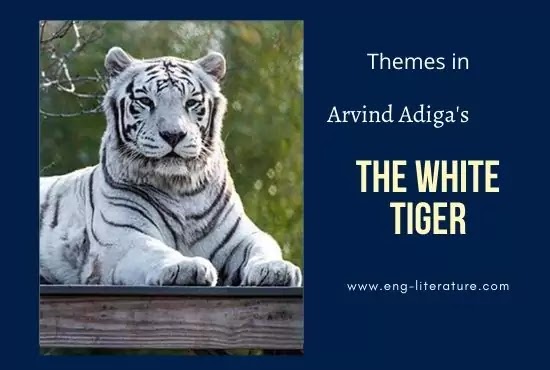
Various Themes in Aravind Adiga's The White Tiger

Various Themes in Aravind Adiga's The White Tiger

The White Tiger provides a darkly humorous perspective of India's class struggle in a globalized world as told through a retrospective narration from Balram Halwai, a village boy. In detailing Balram's journey first to Delhi, where he works as a chauffeur to a rich landlord, and then to Bangalore, the place to which he flees after killing his master and stealing his money, the novel examines issues of religion, caste, loyalty, corruption and poverty in India. Ultimately, Balram transcends his sweet-maker caste and becomes a successful entrepreneur, establishing his own taxi service. In a nation proudly shedding a history of poverty and underdevelopment, he represents, as he himself says, "tomorrow."

 The novel is based on layers of themes. Here are a few :

Globalization

The White Tiger takes place in the modern day world where increased technology has led to world globalization, and India is no exception. In the past decade, India has had one of the fastest booming economies. Specifically Americanization in India has played its role in the plot, since it provides an outlet for Balram to alter his caste. To satisfy Pinky’s want for American culture, Ashok, Pinky, and Balram simply move to Gurgaon instead of back to America. Globalization has assisted in the creation of an American atmosphere in India. Ashok justifies this move by explaining “Today it’s the modernist suburb of Delhi. American Express, Microsoft, all the big American companies have offices there. The main road is full of shopping malls—each mall has a cinema inside! So if Pinky Madam missed America, this was the best place to bring her”. By blackmailing Ram Parsad, the other driver, Balram is promoted and drives Ashok and Pinky to their new home.

Ashok is even convinced India is surpassing the USA, “There are so many more things I could do here than in New York now...The way things are changing in India now, this place is going to be like America in ten years”. Balram is noticing the rapid growth as well. From the beginning of his story he knows that in order to rise above his caste he should become an entrepreneur. Although his taxi service is not an international business, Balram plans to keep up with the pace of globalization and change his trade when need be. “I‘m always a man who sees ‘tomorrow’ when others see today.’” Balram’s recognition of the increasing competition resulting from globalization contributes to his corruption.

Individualism

A white tiger symbolizes power and majesty in East Asian cultures, such as in China and Japan. It is also a symbol for individualism and uniqueness. Balram is seen as different from those he grew up with. He is the one who got out of the “Darkness” and found his way into the “Light”.

Freedom

In an interview with Aravind Adiga, he talked about how “The White Tiger” was a book about a man’s quest for freedom. Balram, the protagonist in the novel, worked his way out of his low social caste (often referred to as “the Darkness”) and overcame the social obstacles that limited his family in the past. Climbing up the social ladder, Balram sheds the weights and limits of his past and overcomes the social obstacles that keep him from living life to the fullest that he can. In the book, Balram talks about how he was in a rooster coop and how he broke free from his coop. The novel is somewhat of a memoir of his journey to finding his freedom in India’s modern day capitalist society. Towards the beginning of the novel, Balram cites a poem from the Muslim poet Iqbal where he talks about slaves and says “They remain slaves because they can’t see what is beautiful in this world.” Balram sees himself embodying the poem and being the one who sees the world and takes it as he rises through the ranks of society, and in doing so finding his freedom.

Immoral corruption

Balram is from a low caste in India where he grew up with barely anything. As a child, Balram was seen as an intelligent and honest fellow in a crowd of thugs. He was a pure soul and was untainted. However, growing up, he was exposed into a lot of corruption and immoral behavior, such as the time with the doctors just let his father die. His childhood ultimately set Balram up for a lifetime of immoral and corrupt behavior as he moved up his social ladder and into the higher castes. To work his way up, Balram ends up cheating, stealing, and even murdering in order to have his way. Balram becomes very selfish, evident by his many immoral actions, due to the entrepreneur/ businessman side of him. This can be seen as both an immoral and moral, depending on how you look at it. If one looks at it in a more business lens, business is all about doing everything one can to beat out whoever one are competing against. Finding ways to ensure the competition does not succeed, finding ways to get ahead of everyone else, and coming out on top are all a big part of the business world. It can be seen as being moral because of competitive nature of our globalized capitalist economic system. In a capitalist economy, any way one can get ahead is fair game. However, if one is looking at this from a non-business standpoint, the actions Balram does are very immoral. He cheats people to put himself in a position to gain for himself. Balram does everything in his power for personal gain, even killing his boss.

Social class/caste

The book shows a modern day, capitalist Indian society with free market and free business. It also shows how it can create economic division. In India there are not social classes, there are social castes. The novel portrays India’s society as very negative towards the lower social caste. Balram refers to it as the “Darkness”. When Balram was asked which caste he was from, he knew that it could ultimately cause a biased stance in his employer and determine the future of his employment. There is definitely a big difference seen in Balram’s lower caste from back home and his current higher caste in their life-styles, habits, and standards of living. This novel is showing how our economic system today creates socioeconomic gaps that create a big division in society. It limits opportunity, social mobility, health, and other rights and pleasures that should be given to all. There is a big difference in the amount of money spread around in society today and this book is alluding to that fact.

Marriage in India

To save their reputation and the marriage, the family has to take out a loan from the Stork. Balram is forced to drop out of school and work in a teashop to help raise money to pay back the debt - triggering the events of the rest of the story. His cousin’s wedding is not the only marriage that disrupts Balram’s life. When Pinky Madam leaves for New York, Mr. Ashok sinks into depression. In addition to drinking and womanizing, he finally accepts his family’s dirty business, ferrying bribes for The Stork. Balram joins in his boss’ decline - eventually murdering Mr. Ashok to pocket the bribe himself.

The Indian Family

In an interview with The Guardian, Adiga emphasizes the importance of family in Indian society. “If you’re rude to your mother in India, it’s a crime as bad as stealing would be here,” he explains. For Balram to abandon his family, then, is perhaps his greatest crime. “This is a shameful and dislocating thing for an Indian to do,” Adiga remarks of his protagonist. Balram also understands the severity of his actions. Fear for his family is the largest obstacle he must overcome to carry out Mr. Ashok’s murder. In the days before, he has visions - imagining abuffalo in the street blaming him for the deaths of his family. Even after he becomes a businessman in Bangalore, he goes to the temple to pray for their spirits.

China’s Relationship to India

At the beginning of the novel, Balram mentions to the Premier that China is the only nation he admires besides Afghanistan and Abyssinia. Why? Because he read in a book called Exciting Tales of the Exotic East that these are the only 3 countries never to be ruled by outsiders. He dubs China the “freedom-loving nation,” a place that has never been subject to a master-slave relationship with the West. But although he hears on All India Radio that “you Chinese are far ahead of us in every respect,” Balram observes that China does not have entrepreneurs - hence the Premier’s visit to Bangalore. China, then, becomes a foil to India, which he describes as a nation with “no drinking water, electricity, sewage, public transportation …” but chock full of entrepreneurs. For this reason, Balram tells the Premier his story, believing that China and India are destined to become the next great superpowers. “In 20 years’ time, it will just be us brown and yellow men at the top of the pyramid, and we’ll rule the whole world.”

Lightness and Darkness

Perhaps Balram’s favorite motif is the duality of “Light” and “Dark.” From the very beginning, he attempts to navigate from his hometown in “The Darkness” to become a member of urban society. Light, then, becomes a multifaceted symbol of time (the future), wealth (lots of it), location (Bangalore), and obligation (none) - while Darkness represents the past, poverty, rural India - and most importantly - loyalty to family and master. These themes battle each other throughout the novel. Even after he has established himself in Bangalore, he continues to seek ways to differentiate himself from the “Darkness.” When 1 of his White Tiger drivers runs over a boy, he visits the family and offers their surviving son a job. He realizes this decision may make him appear weak, but he argues he has no choice. “I can’t live the way the Wild Boar and the Buffalo and the River lived, and probably still live, back in Laxmangarh. I am in the Light Now.”
~~~~~*~~~~~
Share:

Friday, 15 May 2020

Different Types of Themes in Amitav Ghosh's The Shadow Lines

Different Types of Themes in Amitav Ghosh's The Shadow Lines

The Shadow Lines hosts a number of themes. The first and foremost being that it is an attempt to draw the attention of the world to do away with borders that divide the people. Humanity after all is the same everywhere and any attempt to create differences is not only hazardous but also futile. There is nothing on earth that can divide a memory. Many lines and borders may be drawn but it can never set people free of their reminiscences, free of their associations, free of the love and a sense of belonging for their place of birth.

The second thing it considers is how many of these lines can be drawn or divisions made. It is all a mirage. The world cannot be divided into innumerable small stages to satisfy the urge of the people to give their frantic sense of nationalism a political entity and a name. In Indian context, first it was the creation of Pakistan then the demand arose for Punjab, the North East and then Kashmir. Partition or secession is no solution. It may on the other hand trigger never ending hostilities and violence. There can be no better example than India.

Narrator believes in the reality of space, that the distance separates but is sadly mistaken. These borders that are drawn are mere shadow lines according to the author, which often play a role opposite to what they are actually meant to. They reflect not the differences but the similarities and interdependence.

Tha’mma is another example in the novel who cannot bring her to adjust to the fact that her freedom of movement has been restricted by the line that we call border. Her Dhaka is still very alive and colourful in her memory as it was before in reality until Tridib’s killing in Dhaka. There are a good number of instances, which show a good fusion of language, culture and counties to bring home the point that the earth after all is like one country. But at the same time The shadow Lines is also a warning for the cultureless identity. Ila is a burning example.

Another theme of the novel is the concept of nationalism that is gaining ground in today’s world. The author has held the extreme form of nationalism responsible for many a problem these days. The separatist and secessionist tendencies are the outcome of it. Love of the country, passion inspired nationalism and intoxication of patriotism cannot but lead to jingoism. Thus nationalism which had and which has great uses can become the greatest obstacle to world peace. This tribal instinct has been magnified beyond all measures resulting in political and economic megalomania. And the novel in its enthusiasm to prove the point has gone a little too far to proclaim that nationalism is a defunct force and in this background Tha’mma is ridiculed as ‘a still surviving specimen of fossilized nationalism.’

Time and distance are taken to be shadows. The novel makes a smooth transition from present to the past and from past to the future without causing any friction. The novel highlights the reality of the frictions people create around their lives.

The Shadow Lines also talks about the havoc and the terror created by the riots. Despite the orgy of voicence, bloodshed and merciless killing, they have a transient existence. They are washed out from the public memory before long. The narrator is at a loss to know that his friend, Malik at Delhi does not remember anything about the riots that took place in Calcutta and Dhaka in which his role model Tridib was slaughtered

Characters in the novel intermingle not as members of a distinct culture but as complex individuals in a world where geographic boundaries have truly becomes the shadow lines. These boundaries are like a mirror that seems to reflect not their differences but their similarities. May Price falls in love with Tridib and Nick marries Ila.

The Shadow Lines besides dealing with some serious themes is also a picturesque novel. It deals with crowded, shabby and traffic-torn Calcutta with road side vendors and petty shopkeepers to picturesque and clean London; from traditional matriarchs to liberal and friendly Prices; giving snippets of was torn Germany and England. It captures the swinging moods, whims and fancies of the people of scenic Kashmir and its inhabitants-innocent and pure.

The novel highlights the two polarities of human nature. While there can be people on whom sense prevails and they mould palpably volatile situation to their control, there just may be another section which would make a mess of it and the human blood so spilled would shine in the flickering flames of the torched houses. Mu-I-Mubarak is just the kind of incident, which establishes the above fact.

The Shadow Lines sparks off a debate between tradition and modernity. Good fences make good neigbhours and limitations or fences are the touchstone of sanity is put under a test. The characters by whom the two concepts are conveyed are strong ones. Both are the radical women. One is rooted in tradition the other in modernity. On one hand we Tha’mma, a radical, and nationalist rooted in tradition but despised and mugged at invariably for nurturing primitive or supposedly orthodoxed views in the context of the modern day scenario. Ila represents to a great extent the modern cosmopolitan world, and is a free high flying girl, a girl without barriers, hurdles and stops. The borders have long seized to exist for her.

The Shadow Lines is therefore not a solution to modern diaspora but is certainly an attempt to make an appeal to the think tanks of the world; leaders and intellectuals to spare a thought on the philosophy of the novel; to do some hard thinking and put some sense and sanity into the minds of the people.
 ~~~~~*~~~~~
Share:

Thursday, 14 May 2020

Character of Tha'mma in Amitav Ghosh's The Shadow Lines

Character of Tha'mma in Amitav Ghosh's The Shadow Lines

Tha’mma is the protagonist in Amitav Ghosh’s novel The Shadow Lines.  She was narrator's grandma. Born in Jindabahar in Dhaka in a joint family, she grew up when the Indian National Movement was gaining a militant note and fight against the British was jointly being spearheaded by Mahatma Gandhi and the militant nationalists together. Tha’mma was quick tempered with a deep sense of freedom. She is proud, stubborn and strong-willed. She along with Ila is an itinerant character.

Her dislocation is a product of her circumstances. She is perplexed at the history that has led her place of birth to be so messily at odds with her nationality and has made her a foreigner in her hometown, Dhaka. She relates an incident of her college life of 1920s when one of her classmates was arrested by the police for revolutionary terrorism who looked shy and frail but had a great resolution and unrepentence for serving the cause of national freedom. Tha’mma so fervently wished to help him in any way she could, right from cooking the food to washing the clothes. She states that she could even have killed the British and the Police Officers for freedom.

She gets married to a man who gets postings in the neighboring countries and leaves Dhaka and goes to different places before finally coming down to Calcutta after her husband’s premature death from pneumonia. She takes up the teaching job in one of the local schools and continues to serve there for twenty-seven years and retires as a Principal in the year 1962. It was with this job that she brings her son up and takes pride in her refusal for help from anybody especially from her rich sister Maya Devi.

Tha’mma is a strict disciplinarian who was very punctilious about the right use of time and lost her temper if anybody wasted it. This was one of the reasons for her disapproval of Tridib and his waste of time.

The second person that did not find her favour was Ila, the daughter of her sister Maya Devi. For her, Ila is firmly outside the pale of sobriety and common Indians, her looks and her clothes were inappropriate to her Bengali middle class origins: ‘Her hair cut short like a bristle on the tooth brush, wearing tight trousers like a Free School Street whore’, she comments. Her concept of freedom is quite different from that of Ila.

Tha’mma is a steadfast nationalist. She is in love with her place of birth in Dhaka and cannot forget it in any way. The partitioned India and the line drawn between Calcutta; her present place of stay and Dhaka does not make any sense to her. She comes to realize that borders have a weak existence and not even the history of bloodshed can make them truly impregnable.

She is undiplomatic and straight. For her, it is either this way or that but no in between. She had believed that she would be able to see the borders between India and East Pakistan from the plane.

She had long believed that nostalgia is a weakness. ‘It is everyone’s duty to forget the past and look ahead and get on with building the future', she used to say. But one in Dhaka, she understands the harsh reality of the border and realizes that dislocated people like her have no home but in memory. Stunned by her nephew Tridib’s death by a riotous mob in Dhaka she develops a great hatred for Pakistanis. She gifts away her only necklace, the last remembrance of her husband to the war fund so that the Bangldeshi army may fight them properly at last with tanks and guns and bombs. She says to her grandson ‘For your sake, for your freedom.’

Her concepts of nationalism, nationhood and the formation of Indian state are quite clear and forceful. It is observed in her perception of her early days when she saw, felt and experienced the tremors of British imperialism. Her sense of freedom and nationhood was sharpened. She tells her grandson—It took those people a long time to build that country; hundred of years, years and years of wars and bloodshed. Everyone who lives there has earned his right to be there with blood: with their brother’s blood and their fathers ’blood and their sons’ blood. They know they are a nation because they have drawn their borders with blood. That is what it takes to make a country. Once that happens people forget they were born this way or that, Muslim of Hindu, Bengali or Punjabi. They become a family born of the same pool of the blood.
~~~~~*~~~~~
Share:

Follow Me in Social Media

Get Free Updates

Tags

A Doll's House (1) A Renouncing of Love (1) Absurd Drama (2) African English Literature (2) Agyeya (1) Alexander Pope (7) American Literature (26) Amitav Ghosh (3) Analyses (22) Anglo-Saxon Period (1) Aravind Adiga (1) Arthur Miller (5) Australian Literature (2) Beowulf (3) Bertrand Russell (2) Bible (1) Biographies (12) Book Review (2) British Literature (106) Broad Notes (94) Character Analysis (2) Charles Dickens (1) Charles Lamb (2) Charlotte Bronte (2) Chetan Bhagat (2) Chinua Achebe (1) Christopher Marlowe (2) Classical Literature (2) Composition (4) Creative Writing (5) D. H. Lawrence (1) Daniel Defoe (1) Diaspora (4) Drama (1) Dream Children: A Reverie (1) E-book Download (12) Edmund Spenser (1) Edward Fitzgerald (1) Edward II (3) Elizabethan Era (2) English Language (15) English Literature (9) English Literature Quiz (8) Escapism (1) Essay (12) Essays (12) Eugene O'Neill (7) Explanations (3) Feminism (3) Francis Bacon (4) Frankenstein (4) Free E-book Download (5) Free PDF Download (4) Genre (1) Geoffrey Chaucer (1) George Eliot (4) George Herbert (1) George Orwell (1) Girish Karnad (1) Hard Times (1) Heart of Darkness (1) Henrik Ibsen (1) Henry Vaughan (2) Historical Novel (6) History of English Literature (22) Indian Drama (2) Indian English Poetry (1) Indian Fiction (3) Indian Writing in English (33) Indo-Anglican Literature (32) Interesting Facts (9) Interpreter of Maladies (2) Jane Austen (2) Jane Eyre (2) Jayanta Mahapatra (2) Jhumpa Lahiri (3) John Donne (5) John Dryden (1) John Keats (4) Joseph Addison (1) Joseph Conrad (1) Keki N. Daruwalla (1) Kenilworth (3) Kim (1) Knowledge and Wisdom (1) Leo Tolstoy (1) Linguistics (2) Literary Criticism (5) Literary Essay (9) Literary Facts (1) Literary MCQ (4) Literary Photo Album (1) Literary Terms (14) Literary Trends (1) Literary Types (7) Lord of the Flies (1) Lyric (1) M. K. Anand (2) Mac Flecknoe (1) Macbeth (7) Mahadevi Verma (2) Man Eater of Malgudi (2) Mark Twain (1) Mary Shelley (4) Mathew Arnold (1) Midnight's Children (1) Modern Poetry (3) Modernism (1) Motivational Short Story (21) My Penning (1) Nayantara Sahgal (1) Notes (25) Novel (60) Novels (5) O' Henry (1) Ode to a Nightingale (1) Ode to the West Wind (1) Oedipus Rex. Oedipus the King (2) Of Friendship (1) On Fame (1) Online Quiz (8) Othello (1) P B Shelley (1) P. B. Shelley (1) Paulo Coelho (2) Philological Notes (10) Phonetics (3) Picaresque Novel (5) Plays (41) Poetry (52) Popular Literature (1) Post Colonial Literature (1) Post Colonialism (1) Pride and Prejudice (2) Prosody (3) Quiz (6) Quotations (6) R. K. Narayan (2) Rabindranath Tagore (2) Random Quiz (6) Rape of the Lock (5) Realistic Fiction (1) Restoration Era (2) Rhetoric (2) Robert Browning (1) Robinson Crusoe (1) Romantic Poetry (2) Romanticism (2) Rubaiyat of Omar Khayyam (1) Rudyard Kipling (1) Salman Rushdie (2) Samuel Beckett (3) Sarojini Naidu (1) Seven Ages of Man (1) Shakespearean Influence (2) Shakespearean Plays (11) Shakespearean Sonnets (4) Sheridan (4) Short Notes (10) Short Stories (9) Soliloquy (1) Songs of Innocence (1) Sons and Lovers (1) Sophocles (1) Sri Aurobindo (1) Substance Writing (1) Summary (8) Sylvia Plath (1) T. S. Eliot (2) Texts (10) The Adventure of Tom Sawyer (1) The Alchemist (1) The Crucible (3) The Emperor Jones (7) The Golden Light (2) The Guide (1) The Mill on the Floss (4) The Namesake (1) The Pulley (2) The Rivals (5) The Shadow Lines (3) The Sunne Rising (5) The Superannuated Man (1) The Town Week (1) The White Tiger (1) The Winter's Tale (2) Things Fall Apart (1) Thomas Hardy (2) Thomas Wyatt (1) Toni Morrison (6) Tragedy (3) Tughlaq (1) Untouchable (2) Waiting for Godot (2) Walter Scott (3) Way of the World (1) William Blake (2) William Golding (1) William Shakespeare (14) William Wordsworth (3) Word Notes & Annotations (1) Word Notes & Anotations (2)

Blog Archive