


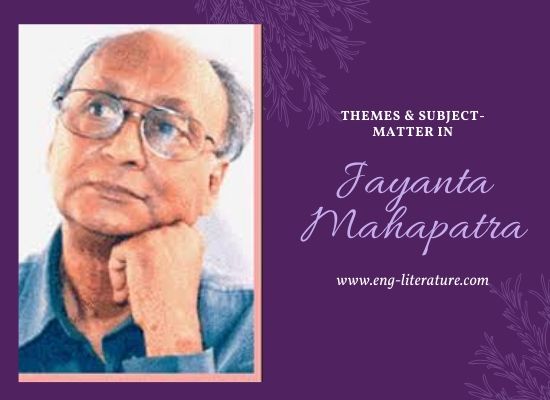
Mahapatra's thematic concerns in his poetry are many,
and in dealing with them he has shown the hand of a master. The excellence of
his treatment of his themes matches the dignity and the significance of his
themes. The Orissa landscape, the Orissa cultural history and background, the
social life of Orissa, and the rites and rituals of the people of Orissa
constitute the most important and significant theme of his poetry. This, of
course, shows Mahapatra's mainly regional outlook. Mahapatra deals human
relationships, Indian social problems, love, sex, marriage, human nature,
and Nature with a capital N. Thus the thematic range patra's poetry is wide
enough, though it cannot be described as all-embracing.
Odissan Landscape, History and Culture:
Dawn at Puri,
Taste for Tomorrow, Slum, Evening Landscape by the River and Events
are poems which deal chiefly with the Orissa landscape. Of these Dawn at Puri is the most conspicuous,
the most realistic, and perhaps the most interesting, with its endless crow
noises, a skull lying on the holy land, sea-beach, white-clad widowed women waiting
to enter the great temple, and so on. Taste
for Tomorrow also depicts a scene at Puri with its crows, with its one very
wide street, with its lepers, and its religious-minded crowds thronging the
temple door. In fact, Puri figures prominently in Mahapatra’s poetry. Puri and
the Konarak temples partly in ruins constitute a big and impressive. If a man
who has never been to Odissa, goes through these dozen poems definitely begin
to think that he has paid a visit to Orissa and spend a couple of days.
The Themes of Sex, Sexuality, and Poverty:
Sex, sexuality, and social concerns come next in
importance so far a Mahapatra's themes are concerned. In this connection two of
the most significant and interesting poems are Hunger and The Whorehouse in
a Calcutta Street. Hunger
depicts both sexuality and poverty. In fact, sexuality here is closely
interlinked with poverty. It is a hungry fisherman with a hungry daughter who has
resorted to prostitution, while it is the sexual urge which takes a customer to
the fisherman's shack. As soon as the fisherman leaves, the girl opens her "wormy
legs" wide, and the customer feels the hunger there. The hunger is
evidently two-fold, there is hunger between the legs, and there is hunger in
the belly above. Of course, there is much more in the poem, but sexuality and
poverty are surely is theme.
Also Read My Articles:
Also Read My Articles:
Sexuality and Prostitution:
The
Whorehouse in a Calcutta Street is a
more elaborate poem. Here the customer has much scope for indulging his
fancies. The customer is glad that he would get this scope but at the same time
he also experiences a sense of guilt and a feeling of shame. While he would be
able to gratify his sexual desire he thinks that he would also learn something
gruesome about women. As for the prostitute, she does everything possible to
please him. And she also betrays her profession saying to the customer: "Hurry,
will you? Let me go.” It highlights the customer-prostitute
relationship in a realistic manner.
Philosophical, Psychological and Realistic:
Mahapatra has written a number of psychological,
philosophical, reflective poems which show that he is not a poet with
superficial mind and an ordinary mental caliber. The Logic, Grass, The Exile, The Abandoned British Cemetery at Balasore, Total Solar Eclipse and The
Moon Moment are the most conspicuous and the most impressive of this
category. The Solar Eclipse depicts both the approaches to the natural phenomenon
of the solar eclipse—the scientific approach and the superstitious approach.
The scientific approach is indicated by the line “Quietly the moon's dark well
moves on", and the superstitious approach is indicated by the
reference to the "fearsome Brahmin priest" treating the darkened sun as "a
portent of the gods".
The Moon Moments is philosophical in its own way. It has its
realistic lines such as "Those women talking outside have
clouds passing across their eyes". It shows Mahapatra's social
concerns in the references to socialism and the doctrine of the brotherhood of
love which are ideals difficult of attainment. The poem acquires a
psychological value from the line "How can I stop the life I lead within
myself?”
The Exile has a philosophical content though it has a realistic
component too. Land's distance; the mouldy village; the hills charred by the
sun; the corpses burning on the funeral pyres; the old, ailing squalid town;
and the long-haired priest of Kali are all true to life recognizable by
everyone. But philosophy enters the poem with the lines:
“It is an exile
Between good and evil
Where I need the sting of death.”
The tussle between good and evil is a philosophical
concept. Realism and surrealism have beautifully been blended in this poem.
The Abandoned
British Cemetery at Balasore is again a psychological poem, full of
reflections over the dead. The deaths of young persons are the most poignant
and heart-rending. Such deaths give rise to profound thoughts.
Probing Human Nature:
There are poems which depict
human nature and probe the human mind. Section 2 of Temple is one such poem.
There is no woman who is not alone there is no woman who is sure that she has
found her way to her real purpose of life: there is no woman who does not
believe that living is more appropriate than dying, and so on. A woman, who is
dying, may be able to chasten the vision of her own death.
According to a critic (K.A. Paniker)
Mahapatra's dominant concern in his the vision of grief, loss, dejection, and
rejection. The tragic consciousness says this critic, does not seem to operate
in the work of any other in English as disturbingly as in that of Jayanta
Mahapatra. The women are drawn with sympathy and with precision as in the
Indian Summer Poem: "The good wife/lies in my bed." This critic finds
moral anguish in The Whorehouse in a Calcutta Street which, according to him,
has been absent for a long time from Indo-Anglian poetry. Another critic (S.
Viswanathan) expresses the view that, when Mahapatra deals with the themes of
trade in flesh, poverty, and destitution, his skill and subtlety do not fail
him. Another critic (Chirantan Kulshrestha) says that Mahapatra often excels in
writing love poetry, especially poetry which expresses the fragility as well as
the stasis of inter-personal relationships. Mahapatra's treatment of sex and
love, according to this critic, is quite a contrast to the calculated cynicism
of Ezekiel or the flaunting sick malady of Kamala Das.
Also Read My Articles:
Also Read My Articles:
Don't forget to share your feedback. Thank u.
~~~~~*~~~~~