
All About English Literature: Modern Poetry

For Exclusive Notes and Analysis

Showing posts with label Modern Poetry. Show all posts

Friday, 15 May 2020

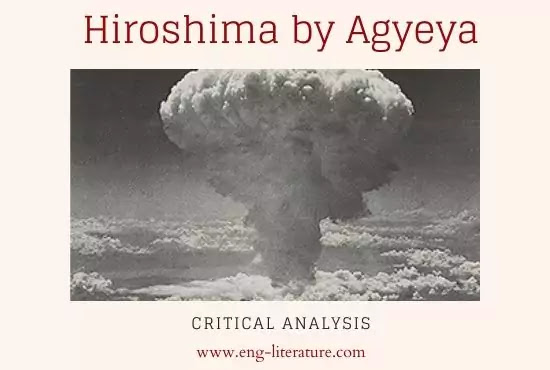
Agyeya's Hiroshima : Critical Analysis

Agyeya's Hiroshima : Critical Analysis

Agyeya's Hiroshima : Critical Analysis

Hiroshima is a modern poem by S. H. Vatsyayan 'Agyeya'. It deals with the humanistic and socialistic leanings of the poet towards the measurable plight of the innocent people of Hiroshima, a city of Japan where the atom bomb was dropped by America. It also shows the brutality of human being, the unwanted carnage caused by the hotty and self-centered politicians, the horrible and incredible human brutality and butchery against humanity. In technique and style the poem has modern tone and temper full of hard and solid images which remind us of T. S. Eliot, Ezra Pound, Hopkins and Auden and other war poets.

In order to understand the poem, one should go to the background of the history related to the bombardment of America on the two important cities of Japan-Hiroshima and Nagasaki during the Second World War. These two cities have become today memorable because of the naked dance of death of human being towards human being or the indiscriminate use of arms and ammunition. We know that during the Second World War America wants to get a very early conquest and its dominance over the Japan it dropped atom bombs without knowing anything about its consequence on the two great cities of Japan. As a result many people consigned to ashes, their dwellings demolished, their dreams and aspirations shattered to nothingness and the whole activity of the city reduced to the dust. This traumatic experience has been haunting not only the people of these two cities but also the whole world. Based on this theme the poem is very interesting in matter and manner, feeling and form.

The very opening of the poem is figurative and connotative. It shows irony and contrast which are the two important tools of modern poetry. The poet says:
"On this day, the sun
Appeared-no, not slowly over the horizon
But right in the city square."

Here in this stanza the poet takes the image of the bright sun; but the sun here is not the natural sun rising in the cast daily for giving life to the whole world and driving the darkness away from the world. The sun here refers to the man-made sun caused by the pouring down of atom bombs. Just like the sun, the atom bombs also emit bright rays: but the rays are not the fruitful rays of the sun giving health and energy to both men and plants. Here the rays engendered by the bombs thrashed and butchered the whole humanity within a second. The phrase 'right in the city square shows the dropping of the bomb in the middle of the town generally the centre for people's entertainment and their strolling, In the natural process the sun generally appears in the east and it slowly and slowly comes over the horizon. But here the case is just the opposite. The sun here never comes slowly but very speedily and that too in the very middle of the city. Thus here the comparison is very appropriate and interesting.

The poet says that there was a great blast caused by the dazzle not from the middle sky but from the earth which is turned raggedly open. After the bombardment the situation was very apocalyptic rendering the people homeless and making their life even worse than animal. People and their objects as well as their dwelling places where dazed and lost and pitched in every direction. This measurable and pathetic plight of the general people have been shown by the skilled poet with some beautiful words and diction, images and symbols :
"Human shadows, dazed and lost, pitched
in every direction : this blaze
Not risen from the east
Smashed in the city's heart-
An immense wheel of Death's swart suncar spinning down and apart
in every direction."

Here in this stanza some words and phrases are highly suggestive. The phrase "human shadows" is highly suggestive. It shows various layers of meaning. At first it suggests how human beings of the city were turned to shadows that are, turned to death. Secondly, it stands for the dark shadow of the whole human being who boasts of the great civilization and culture. It also suggests the self centered egomaniac politicians who seldom feel the qualm of conscience in dropping out the bombs on the innocent people. This phrase also presents a contrast to the natural sun. Generally when the sun is over our head in the sky there is a shadow of our body created by the light of the sun. But here the human shadows are dazed and lost. In other words there were no men so there were no shadows. The phrase "Death's swart suncar' is also very connotative. It connotes how the atomic blast is just like the wheels of the sun causing violent death all over.

The next stanza of the poem is even more ironic and thought provoking. The poet says that during the dance of the death in the middle of the Hiroshima city, the sun rises and sets in a very short time. As a result all the visions, dreams and aspirations of human being were smashed to pieces.
"Instant of a Sun's rise and set.
Vision annihilating flare one compressed noon."

The implied meaning is that the terrible blast of the bomb flashed out very suddenly and also subsided in a moment. So both the rising and the setting of the sun were done within a very short period of time. We know that the sun generally rises in the morning and sets in the evening but here in this city of Hiroshima, this whole process of the sun from morning to evening were confined to few seconds at noon of the day. This is why the poet uses the phrase 'one compressed noon'. This phrase also shows the cruel and inhuman activity of human being to change the rule of nature. This reminds us of William Wordsworth, a great poet of Romantic School of poetry, who once says,
"To her fare works did nature link
the human soul that through me ran
but much it grieved my heart to think
what man has made of man."

This brutal activity of human being without any rhyme or reason also very similar to the description made by G. B. Shaw in Arms the Man and Hemingway in 'A Farewell to Arms'.

The extended metaphor of the sun has been again very beautifully used in the next stanza in which the poet says that it was not human shadows that lengthened, paled and died. The only shadows that stay are the shadows of the burning rocks and stones of these vacant streets :
"And then ?
It was not human shadows that lengthened, paled and died;
It was men suddenly become as mist then gone.
The shadows stay :
Burned on rocks, stones of these vacant streets."

This poetic and metaphoric description present a very realistic picture of that situation caused by the atom bombs. The poet is of the opinion that all men of the city were died as suddenly as the mist. In the natural process of the day, the heat of the sun dries the mist on the blades of the grass but here this man-made fears and horrible bomb end of the life of man within a very few minutes. The only thing that stays in this city is the shadows. Again, here the term, 'shadow’ has got a number of meanings. At first it suggests the dark aspects of that satiric behaviour of man. It also denotes the stain and scar made by the merciless mankind towards the innocent mankind. This dark shadows have haunted the civilization and is still haunting and will be haunted in the next generation. So the only thing that stays today is the shadows. On the second scale of meaning the shadows here also denotes the shadow caused by the flame of the burning rock and stones of the vacant streets as there were no people in the city.

The last stanza again extents the image of sun, light and shadow with contrast and irony. The poet says,
"A Sun conjured by men converted men to air, to nothing;
White shadows singed on the black rock give back man's
witness to himself."

These last lines of the poem convey the poet’s message to such men who were tempted by the power and authority, fame and popularity. It also shows how it was a great folly of human being to destroy the other human being. Here the phrase 'A Sun' doesn't denote the God-made sun made for the welfare of the whole flora and fauna. Here 'A Sun with indefinite article 'A' and not the definite article the shows the indefinite fate of human being bound to be shattered in the days to come if man keeps on making such type of Sun's for the annihilation of human being. So, it is the message of the poet that such type of sun or bomb conjured by men will do nothing but to convert men to air or to nothingness. The phrase "White shadows' is very ironic in this context. It suggests the so-called modern materialistic development of modern science for which men are always brasting and braging on their achievements. But truly speaking this white shadows or the modern generation is burning slightly on the black rock made by men. So the witness of this great havoc and tragedy done on the innocent people directly go to the modern man who is quite insensitive and cold to nature and to his own human brethren.
 ~~~~~*~~~~~
Share:

Tuesday, 11 February 2020

Symbolism & Imagery in Eliot’s “Love Song of J. Alfred Prufrock”.

Symbolism & Imagery in Eliot’s “Love Song of J. Alfred Prufrock”.
T. S. Eliot’s work covers a vast arena of modern life. Vikramaditya Rai comments that “Eliot with his high charged microscopic insight portrays the graphic picture of a despaired generation, the smell of war ridden soil, a state of psychological insurgency and the monotony and futility of modern civilization and they are the images of imperial catastrophe.”

Symbolism suggests an image with a host of associations. For instance, rose is generally a symbol of beauty, but Eliot makes it represent Virgin Mary. Coriolanus stands for proud and selfish man. Eliot makes it a representation of the lost leader and isolation and spiritual alienation. According to Edmund Wilson, symbolism is the medley of images; the deliberately mixed metaphors, the combination of the grand and the prosaic manners; the bold amalgamation of the material with the spiritual. Images imply pictures or other sense impressions conveyed in words. An image in poetry is a word or expression which appeals directly to the sense organs.

There are two types of symbols-traditional and personal. Traditional symbols are common stock symbols which have been used in ancient times. Poets use personal symbols to actualize their work. For example in “The Love Song of J. Alfred Prufrock”, the evening is compared to a patient lying on an operation table and endless streets are compared to irritating, monotonous arguments.

Published in 1915, “The Love Song of J. Alfred Prufrock” is a symbolic poem which reflects the condition and mood of the modern city dwellers. It expresses the hollowness, infertility, the psychological trauma, the spiritual languor, the frustration and the hamletic state of mind of the post war generation.

The mental condition of Prufrock, a bald headed, middle aged man is symbolized by an etherized patient on an operation table:
“…when the evening is spread
Out against the sky
Like a patient etherized upon a table.”

The lines -“Woman come and go, talking of Michaelangelo” satirises the vague pretensions of the modern ladies in a symbolic way. Then the image of “lonely man in shirt -sleeves, leaning out of the window” gives the essence of sterility and vacuity characterizing the lives of these hollow men.

The spreading fog of the October evening resembles a cat that is lazily going about. The fog also reflects Prufrock’s state of mind - his laziness and hesitancy towards taking decision regarding the proposal. The fog also symbolises the dirty and unhygienic environment of city life.

Prufrock’s death wish o modern man is evident in different parts of the poem. The poet has used various images to expose the idea like “pinned on the wall”, “the floors on the silent seas”, “the eternal footman", “chambers of the sea”, “we drown”, “I am Lazarus”.

Eliot likes the images of nature, particularly of the sea which represents the mind of Prufrock which is violated by stormy waves and cannot be relaxed.

There are three allusions in the poem-Lazarus, Prince Hamlet and John the Baptist. Besides this, the Epigraph written at the top, from Dante’s Inferno signifies that the world of Prufrock is a kind of hell. The second literary allusion suggests Prufrock is indecisive and tensed like that of Hamlet. The third literary allusion is the story of John the Baptist. John lived for a purpose and died for a cause whereas prufrock wishes to die because he finds his life to be purposeless.

The symbols and images used by Eliot in “The Love Song of J.Alfred Prufrock” are appealing and very compact, as they can penetratingly portray their concerned atmosphere and situation. They emerge out of Eliot’s deep realization of the anarchy, futility and alienation of man in a fragmented and disintegrated war ridden world.

~~~~~$~~~~~
Share:

Critical Analysis of Dylan Thomas’s “Poem in October”

Critical Analysis of Dylan Thomas’s “Poem in October”

Dylan Thomas’s ‘Poem in October’ is derived from the volume, Death and Entrance where he presents a vision of his childhood in contradiction to the monotonous, frustrated urban life after world wars. The poem describes comparing and contrasting picture of village’s life and town life which show us the backward and forward movement of Time.

The title ‘Poem in October’ is an apt and suggestive reveals the theme of poem. Poet has presented his sweet past memories of the village where he passed his childhood. Indirectly poet compared his present city full of frustration, weariness, boredom with peaceful village life. The poem is a symbol of his thoughts and feelings towards his present life which is quite opposite to the picture of his small town. The poet becomes emotional and tries to be in those days of his village in October.

In this poem, Thomas describes the glory of nature. In the first part of the poem, poet describes beautiful and peaceful like of village, while in the second part poet describes mechanism of urban society. In the first line poet says that
“It was my thirtieth year to heaven
Woke to my hearing from harbor and neighbour wood”

These lines show the poet’s predicament with ironically. The poet describes leaving his house in early morning when he was 30.  In the morning on the shore the scene is so holy that the water seems to be praying and the herons seem to be priest. The River with mussels beautified the neighboring wood. Seagull and rooks (a crow - like bird) enjoy the water. Still poet remembers the sound of boats. Here, the poet shows that each and every object of nature welcome him with great love and care.

In second stanza, he walks through a scene which is a beautiful mingling of actuality and memory of country and sea, of sun and rain. When the birds fly over the water in a large number singing, the poet feels as if they all are flying his name in the air. As he says,
"My birthday began with the water bird,
And the birds of the winged, flying my name"

That little town where the poet was born still has the beauty of birds and the sound of high tide and also the birds diving in the water. It means the town has still such a glorious beauty, but his present city life has no such natural and pleasing atmosphere.

In the third stanza poet remembers that the larks sing as they sing in the spring but it October in which the sun shines like hot summer, whereas up till now he has ‘wandered and listened to the rain’. Thus in this stanza, there is a superb mingling of three seasons- summer, winter and rain. This is a rare combination found in poetry which shows the poet’s aesthetic sense. The poet also shows how powerful influence nature has made upon his mind, he writes,
“There could I marvel, My birthday,
Away but the weather turned around.”

Now poet turned into city. He believes that urban society is like outwardly solid but internally hollow. He compares garden and wood with each other. Here garden means scientific or artificial place while wood means village of forest. He would like to keep away from the city life. He does not like city’s atmosphere and its life style:
“That his tears burned my cheeks,
And his heart moved in mine.”

 In this things are gone and sweet memories burn the poet. He has whispered truth of joy to tear, stones, and the fish. The sweet song is still alive in the water and birds but he is not there. The song he used to sings is dead. The boy who had seen all this is dead. He believes that he had died when he came in city. The poet becomes emotional and tries to be in those days of his village in October.

To sum up, ‘Poem in October’ is one of the masterpieces in the field of modern poetry. It presents a sensational picture of nature which the poet enjoyed in his infancy his small town. Poet has indirectly presented the urban civilization in which man is living static and hectic life. A.S. Collins says ,
“A passionate love of nature linkened to childhood memories produced a beauty that touches the heart and stirs the sense.”
          
~~~~~*~~~~~
Share:

Follow Me in Social Media

Get Free Updates

Tags

A Doll's House (1) A Renouncing of Love (1) Absurd Drama (2) African English Literature (2) Agyeya (1) Alexander Pope (7) American Literature (26) Amitav Ghosh (3) Analyses (22) Anglo-Saxon Period (1) Aravind Adiga (1) Arthur Miller (5) Australian Literature (2) Beowulf (3) Bertrand Russell (2) Bible (1) Biographies (12) Book Review (2) British Literature (106) Broad Notes (94) Character Analysis (2) Charles Dickens (1) Charles Lamb (2) Charlotte Bronte (2) Chetan Bhagat (2) Chinua Achebe (1) Christopher Marlowe (2) Classical Literature (2) Composition (4) Creative Writing (5) D. H. Lawrence (1) Daniel Defoe (1) Diaspora (4) Drama (1) Dream Children: A Reverie (1) E-book Download (12) Edmund Spenser (1) Edward Fitzgerald (1) Edward II (3) Elizabethan Era (2) English Language (15) English Literature (9) English Literature Quiz (8) Escapism (1) Essay (12) Essays (12) Eugene O'Neill (7) Explanations (3) Feminism (3) Francis Bacon (4) Frankenstein (4) Free E-book Download (5) Free PDF Download (4) Genre (1) Geoffrey Chaucer (1) George Eliot (4) George Herbert (1) George Orwell (1) Girish Karnad (1) Hard Times (1) Heart of Darkness (1) Henrik Ibsen (1) Henry Vaughan (2) Historical Novel (6) History of English Literature (22) Indian Drama (2) Indian English Poetry (1) Indian Fiction (3) Indian Writing in English (33) Indo-Anglican Literature (32) Interesting Facts (9) Interpreter of Maladies (2) Jane Austen (2) Jane Eyre (2) Jayanta Mahapatra (2) Jhumpa Lahiri (3) John Donne (5) John Dryden (1) John Keats (4) Joseph Addison (1) Joseph Conrad (1) Keki N. Daruwalla (1) Kenilworth (3) Kim (1) Knowledge and Wisdom (1) Leo Tolstoy (1) Linguistics (2) Literary Criticism (5) Literary Essay (9) Literary Facts (1) Literary MCQ (4) Literary Photo Album (1) Literary Terms (14) Literary Trends (1) Literary Types (7) Lord of the Flies (1) Lyric (1) M. K. Anand (2) Mac Flecknoe (1) Macbeth (7) Mahadevi Verma (2) Man Eater of Malgudi (2) Mark Twain (1) Mary Shelley (4) Mathew Arnold (1) Midnight's Children (1) Modern Poetry (3) Modernism (1) Motivational Short Story (21) My Penning (1) Nayantara Sahgal (1) Notes (25) Novel (60) Novels (5) O' Henry (1) Ode to a Nightingale (1) Ode to the West Wind (1) Oedipus Rex. Oedipus the King (2) Of Friendship (1) On Fame (1) Online Quiz (8) Othello (1) P B Shelley (1) P. B. Shelley (1) Paulo Coelho (2) Philological Notes (10) Phonetics (3) Picaresque Novel (5) Plays (41) Poetry (52) Popular Literature (1) Post Colonial Literature (1) Post Colonialism (1) Pride and Prejudice (2) Prosody (3) Quiz (6) Quotations (6) R. K. Narayan (2) Rabindranath Tagore (2) Random Quiz (6) Rape of the Lock (5) Realistic Fiction (1) Restoration Era (2) Rhetoric (2) Robert Browning (1) Robinson Crusoe (1) Romantic Poetry (2) Romanticism (2) Rubaiyat of Omar Khayyam (1) Rudyard Kipling (1) Salman Rushdie (2) Samuel Beckett (3) Sarojini Naidu (1) Seven Ages of Man (1) Shakespearean Influence (2) Shakespearean Plays (11) Shakespearean Sonnets (4) Sheridan (4) Short Notes (10) Short Stories (9) Soliloquy (1) Songs of Innocence (1) Sons and Lovers (1) Sophocles (1) Sri Aurobindo (1) Substance Writing (1) Summary (8) Sylvia Plath (1) T. S. Eliot (2) Texts (10) The Adventure of Tom Sawyer (1) The Alchemist (1) The Crucible (3) The Emperor Jones (7) The Golden Light (2) The Guide (1) The Mill on the Floss (4) The Namesake (1) The Pulley (2) The Rivals (5) The Shadow Lines (3) The Sunne Rising (5) The Superannuated Man (1) The Town Week (1) The White Tiger (1) The Winter's Tale (2) Things Fall Apart (1) Thomas Hardy (2) Thomas Wyatt (1) Toni Morrison (6) Tragedy (3) Tughlaq (1) Untouchable (2) Waiting for Godot (2) Walter Scott (3) Way of the World (1) William Blake (2) William Golding (1) William Shakespeare (14) William Wordsworth (3) Word Notes & Annotations (1) Word Notes & Anotations (2)

Blog Archive