


All About English Literature: Oedipus Rex. Oedipus the King

For Exclusive Notes and Analysis

Showing posts with label Oedipus Rex. Oedipus the King. Show all posts

Saturday, 18 April 2020

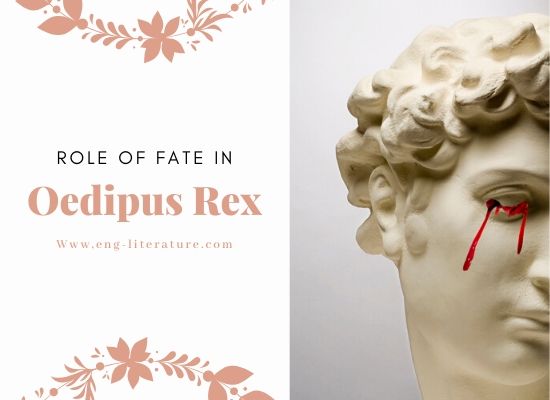
Role of Fate in Oedipus Rex

Role of Fate in Oedipus Rex

Role of Fate in Oedipus the King
In the Greek tragedy Oedipus the King written by Sophocles, the antagonist is fate. “Destiny is character” here. The role of fate is deeply intertwined in the plot. Predestination in Oedipus the King caused havoc despite attempting to escape it. Two characters bring about a fate worse than their original fate as punishment for trying to cheat fate.

The first instance-involving fate occurs when Oedipus sends Creon, Jocasta’s brother, to the temple of Apollo, the god of prophecy and healing, to find the fate of Thebes and how to rid Thebes of the plague the people are suffering from. Oedipus says,
“I acted at once. I sent Creon,
My wife’s own brother, to Delphi—
Apollo the Prophet’s oracle7—to learn
What I might do or say to save our city.”
(Sophocles, 81-84)

It is important to note that Apollo made the prophecy to King Laius, Jocasta’s former husband, and Jocasta, Oedipus’s wife, that they would bear a son who would kill King Laius, and Apollo made the prophecy to Oedipus that he would kill his biological father and sleep with his biological mother.

Fate is next brought into the play when Creon is sent in search of the blind prophet of Apollo, Tiresias. Against his will, Tiresias reveals Oedipus' fate. Oedipus is so anxious to find the murderer of King Laius that he will not give up until the murderer is found. Oedipus relentlessly pursues the truth, unwilling to give up until the truth is found.
After Oedipus repeatedly provokes Tiresias, he reveals what Oedipus is and who Oedipus really is. Tiresias says to Oedipus,
“You cannot imagine…I tell you,
you and your loved ones live together in infamy,
you cannot see how far you’ve gone in guilt.”
(Sophocles, 417-419)

Tiresias is alluding to the fact that Oedipus unknowingly is married to his mother and has produced offspring through her. Oedipus is too blind to comprehend what Tiresias is saying. Tiresias goes on to say, "I pity you, flinging at me the very insults / each man here will fling at you so soon" (Sophocles, 423-424). Tiresias is warning Oedipus that everything he thinks he has is not really his. People will turn against Oedipus and he will lose everything. Oedipus blasphemes against the gods when he tells Tiresias that he does not have the gift of prophecy. This is blasphemy because Tiresias is the messenger between gods and humans, and when Oedipus calls him a liar he is denying the words of the gods.

Upon further provocations, Tiresias tells Oedipus that Oedipus does not know where he is living or who his parents are. Tiresias insinuates that Oedipus is both father and sibling to his children when he says, "And a crowd of other horrors you’d never dream / will level you with yourself and all your children" (Sophocles, lines 485-486). Next Tiresias predicts, "This day will bring your birth and your destruction" (Sophocles, 499).

In his final speech towards Oedipus, Tiresias tells Oedipus that he is the murderer. Tiresias further tells Oedipus that though he is a stranger to Thebes, he will soon discover that he is a native Theban. Oedipus will also discover that he is both father and brother to his children, and both son and husband to his wife. Tiresias aptly foretells that Oedipus will lose everything; that Oedipus will be blind and exiled (Sophocles, 510-525).

After first arguing with Tiresias and then Creon, Oedipus talks to Jocasta, bringing about our third example of fate as an antagonist. Upon learning what the argument was about Jocasta relays that an oracle had come to King Laius and told him that he would "die a victim at the hands of his own son" (Sophocles, 786-787). The king had pierced the infant's ankles and sent him to die. Besides King Laius was killed by highwayman. Jocasta argues that Oedipus should not fear prophecy because of the following,
“Apollo brought neither thing to pass. My baby,
no more murdered his father than Laius suffered,
his wildest fear—death at his own son’s hands.
That’s how the seers and all their revelations.”
(Sophocles, 794-797)

Jocasta should have known that she could not outwit the gods, or fate. Fate next comes into play when Oedipus, who has begun to think he is King Laius' killer, recounts the dinner where the drunken man accused Oedipus of being a bastard. Oedipus goes to the oracle at Delphi to find his destiny. The oracle tells Oedipus as follows:
“You are fated to couple with your mother, you will bring,
A breed of children into the light no man can bear to see—
You will kill your father, the one who gave your life!.”
(Sophocles, 873-875)

After hearing the oracle's prediction, Oedipus flees Corinth to protect Merope and Polybus and to escape his destiny, which gives us our fifth instance of fate.

The change in the curse was brought about by Jocasta, who feared the oracle's prophecy. Jocasta sent the infant, Oedipus, to his death. In doing this Jocasta was attempting to cheat fate. Jocasta thought that if she killed the baby, she could change her husband's destiny. The added prophecy that Oedipus would lie with his mother and produce cursed offspring is a result of Jocasta's attempt to cheat fate. Oedipus is really an innocent victim of fate.

Again fate is seen when the messenger brings news that Polybus has died a natural death. Both Oedipus and Jocasta rejoice briefly in this news for it further proves that oracles are wrong Yet, Oedipus still has fear of prophecy for he will not return to Corinth as long as Merope is alive, for fear that he will lay with her. The messenger tells Oedipus that Merope is not Oedipus' true mother, as he himself gave Oedipus to her and to Pelops as a gift (Sophocles, 1113-1119). It is a strange twist of fate this messenger both took Oedipus to Corinth, but also is one of the final puzzle pieces in Oedipus' true identity.

When the shepherd arrives on the scene he is forced by Oedipus to verify that Oedipus is the child of Jocasta and King Laius. Oedipus' is now forced to realize that he has not escaped his fate. The entire prophecy has been fulfilled. After finding Jocasta's body, "And there we saw the woman hanging by the neck" (Sophocles, 1396), Oedipus does the following:
“He rips off her brooches, the long gold pins
holding her ropes—and lifting them high,
looking straight up into the points,
he digs them down the sockets of his eyes, crying.”
(Sophocles, 1403-1406)

In the end of the play Oedipus is blind, ruined, and exiled just as Tiresias foretold when he said,
“You are the scourge of your own flesh and blood,
And the double lash of your mother and your father’s curse
Will whip you from this land one day, their football
Treading you down in terror, darkness shrouding
Your eyes that now can see the light.”
(Sophocles, 474-479)

Fate came out victorious in the end. In the Greek vision Fate cannot be altered or cheated. Even the gods cannot change Fate. Instead of claiming one victim, many were ruined. If Jocasta had not tried to cheat fate, perhaps King Laius would be the only death. Instead King Laius and Jocasta are both dead, Oedipus is ruined and his children are cursed by this incestuous pollution. Fate is a force not to be reckoned with.

Is Oedipus responsible for his own fate? Considering all the facts ,we can say that Oedipus is neither a free agent nor a mere victim of fate. The major events of his life are determined by the tragedy of fate, but his own acts such as fleeing from Corinth, killing an old man, marrying an aged woman, without knowing his whole identity, showing over-confidence and milking the shepherd for information all have contributed in precipitating the disaster.

Also Read:

~~~~~*~~~~~
Share:

Monday, 13 April 2020

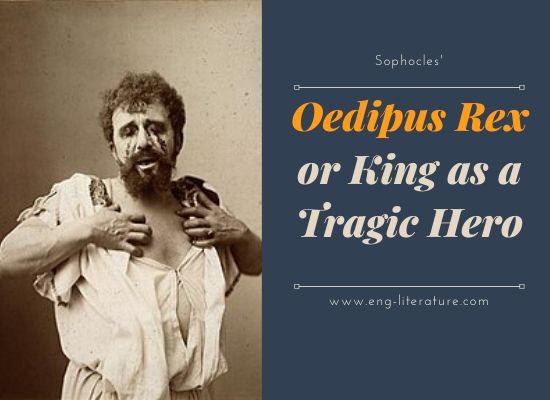
Oedipus as a Tragic Hero in Sophocles' Oedipus Rex

Oedipus-Tragic-Hero-Sophocles-Oedipus-Rex

Oedipus as a Tragic Hero

A tragic hero is the principal character of a tragedy that enjoys all the trappings of power, fame and wit but through a major flaw of character fatally errs. The realization and will to concede also known as catharsis is what marks their position as a tragic hero. Oedipus is wise, of blue blood, is lovable but arrogant and he fatally errors in order to complete his picture as a tragic hero.
This study of Oedipus King explores the qualities of the drama that bring out the development of character, fate, timing, tragedy and how this all spirals to make a tragic hero. Sophocles work reflects major influences like fate, time or coincidence and character flaws to bring out what exactly a tragic hero is and he uses a variety of other literary devices among which are dramatic irony, using the chorus, suspense, fate, timing and others. Sophocles is one of the dramatists that has been greatly celebrated. His claim to fame was with his drama Oedipus King.
Aristotle established his view of what makes a tragic hero as one that must evoke a sense of pity or fear in the audience. Aristotle contests that “The tragic hero has to be a man who is not eminently good and just, yet whose misfortune is brought about not by vice or depravity, but by some error or frailty.” Furthermore, another interesting way to think about a tragic hero in Sophocles is by using an adjective Sophocles applies to all of them: "deinos" meaning both wonderful and terrible.
A tragic hero is a great or virtuous character, of high social standing who eventually meets his downfall with suffering or defeat and he realizes his error only too late.
According to Aristotle's Poetics, the ideal tragic hero is a man whose good and bad character are mixed, but with the good predominating. Oedipus is certainly that! He is a concerned, caring king whose people love and trust him, but he has a quick, impulsive temper and fails to think in some critical situations. As a result, he commits unforgivable errors that bring him down and drags some innocent people down with him.
Oedipus is largely a victim of fate and timing for he is born in Thebes and Oedipus’ gruesome prophecy is told upon Laius’ house. Laius and Jocasta attempt to thwart the prophecy by killing Oedipus but Oedipus is born at a time when the King and Queen Polybus of Corinth are childless so they adopt Oedipus. All attempts to kill the prophecy actually bring it to completion. It is also ironic that The King and Queen Polybus think Oedipus is royal because of them but he is truly royal.
Oedipus does so many right things and few wrong things that are gruesome. A sense of hubris is seen when Oedipus is vain enough to run away from the gods who hold power about what one can be. He tries to unwind the will of the gods for dares the gods. But again we appreciate Oedipus’ caring nature that makes him meet whatever extent to do right. Oedipus didn’t want to hurt his parents so he actually ran away from them. Little did he know that he was actually fulfilling his fate in the course of leaving Corinth for Thebes.
Oedipus is rush and arrogant in such a way that he kills Laius along the way because the old man and his entourage effuse to give him way. In spite of the fact that he is warned, he breaks Laius’ neck. Fate is also a major aspect to consider for it happens to be Laius that he kills Laius as was prophesied. This action is against any form of counsel for a man only recently cautioned him about killing his father.
Fate and timing are interconnected in such a way that Oedipus arrives in Thebes when his wisdom is required. He meets the people of Thebes in a time of great despair as they are killed for not knowing the riddle of the Sphinx. What were the odds that Oedipus was wise enough to know the riddle of the Sphinx? How come he was just in time to save the people of Thebes? On being a savior, he is accelerated to the position of kingship and he is gifted with a queen or widow, Jocasta. The speed with which Oedipus becomes a King is wild and his wisdom is admired by many.
Oedipus is obstinate when he suspects connivance between Creon and Tiresias when he is trying to find out the source of the plague. Oedipus is determined to seek the truth even of it means neglecting the elders like Tiresias who can see the past, present like the chorus and future. It is ironic that Tiresias sees but the King who sees cannot. Tiresias goes on to say, “Pride breeds the tyrant.” The playwright uses the irony of the blind that seem to achieve the grave portrayal of the tragic hero.
Oedipus, as hasty as he is, loves pleasing the public and is beyond excitement which makes him pass a judgment on the murderer of Laius, that is, to be banished from Thebes. He is an outright dictator for he doesn’t ask the functions of the state to counsel him. Satire is employed for he passes a judgment on himself in the end and runs into problems. Oedipus sees Thebes as his responsibility in all ways so can one blame him for feeling the remorse he felt? Oedipus says, “My spirit grieves for the city, for myself and all of you.” On the other hand, he is strong-willed for he sets his verdict and actually meets it.
Oedipus is vain and shallow minded and he portrays hamartia in that he doesn’t caution if Jocasta could be his mother. A man recently warned about marrying his mother would think twice about marrying an older woman, yet the allure of a Queen. Power and beauty bring Oedipus bring Oedipus straight to the fangs of fate. To make the situation of poorer quality than it already is, Oedipus tells Jocasta his upbringing after he is married for 4 years and having 4 children using the style of flashback.
No sooner does Oedipus tell Jocasta his background than he realizes the ugly truth of his existence. This is peripetia. If banishment was Oedipus’ only punishment, the play might have been a bit simpler but Oedipus in a fit of rage, stabs out his own eyes. This was Oedipus’ way of punishing himself as well as an escape from the gazes by his subjects, his brother or uncle and his children. Oedipus is plunged into darkness as a means of punishment for the physical pain seems to prove that. He pays for being blinded by his foolish pride and power. This is catharsis, an emotional cleansing, a point of realization after all wrong is done and a call for pity. The chorus feels sorry for this man who has unknowingly killed his father and married his mother for the people of this land that he saves from a curse and brings them a curse. The chorus also pities Jocasta who is an innocent bystander in the whole confusing disaster.
Therefore judging from Oedipus’ self-assessment which ends in a lifetime of misery, shame and exile for the major character is clearly a tragedy. Where fate had left a fracture on the fabrics of life, character has completed its decimation. Tragedy is what Jean Racine says in one of her quotes; “A tragedy need not have blood and death; it’s enough that it all be filled with that majestic sadness that is the pleasure of tragedy.”

~~~~~*~~~~~
Share:

Follow Me in Social Media

Get Free Updates

Tags

A Doll's House (1) A Renouncing of Love (1) Absurd Drama (2) African English Literature (2) Agyeya (1) Alexander Pope (7) American Literature (26) Amitav Ghosh (3) Analyses (22) Anglo-Saxon Period (1) Aravind Adiga (1) Arthur Miller (5) Australian Literature (2) Beowulf (3) Bertrand Russell (2) Bible (1) Biographies (12) Book Review (2) British Literature (106) Broad Notes (94) Character Analysis (2) Charles Dickens (1) Charles Lamb (2) Charlotte Bronte (2) Chetan Bhagat (2) Chinua Achebe (1) Christopher Marlowe (2) Classical Literature (2) Composition (4) Creative Writing (5) D. H. Lawrence (1) Daniel Defoe (1) Diaspora (4) Drama (1) Dream Children: A Reverie (1) E-book Download (12) Edmund Spenser (1) Edward Fitzgerald (1) Edward II (3) Elizabethan Era (2) English Language (15) English Literature (9) English Literature Quiz (8) Escapism (1) Essay (12) Essays (12) Eugene O'Neill (7) Explanations (3) Feminism (3) Francis Bacon (4) Frankenstein (4) Free E-book Download (5) Free PDF Download (4) Genre (1) Geoffrey Chaucer (1) George Eliot (4) George Herbert (1) George Orwell (1) Girish Karnad (1) Hard Times (1) Heart of Darkness (1) Henrik Ibsen (1) Henry Vaughan (2) Historical Novel (6) History of English Literature (22) Indian Drama (2) Indian English Poetry (1) Indian Fiction (3) Indian Writing in English (33) Indo-Anglican Literature (32) Interesting Facts (9) Interpreter of Maladies (2) Jane Austen (2) Jane Eyre (2) Jayanta Mahapatra (2) Jhumpa Lahiri (3) John Donne (5) John Dryden (1) John Keats (4) Joseph Addison (1) Joseph Conrad (1) Keki N. Daruwalla (1) Kenilworth (3) Kim (1) Knowledge and Wisdom (1) Leo Tolstoy (1) Linguistics (2) Literary Criticism (5) Literary Essay (9) Literary Facts (1) Literary MCQ (4) Literary Photo Album (1) Literary Terms (14) Literary Trends (1) Literary Types (7) Lord of the Flies (1) Lyric (1) M. K. Anand (2) Mac Flecknoe (1) Macbeth (7) Mahadevi Verma (2) Man Eater of Malgudi (2) Mark Twain (1) Mary Shelley (4) Mathew Arnold (1) Midnight's Children (1) Modern Poetry (3) Modernism (1) Motivational Short Story (21) My Penning (1) Nayantara Sahgal (1) Notes (25) Novel (60) Novels (5) O' Henry (1) Ode to a Nightingale (1) Ode to the West Wind (1) Oedipus Rex. Oedipus the King (2) Of Friendship (1) On Fame (1) Online Quiz (8) Othello (1) P B Shelley (1) P. B. Shelley (1) Paulo Coelho (2) Philological Notes (10) Phonetics (3) Picaresque Novel (5) Plays (41) Poetry (52) Popular Literature (1) Post Colonial Literature (1) Post Colonialism (1) Pride and Prejudice (2) Prosody (3) Quiz (6) Quotations (6) R. K. Narayan (2) Rabindranath Tagore (2) Random Quiz (6) Rape of the Lock (5) Realistic Fiction (1) Restoration Era (2) Rhetoric (2) Robert Browning (1) Robinson Crusoe (1) Romantic Poetry (2) Romanticism (2) Rubaiyat of Omar Khayyam (1) Rudyard Kipling (1) Salman Rushdie (2) Samuel Beckett (3) Sarojini Naidu (1) Seven Ages of Man (1) Shakespearean Influence (2) Shakespearean Plays (11) Shakespearean Sonnets (4) Sheridan (4) Short Notes (10) Short Stories (9) Soliloquy (1) Songs of Innocence (1) Sons and Lovers (1) Sophocles (1) Sri Aurobindo (1) Substance Writing (1) Summary (8) Sylvia Plath (1) T. S. Eliot (2) Texts (10) The Adventure of Tom Sawyer (1) The Alchemist (1) The Crucible (3) The Emperor Jones (7) The Golden Light (2) The Guide (1) The Mill on the Floss (4) The Namesake (1) The Pulley (2) The Rivals (5) The Shadow Lines (3) The Sunne Rising (5) The Superannuated Man (1) The Town Week (1) The White Tiger (1) The Winter's Tale (2) Things Fall Apart (1) Thomas Hardy (2) Thomas Wyatt (1) Toni Morrison (6) Tragedy (3) Tughlaq (1) Untouchable (2) Waiting for Godot (2) Walter Scott (3) Way of the World (1) William Blake (2) William Golding (1) William Shakespeare (14) William Wordsworth (3) Word Notes & Annotations (1) Word Notes & Anotations (2)

Blog Archive