All About English Literature: Romantic Poetry

For Exclusive Notes and Analysis

Showing posts with label Romantic Poetry. Show all posts

Tuesday, 23 June 2020

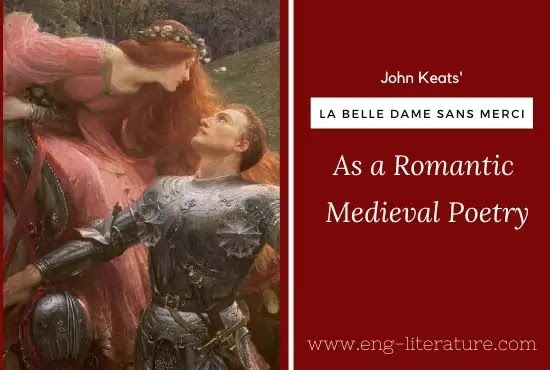
Keats' La Belle Dame Sans Merci as Medieval Romantic Poem or Critical Appreciation of La Belle Dame Sans Merci

La Belle Dame Sans Merci as Medieval Romantic Poem or Critical Appreciation of La Belle Dame Sans Merci

La Belle Dame Sans Merci is the glory of romantic poetry. In it the medieval revival which constitutes one of the most significant aspects of romanticism reaches its culmination. Keats was ever enamoured of the Middle Ages. But it was the external glitter and glamour of the Middle Ages that captivated him. Their weird spirit - the elements of their magic and marvel hardly stirred his imagination.

In La Belle Dame Sans Merci Keats not only reproduces the medieval pomp and chivalry, but also creates the typical medieval atmosphere of enchantment and marvel. The picture of the knight-at-arms with which the poem opens at once transports us into the medieval days of knight-errantry. The beautiful fairy lady who bewitched the knight and ultimately led him to his spiritual doom recalls the medieval vampire woman who sucked men's blood with cold. The reference to elfin grot, "honey wild and manna dew", dream-vision of the skeletons of kings, princes and warriors diffuse over the whole poem the mood of awe and wonder that is associated with the medieval mind.

Again in the treatment of medievalism Keats, like Coleridge relies more on subtle suggestion than on description. Nothing is said definitely and in detail. Everything is left to the imagination of the reader. Nothing is said about the nature of the "fairy's child" or about the fate that awaits the knight. The poem is truly a masterpiece of horror-stricken reticence. George Saintsbury rightly says:

"He (Keats) could have known extremely little of medieval literature; yet there is nothing anywhere which catches up the whole of the true medieval romantic spirit as does the short piece of La Belle Dame Sans Merci."

Like a romantic poem La Belle Dame Sans Merci gives a faithful description of nature. It portrays the winter landscape with its barrenness and desolation:
"The sedge has wither'd from the lake
And no birds sing."

La Belle Dame Sans Merci is a superb example of the ballad. The story of a mortal creature being bewitched by an enchantress and carried to an elfin world is a fairly recurrent theme in ballad literature. The poem has all the simplicity and directness, the weird beauty and imaginative intensity of the best ballads. L. Hearn rightly says:

"The theme, the phantom woman whose love is death, is almost as old as the world; thousands of poems have been produced upon it. But in simple weird beauty I do not know of anything in all English literature exactly like this."

Though the poem is a ballad, it is intensely lyrical like a romantic poem. It is in a sense a cry from the poet's heart, a tale of disillusionment told by a man whose dream of love has faded, leaving behind a taste of dust and ashes in the mouth. Consumed as he was by an intense passion of love, the knight at arms seems to be a reflex of Keats's own self. Fanny Brawne who played with the poet's love is the lady without mercy. But the subjective note seems to be utterly impersonal because of the narrative and dramatic form of the poem.

Like other poems of Keats La Belle Dame Sans Merci turns on the contrast or conflict between the ideal and the real - between reality and imagination. The elfin grot represents the ideal world and the fairy's child its denizens. The knight belongs to the real world. The adequate communication between these two worlds is impossible as is evident in the lines:
"And sure in language strange she said
"I love thee true'."

The contrast between the two worlds is also implicit in the kind of food that the fairy offered—"roots of relish sweet/ and honey wild and manna dew". The sad moan and sigh of the Fairy's child imply a recognition of the unbridgeable gulf that exists between the two worlds. The conflict between these two worlds is so great that one who has an access into the immortal sphere withers away and dies like the knight-at-arms.

The poem illustrates Keats's use of concrete images. It opens with the description of the barren landscape which images the knight’s desolation. The rich autumnal harvest conveys the sense of fulfilment and a promise of sustenance. The twin images of lily and rose call forth the memory of the transient bliss the knight had in the elfin grot. The "fading rose" also indicates that the knight is progressing towards death. The food that the fairy offered "roots of relish sweet", "honey wild, and manna dew" is the image for the unbridgeable distance that exists between the ideal and real worlds. The image of death - pale kings, princes and warriors suggest the tragic fate of those who leave the mortal sphere in search of an impossible ideal.

The beauty of the poem lies in its marvelous suggestiveness. Words, expressions and images are so used as to call up vivid pictures before our vision. As we read the lines
"The sedge has wither'd from the Lake
And no birds sing."
the picture of the sedge withering in a lake and the dreary winter desolation starts floating before our mental eyes. The expression "fragrant zone" is rich in suggestion. It conjures up the picture of the girdle made of sweet-smelling flowers.

John Keats follows the example of Coleridge in his use of the ballad metre. But his use of a short fourth line, heavily accentuated, and admirably expressing the weird tragedy is his own development.

Also Read:
 ~~~~~*~~~~~
Share:

Monday, 12 November 2018

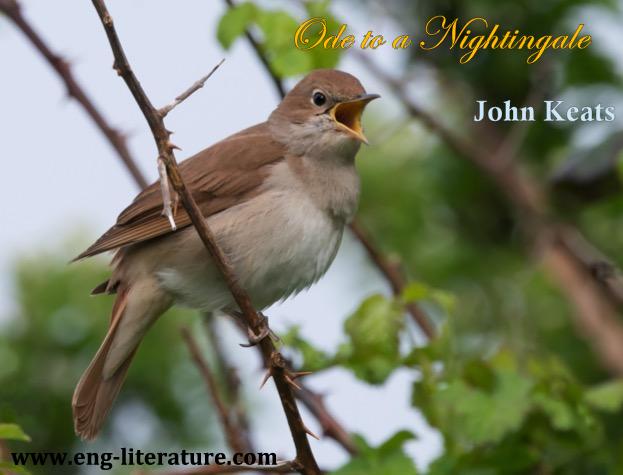
Is Keats' "Ode to a Nightingale" a poem of escape or a reflection of human experience? or How does Keats explore the capacity of the imagination to transcend reality in "Ode to a Nightingale"?

Is Keats' "Ode to a Nightingale" a poem of escape or a reflection of human experience? or How does Keats explore the capacity of the imagination to transcend reality in "Ode to a Nightingale"?

Escapism is the English Romantic Movement as affirmation by Keats and many other poets. Escapists run away from harsh, unpleasant facts and duties, thus try to hide themselves in their idle world of dream and peace. Yes, a note of escapism is sounded clearly in “Ode to a Nightingale” because the poet wants passionately to 'leave the world unseen' and with the nightingale 'fade away into the forest dim'. Escapism is the life and soul of romantic poetry. The romantic poets are all fed up with the hard, stern realities of life - its din and bustle, fever and fret. The realization that happiness in this world is but an occasional episode in the general drama of pain is too much for them to bear. Thus Wordsworth escapes to Nature, the vast world of flowers, trees, mountains, valleys etc. ; Coleridge to the mysterious world of supernatural, and Shelley to the Golden Millennium of the future.

“Ode to a Nightingale” is a poem of escape into the dreamland cast up by Keats’ romantic imagination. The poet heard the song of nightingale. The song fills his mind with intense joy which borders no pain. Drunk with delight the poet wants to escape from the world of “the weariness, the fever and the fret” to the world of fantasy where evanescence of youth, beauty and love exist. Thus he hits upon different ideas like opiate himself, taking a small doze of hemlock, sinking into the river of Lethe, drinking wine but finally he transports himself to the ideal land of nightingale with “the viewless wings of poesy”.

The general picture of malady is undeniably moving in its pitiful starkness:
“Here, where men sit and hear each other groan;
Where palsy shakes a few, sad, last grey hairs,
Where youth grows pale, and spectre-thin, and dies,
Where but to think is to be full of sorrow
And leaden-eyed despairs;
Where beauty cannot keep her lustrous eyes,
Or new love pine at them beyond tomorrow.”


The poem reflects tragic human experience that human life is a tedious tale of sorrow, of hopes baffled and efforts disappointed. In this world few men live up to old age, and even those who are fortunate to live up to that age are struck with paralysis, and with a few grey hairs on their heads they hobble along trembling and tottering.  Here he remembers the bitterness of his own life. The poet here thinks of his young brother Tom, dying just before his eyes.  He considers that life is full of misery, sorrow and disease, of tiring struggle, of restlessness and pain; that life is nothing but a series of groans and complaints. The charm of loveliest woman fades away very soon, and the love of woman for her lover does not last longer. Here he remembers his beloved Fanny Browne’s rejection of his young love and turning to others.

The note of escapism asserts more strongly in the death-wish of the poet. The soothing darkness brings up his desire for the dark death -
“… for many a time
I have been half in love with easeful Death”

But Keats’ world of imagination remains only a short while. The ring of illusion vanishes. The very word ‘forlorn’ makes him strand on the hard shore of reality:
“Forlorn! The very word is like a bell
 To toll me back from thee to my sole self”.

We may conclude with the voice of C.D. Thorpe as he comments in his book The Mind of John Keats -
“The moment of insight with him was a moment of complete emotion,           absorption in which the poet lost even his own senses of being in intense pursuit of his imaginative query. The extreme of this activity was a flight, far away from the fret and fever of life into a realm of imaginative delight into a region of abstractions of the poets own creations.”

~~~~~*~~~~~
Share:

Follow Me in Social Media

Get Free Updates

Tags

A Doll's House (1) A Renouncing of Love (1) Absurd Drama (2) African English Literature (2) Agyeya (1) Alexander Pope (7) American Literature (26) Amitav Ghosh (3) Analyses (22) Anglo-Saxon Period (1) Aravind Adiga (1) Arthur Miller (5) Australian Literature (2) Beowulf (3) Bertrand Russell (2) Bible (1) Biographies (12) Book Review (2) British Literature (106) Broad Notes (94) Character Analysis (2) Charles Dickens (1) Charles Lamb (2) Charlotte Bronte (2) Chetan Bhagat (2) Chinua Achebe (1) Christopher Marlowe (2) Classical Literature (2) Composition (4) Creative Writing (5) D. H. Lawrence (1) Daniel Defoe (1) Diaspora (4) Drama (1) Dream Children: A Reverie (1) E-book Download (12) Edmund Spenser (1) Edward Fitzgerald (1) Edward II (3) Elizabethan Era (2) English Language (15) English Literature (9) English Literature Quiz (8) Escapism (1) Essay (12) Essays (12) Eugene O'Neill (7) Explanations (3) Feminism (3) Francis Bacon (4) Frankenstein (4) Free E-book Download (5) Free PDF Download (4) Genre (1) Geoffrey Chaucer (1) George Eliot (4) George Herbert (1) George Orwell (1) Girish Karnad (1) Hard Times (1) Heart of Darkness (1) Henrik Ibsen (1) Henry Vaughan (2) Historical Novel (6) History of English Literature (22) Indian Drama (2) Indian English Poetry (1) Indian Fiction (3) Indian Writing in English (33) Indo-Anglican Literature (32) Interesting Facts (9) Interpreter of Maladies (2) Jane Austen (2) Jane Eyre (2) Jayanta Mahapatra (2) Jhumpa Lahiri (3) John Donne (5) John Dryden (1) John Keats (4) Joseph Addison (1) Joseph Conrad (1) Keki N. Daruwalla (1) Kenilworth (3) Kim (1) Knowledge and Wisdom (1) Leo Tolstoy (1) Linguistics (2) Literary Criticism (5) Literary Essay (9) Literary Facts (1) Literary MCQ (4) Literary Photo Album (1) Literary Terms (14) Literary Trends (1) Literary Types (7) Lord of the Flies (1) Lyric (1) M. K. Anand (2) Mac Flecknoe (1) Macbeth (7) Mahadevi Verma (2) Man Eater of Malgudi (2) Mark Twain (1) Mary Shelley (4) Mathew Arnold (1) Midnight's Children (1) Modern Poetry (3) Modernism (1) Motivational Short Story (21) My Penning (1) Nayantara Sahgal (1) Notes (25) Novel (60) Novels (5) O' Henry (1) Ode to a Nightingale (1) Ode to the West Wind (1) Oedipus Rex. Oedipus the King (2) Of Friendship (1) On Fame (1) Online Quiz (8) Othello (1) P B Shelley (1) P. B. Shelley (1) Paulo Coelho (2) Philological Notes (10) Phonetics (3) Picaresque Novel (5) Plays (41) Poetry (52) Popular Literature (1) Post Colonial Literature (1) Post Colonialism (1) Pride and Prejudice (2) Prosody (3) Quiz (6) Quotations (6) R. K. Narayan (2) Rabindranath Tagore (2) Random Quiz (6) Rape of the Lock (5) Realistic Fiction (1) Restoration Era (2) Rhetoric (2) Robert Browning (1) Robinson Crusoe (1) Romantic Poetry (2) Romanticism (2) Rubaiyat of Omar Khayyam (1) Rudyard Kipling (1) Salman Rushdie (2) Samuel Beckett (3) Sarojini Naidu (1) Seven Ages of Man (1) Shakespearean Influence (2) Shakespearean Plays (11) Shakespearean Sonnets (4) Sheridan (4) Short Notes (10) Short Stories (9) Soliloquy (1) Songs of Innocence (1) Sons and Lovers (1) Sophocles (1) Sri Aurobindo (1) Substance Writing (1) Summary (8) Sylvia Plath (1) T. S. Eliot (2) Texts (10) The Adventure of Tom Sawyer (1) The Alchemist (1) The Crucible (3) The Emperor Jones (7) The Golden Light (2) The Guide (1) The Mill on the Floss (4) The Namesake (1) The Pulley (2) The Rivals (5) The Shadow Lines (3) The Sunne Rising (5) The Superannuated Man (1) The Town Week (1) The White Tiger (1) The Winter's Tale (2) Things Fall Apart (1) Thomas Hardy (2) Thomas Wyatt (1) Toni Morrison (6) Tragedy (3) Tughlaq (1) Untouchable (2) Waiting for Godot (2) Walter Scott (3) Way of the World (1) William Blake (2) William Golding (1) William Shakespeare (14) William Wordsworth (3) Word Notes & Annotations (1) Word Notes & Anotations (2)

Blog Archive