
Blake's Mysticism and Symbolism in The Lamb
William Blake was an extraordinary literary genius in the Age of Transition. He often
used to say that ‘only imagination is real’ and that his task as a poet was to ‘open
the mortal eyes of man inwards into the worlds of thought.’ His
visionary quality and his use of myth and mysticism made his more profound
works so complicated for ordinary men’s understanding that he remained unknown
so long as he lived.
Was William Blake a mystic?
As a hardcore
mystic, Blake in his boyhood days saw bright angels standing in a tree by
the roadside. In his manhood, the earth and the air seemed to him full of
spiritual presences. His imagination could not summon at any moment before him
“armies of angels that soar, legions of demons that lurk.” In his intense
mysticism he visualises the entire world as a spiritual and symbolical verities:
"To
see a world in a grain of sand,
And
a heaven in a wild flower,
Hold
infinity in the palm of your hand
“The Lamb” is an emblematic poem of Songs of Innocence, a collection
of Blake’s poems which give us glimpse of the ideal world free from the
deadening influence of the social customs, selfishness or jealousy which
assails the mind of man as he grows up. In this poem there are two characters -
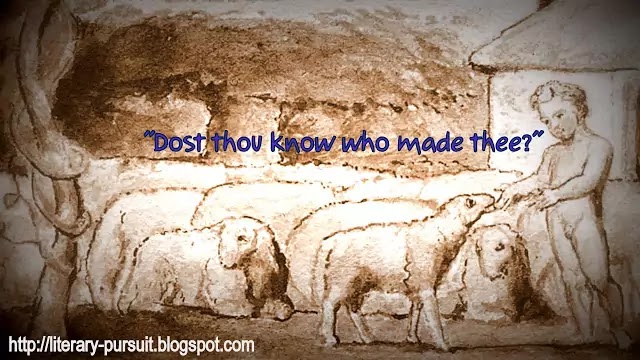
a child and a lamb. The child is the speaker and he lamb is the listener. The
child asks several questions to the lamb expecting replies from it. This
question-answer technique lends a dramatic touch to the poem.
Being struck with wonder at the beauty, innocence, meekness and mildness of a lamb an innocent
child out of his naivety asks it if it knows who its Creator, giver of its
food, beautiful fleece and charming and joyful voice. He does not contemplate
child in the manner of Wordsworth, Hugo and Longfellow; he actually goes
straight into their souls speaks through their own mouths. The grave meaning
comes out when the child remarks:
“I,
a child and thou a lamb
We
are called by His name.”
These
lines finely expose that all the creations are manifestations of Godhead. The child and the lamb are
unified with God and the quality that links them together is innocence. Thus
God, lamb and the child form a holy Trinity. The child harbours no evil
thought. His mind is not polluted by any selfishness, envy, corruption. Blake
frankly states “God is Man and exists in us and we in him...Imagination is the Divine
Body in every man.” In the world of creation nothing is trivial even
the a little lamb occupies a grand value.
A
fundamental question comes out from here, if the mundane things are created by
someone else why not our natural world including air, water, earth and the
animals? Mystics can give the answer in a ready way that behind every origination there must have been a source. Blake
through the enthusiastic mind of the child seeks to answer those.
How does the lamb symbolize innocence?
Nobody
acquainted with Blake’s poetry will deny that symbolism has large role to play in
it. The present poem is no exception. Symbols are largely drawn from the Bible. Unlike the tiger which
stands for power, wildness, and cruelty, represents innocence, simplicity and
joy. The child is also the symbol of
love, innocence, sympathy and instinctive wisdom. God in the same way acts as a
symbol of the Good Shepherd under whose supervision both the lamb and the child
can enjoy such delight, security and peace. Furthermore the child and the lamb
represent two very important phases of Christ’s life - Incarnation and Redemption.
In the stage of Incarnation, God came to earth in the body of Jesus Christ. In
the child we witness the existence of both divine and human nature. In the age
of Redemption Christ underwent self sacrifice to deliver mankind from sin. In
the lamb we can see similar kind of sacrifice.
Blake
expresses his mystical thoughts through symbols. Like Shelley he uses the object of nature as symbols to suggest the
spiritual reality that lies behind the appearance.
Also Read:
~~~~~*~~~~~